“We are going to fight again. Whether it’s in the octagon or on the sidewalk, you don’t say the stuff he said.”
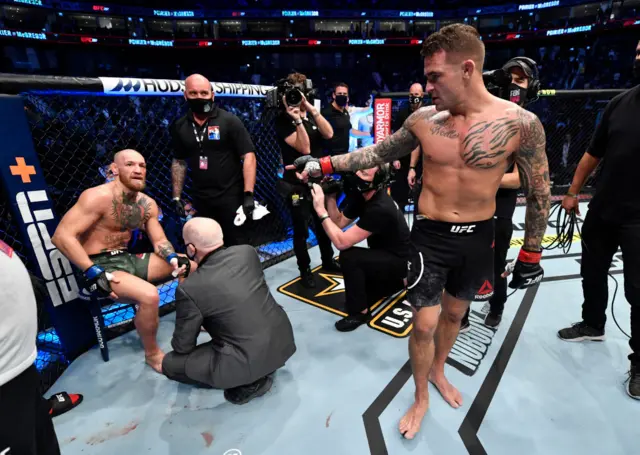
Those were Dustin Poirier’s words in July 2021, moments after Conor McGregor’s leg snapped beneath him at UFC 264. The Irish superstar lay on the canvas in agony. Poirier stood over him, victorious for the second time in six months, fury still burning behind his eyes.
Four and a half years later, officially retired and supposedly at peace with the world, “The Diamond” proved that promise was never empty talk.
On February 7, 2026—exactly seven months and 19 days after leaving his gloves in the center of the octagon in New Orleans—Dustin Poirier logged onto X and set the MMA world on fire.
He did not announce a comeback.
He did not tease a business deal.
He did not post training footage.
Instead, the 37-year-old from Lafayette, Louisiana quote-tweeted a clip of McGregor striking a karate stance during one of their past encounters and attached seven words that detonated across combat sports social media:
“Beat his ᴀss. Felt so nice I did it twice.”
Within 24 hours, the post racked up over 15,000 likes, more than 900 reposts, and hundreds of replies. Fans, fighters, media outlets—everyone scrambled to react. A retired legend, months removed from his farewell fight, still carrying enough venom to publicly eviscerate the biggest name in UFC history without hesitation.
And Poirier wasn’t finished.
When a fan claimed the third fight “didn’t count” because of McGregor’s leg break, Poirier fired back:
“Check his record and my record.”
When another accused him of “turning into a wrestler” to avoid McGregor’s left hand, Poirier calmly asked who initiated the grappling exchanges.
When someone suggested the trilogy decider was “neck and neck” before the injury, Poirier shut it down cold:
“Definitely not neck and neck. I was punishing him.”
The MMA media machine amplified every exchange. Headlines declared that Poirier was “cooking” McGregor’s defenders. Fan accounts reposted screensH๏τs with captions like “The hatred is real.” And one question quickly rose above the noise:
Will we see a fourth fight?
The Context Behind the Fire
This wasn’t random nostalgia. It wasn’t boredom.
Conor McGregor has spent early 2026 teasing a return to the Octagon. He’s posted about training camp, declared he possesses “huge plans” and “modern medical science superpowers,” and promised fans they’ve “seen nothing yet.” Rumors of a blockbuster UFC event at the White House on June 14, 2026 have swirled for months. McGregor’s name is always attached.
Reports have even suggested Poirier might be willing to come out of retirement to welcome him back.
As of February 8, McGregor had not responded to Poirier’s taunts. He posted about family, cigars, faith, and his ambiguous timeline—but not a word about Dustin.
The sH๏τs, for now, are entirely one-sided.
But the silence doesn’t erase the history.
How It Began: 106 Seconds
Their rivalry began on September 27, 2014, at UFC 178 in Las Vegas.
McGregor was an ascending comet in the featherweight division—brash, charismatic, weaponizing trash talk in a way the sport had never seen.
Poirier was a talented 25-year-old from Cajun country, a former troubled teen who found salvation in fighting.
“I didn’t have a goal,” Poirier once said. “When I found fighting, I wanted to be the best at that.”
McGregor dismantled him in 106 seconds. A crisp left hand. Ground strikes. TKO at 1:46 of Round 1.
For McGregor, it was liftoff.
For Poirier, it was humiliation.
He later admitted the psychological warfare had gotten inside his head. That loss rewired him. He rebuilt his idenтιтy from scratch.
The Rebuild
While McGregor captured featherweight gold in 13 seconds against José Aldo, became the UFC’s first simultaneous two-division champion, boxed Floyd Mayweather, and built a global empire, Poirier quietly evolved.
He sharpened his boxing.
Deepened his grappling.
Developed devastating calf kicks.
He defeated champions. Won an interim lightweight тιтle. Built the Good Fight Foundation to support at-risk youth back home in Lafayette.
He became complete.
And in January 2021, the rematch arrived.
The Death of a Southpaw
At UFC 257, Poirier executed a masterclass.
McGregor started fast. But Poirier methodically attacked the lead leg with brutal calf kicks. By Round 2, McGregor’s mobility was gone. A right hook dropped him. Ground-and-pound finished him.
It was McGregor’s first knockout loss in the UFC.
The trilogy was tied.
Then things turned personal.
Broken Promises, Broken Lines
The $500,000 donation McGregor had pledged to Poirier’s charity became a public dispute. Poirier accused McGregor’s team of ghosting the paperwork. McGregor questioned the legitimacy of the foundation.
The relationship deteriorated beyond repair.
Then came UFC 264—and the ugliest buildup of McGregor’s career.
He attacked Poirier’s wife, Jolie. Made degrading remarks. Issued threats. Deleted tweets that the internet preserved forever.
To understand why that line mattered, you have to understand Jolie.
She wrote Poirier letters in juvenile detention.
Drove him to his first fight.
Stayed in roach-infested motels when he made almost nothing.
“She’s seen the struggles from the beginning,” Poirier has said. “I could never rebuild this with another person.”
When McGregor dragged her into the spectacle, the rivalry crossed from sport into something deeper.
The Snap Heard Around the World
On July 10, 2021, the trilogy ended in chaos.
They fought violently. McGregor attempted a guillotine. Poirier dominated ground control. In the final seconds of Round 1, McGregor stepped back—and his tibia and fibula snapped.
Doctor stoppage. TKO. Poirier won.
He now led the series 2–1.
McGregor hasn’t fought since.
The Career That Followed
Poirier didn’t coast.
He challenged Charles Oliveira for the lightweight belt.
Fought Justin Gaethje again in a brutal war.
Faced Islam Makhachev for undisputed gold.
Retired in July 2025 after a five-round battle with Max Holloway in New Orleans.
Record: 30–10 (1 NC).
15 UFC finishes.
1,861 significant strikes landed.
Ten Fight of the Night bonuses.
No undisputed тιтle—but no debate about Hall of Fame status.
“I don’t believe in coincidence,” Poirier once reflected. “This was the path I was supposed to follow.”
Why It Still Burns
Here’s the truth:
McGregor changed the sport forever.
He broke financial records.
Held two belts simultaneously.
Delivered the fastest тιтle fight knockout in UFC history.
But in their rivalry—the one with the deepest emotional stakes—it was Poirier who won.
Twice.
And despite that, a vocal segment of fans still elevates McGregor above him in the historical conversation.
The record says 2–1.
The internet debates anyway.
For Poirier, it’s not just about wins and losses.
It’s about:
-
The 106-second humiliation.
-
The ghosted donation.
-
The attacks on his wife.
-
The lingering revisionism.
You don’t forget that.
Not when you’re built the way he is.


