🔥 The Legend of Smokey Yunick: Cheater, Innovator, or Both?
In the history of American motorsports, few names spark as much fascination, controversy, and admiration as Smokey Yunick.
To some, he was the greatest cheater NASCAR ever saw.

To others, he was a mechanical genius who simply understood the rulebook better than anyone else.
Decades after his most famous exploits, the debate still rages: was Smokey Yunick bending the rules—or redefining them?
Born in Pennsylvania in 1923, Henry “Smokey” Yunick developed an early fascination with engines and machinery.
Like many young men of his generation, his life was interrupted by World War II.
He served as a B-17 bomber pilot in the U.S.
Army Air Forces, flying dozens of combat missions over Europe.
The discipline, precision, and technical knowledge he gained during the war would later shape his approach to racing.
After the war, Yunick moved to Daytona Beach, Florida, a place that would become synonymous with speed and stock car racing.
At the time, racing on the hard-packed sands of Daytona Beach was one of the most popular forms of motorsport in America.
Yunick quickly found his place in this high-speed world, not as a driver, but as a mechanic and innovator.
He opened a shop that would later become legendary: “Best Damn Garage in Town.
” The name was not just a marketing slogan—it became a symbol of Yunick’s reputation.
Inside that garage, engines were pushed beyond their limits, designs were reimagined, and ideas that others considered impossible became reality.
Yunick’s approach to racing was simple: if the rulebook didn’t specifically forbid something, it was fair game.
He studied regulations with the same intensity that other mechanics studied engine diagrams.
To him, the rules were not barriers—they were puzzles waiting to be solved.
This philosophy quickly made him both famous and infamous.
One of the most famous stories about Yunick involves a fuel tank inspection at Daytona.
NASCAR officials suspected something unusual about one of his cars and decided to inspect it.
According to the legend, they removed the fuel tank as part of the inspection.
Instead of panicking, Yunick allegedly climbed into the car, started the engine, and drove it out of the inspection area—without the fuel tank.

The trick, it was said, involved an oversized fuel line that held enough gasoline to keep the engine running.
Whether the story has been slightly exaggerated over time or not, it perfectly captures the spirit of Smokey Yunick’s reputation.
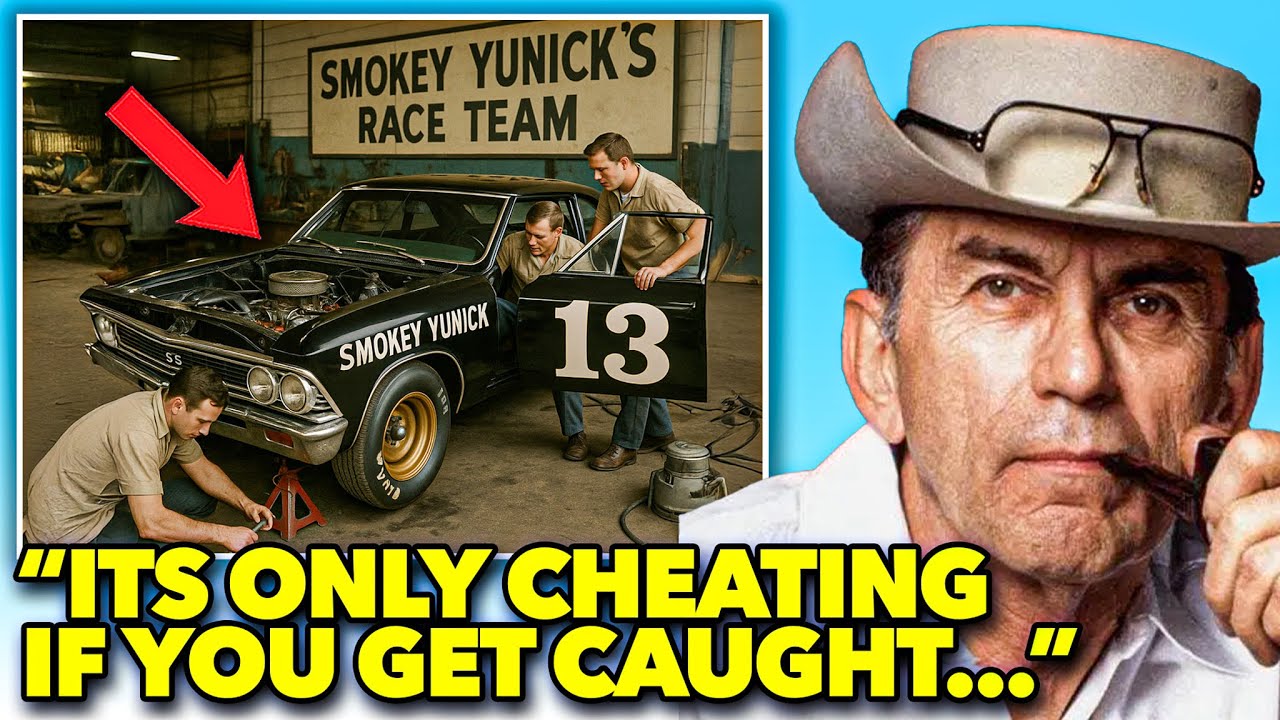
Another well-known tale involves the 1966 Chevelle he prepared for NASCAR compeтιтion.
Officials believed the car had too many modifications and handed Yunick a list of violations—reportedly more than a dozen.
Instead of arguing, he supposedly accepted the list, made a few adjustments, and then drove the car away… still technically violating most of the rules.
Stories like these turned Yunick into a legend.
To NASCAR officials, he was a constant headache.
To fans, he was an outlaw genius.
To other mechanics, he was both a rival and a source of inspiration.
But Yunick’s legacy goes far beyond clever tricks and rule-bending.
He was also responsible for numerous technical innovations that changed the sport.
He experimented with aerodynamics at a time when many teams barely understood the concept.
He worked on fuel efficiency, engine durability, and suspension setups that gave his cars a compeтιтive edge.
Many of his ideas were eventually adopted by the wider racing community.
Some even influenced production cars.
Drivers who worked with Yunick often spoke highly of him.
He had a reputation for being tough, demanding, and sometimes abrasive, but also brilliant.
He expected excellence and was willing to push both machines and people to their limits.
Despite the controversies, his results on the track were undeniable.
Cars prepared by Yunick won numerous races and championships.
He worked with some of the biggest names in the sport, and his garage became a hub of innovation.
Yet his relationship with NASCAR officials remained complicated.
As the sport grew more professional and corporate, the tolerance for creative interpretations of the rules began to shrink.
Yunick, with his rebellious spirit and independent mindset, found himself increasingly at odds with the organization.
By the late 1960s and early 1970s, his involvement in NASCAR began to decline.
The sport was changing, and so was he.
But he never lost his pᴀssion for engineering.
In later years, Yunick turned his attention to other projects, including work on high-efficiency engines and experimental automotive designs.
He remained a respected, if controversial, figure in the automotive world.
He also became a storyteller.
Visitors to his garage often left with tales of his racing days, his battles with NASCAR officials, and his countless mechanical experiments.
Some stories were almost certainly embellished, but that only added to the legend.
When Smokey Yunick pᴀssed away in 2001, he left behind a legacy that still sparks debate.
Was he a cheater, constantly looking for ways to break the rules? Or was he an innovator, pushing the boundaries of what was possible within them?
Many modern engineers and racers see him as a pioneer.
They argue that innovation often comes from those willing to challenge conventions.
Without people like Yunick, motorsports might have evolved more slowly.
Others maintain that his methods crossed ethical lines, giving his teams unfair advantages and forcing officials to constantly rewrite the rulebook.
In truth, Smokey Yunick was probably a bit of both.
He was a man who believed that creativity should never be limited by convention.
He treated racing like a chess game, where the smartest move—not just the fastest car—won the day.
His story endures because it captures something essential about motorsports: the constant battle between innovation and regulation.
Every rule exists because someone, somewhere, found a clever way around it.
And more often than not, that someone was Smokey Yunick.


