🔥 Mount Etna Awakens – And This May Be Only the Beginning… 🌋
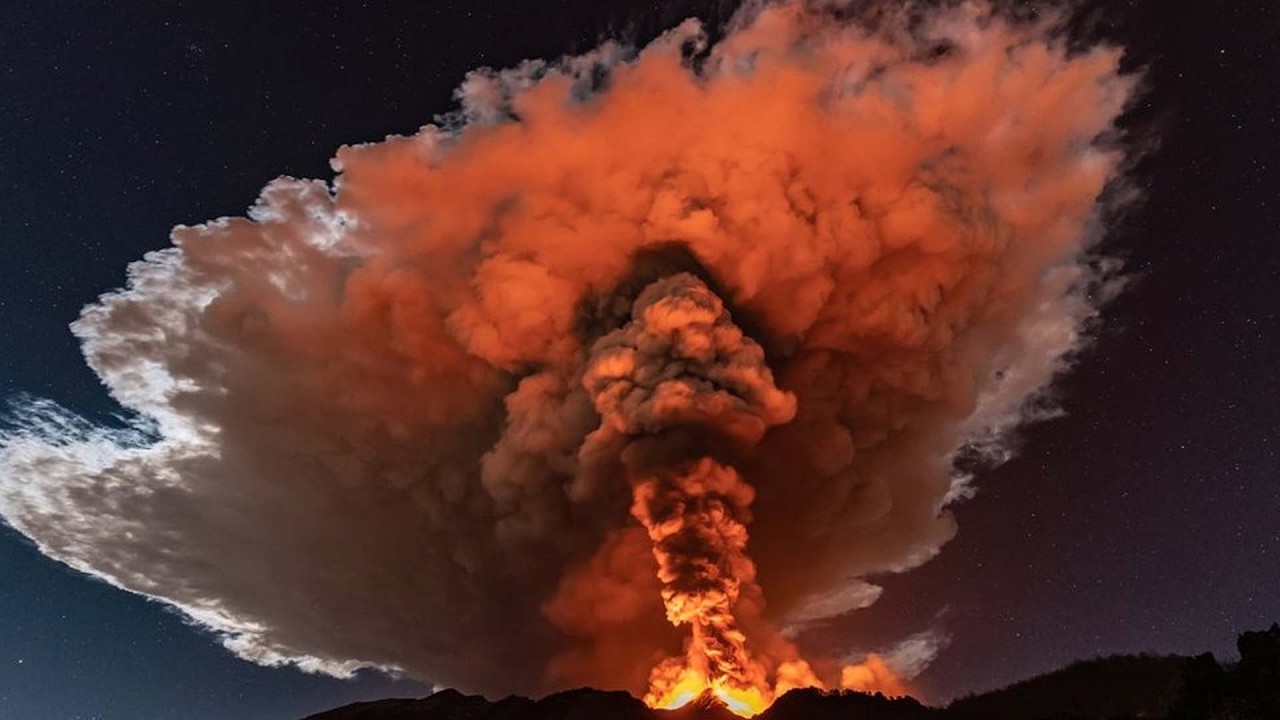
The sky above Sicily did not simply glow the night Mount Etna erupted — it burned.
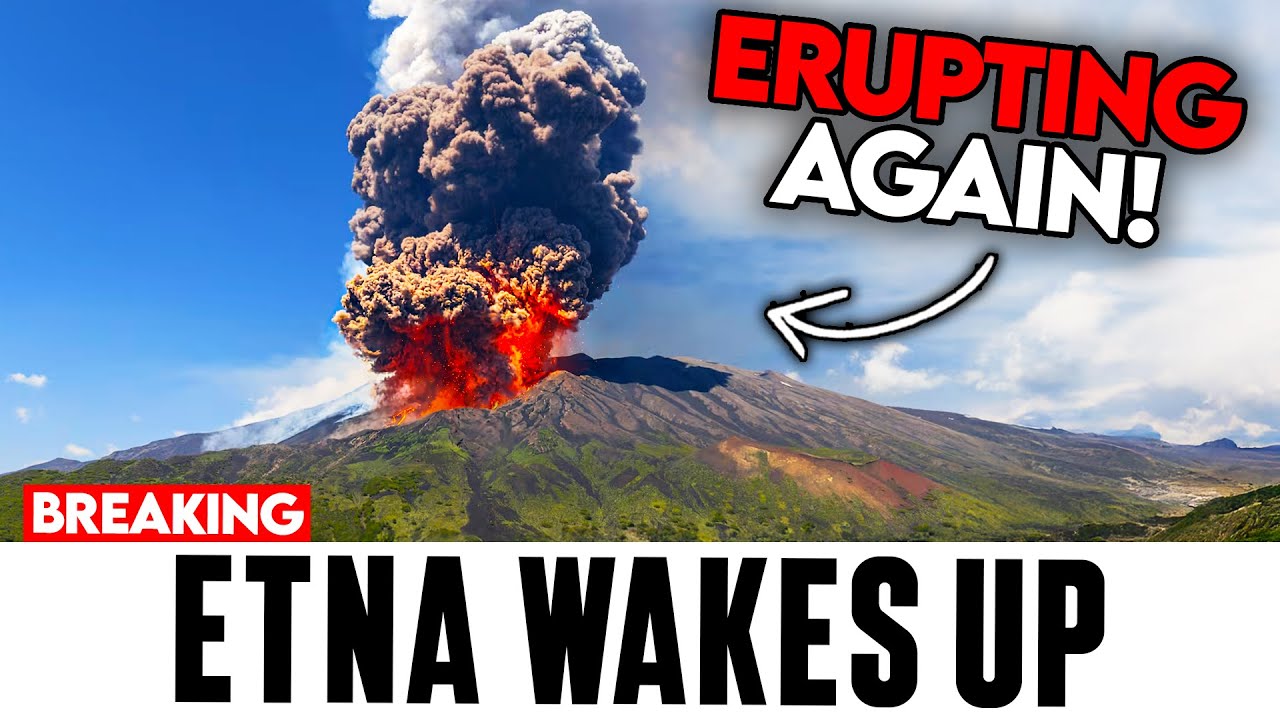
A deep, bruised crimson swallowed the horizon as molten rivers carved their way down blackened slopes, slow and deliberate, like something ancient reclaiming its territory.
Residents stood in silence on balconies and rooftops, phones raised, their faces illuminated by the pulsing orange light.
Some called it beautiful.
Others said it felt wrong.
Mount Etna has erupted countless times before.
It is Europe’s most active volcano, a restless giant that rarely sleeps for long.
To those who live in its shadow, fire is not unfamiliar.
Ash on windshields, tremors beneath dinner tables, airport closures — these are part of the rhythm of life.
But this time, scientists admit in quieter conversations, something about the pattern is different.
The eruption itself was violent, but not unprecedented.
Lava fountains burst hundreds of meters into the air.
Thick columns of ash surged upward, drifting across eastern Sicily and forcing temporary shutdowns at nearby airports.
Streets were dusted in fine gray powder by morning.
It was dramatic, yes — but Etna has staged such spectacles before.
The unease does not lie in what was seen.
It lies in what wasn’t.
In the weeks leading up to the eruption, seismic instruments recorded a subtle but persistent increase in microtremors — tiny earthquakes too small for most people to feel.
Individually insignificant.
Collectively unsettling.
The frequency shifted.
The depth changed.
Pressure readings within the magma chambers hinted at movement not just upward, but laterally — a slow migration beneath the crust that some volcanologists describe as “unusual for this phase.”
Publicly, officials maintain composure.
They emphasize that Etna remains under constant surveillance.
Monitoring systems are sophisticated.
Evacuation protocols exist.
“There is no immediate cause for alarm,” one regional spokesperson stated calmly during a press briefing.
Yet in research forums and late-night lab discussions, the language grows less certain.
One geophysicist, speaking anonymously, described the internal activity as “messy.” Not in the sense of chaos — but in unpredictability.
“We expect certain sequences,” the scientist said.
“Pressure builds, tremors increase, a vent opens, energy releases, things stabilize. This… hasn’t fully stabilized.”
Satellite imagery reveals subtle ground deformation — swelling in areas not typically ᴀssociated with Etna’s main craters.
Thermal scans show pockets of heat emerging in unexpected zones along the flanks.
None of these indicators confirm catastrophe.
But together, they sketch a pattern that refuses to fit neatly into established models.
The most controversial theory circulating among a small group of researchers suggests that Etna’s internal plumbing system may be reconfiguring.
Volcanoes are not hollow cones filled with lava, as childhood diagrams imply.
They are labyrinths — networks of conduits, chambers, fractures, and pressurized pathways that evolve over time.
When these systems shift, surface behavior can change in ways that defy historical precedent.
And Etna has a long memory.
Its eruptions have buried villages, reshaped coastlines, and rewritten maps.
In 1669, lava flows reached the walls of Catania.
In 1992, desperate efforts were made to divert advancing molten rivers away from populated areas.
Time and again, humanity has adapted — but never fully controlled.
The current eruption’s lava flows, though destructive in isolated zones, have so far avoided densely populated centers.
That fact alone has tempered panic.
But volcanology is not merely about what lava touches.
It is about pressure, timing, and escalation.
One unsettling variable is gas composition.
Recent samples indicate fluctuations in sulfur dioxide and carbon dioxide emissions that do not perfectly align with typical eruptive phases.
Elevated CO₂ levels, in particular, can signal deeper magma rising — magma that has not yet degᴀssed near the surface.
When that kind of material erupts, it can do so explosively.
No one is predicting an apocalyptic scenario.
At least, not officially.
But data points whisper their own story.
There are also historical cycles to consider.
Etna operates in pulses — years of heightened activity followed by relative quiet.
Some researchers believe the volcano may be entering a more intense multi-year phase.
Others argue that drawing parallels to past cycles oversimplifies a system that evolves with each eruption.
Then there are the tremors that followed the main event.
In the days after the dramatic lava fountains subsided, seismic activity did not decline as sharply as expected.
Instead, it plateaued at a higher-than-average baseline.
Small quakes rippled beneath nearby towns, enough to rattle windows but not enough to trigger emergency alerts.
For residents, it was a reminder that the mountain’s silence can be deceptive.
Tourists still arrive.
Guided excursions continue when conditions permit.
Social media fills with breathtaking footage — lava against starlit skies, ash clouds illuminated by lightning.
The spectacle draws fascination from around the world.

But for those who study the numbers scrolling across monitoring screens, the awe is tempered by calculation.
Could this be the beginning of a larger structural shift within the volcano? A precursor to a more significant eruptive phase months or even years from now? Or is it merely another chapter in Etna’s long, volatile narrative?
The answer depends on variables still unfolding beneath kilometers of rock.
One particularly debated issue involves flank instability.
Parts of Etna’s eastern side are slowly sliding toward the Ionian Sea — a movement measured in millimeters per year.
It is a known phenomenon.
But if internal magma pathways expand or reorient, that gradual creep could accelerate.
A significant landslide event, though statistically rare, would introduce hazards beyond lava and ash.
Such possibilities are not predictions.
They are contingencies — scenarios considered in hazard ᴀssessments and academic journals.
Yet once mentioned, they linger in the imagination.
Night has fallen again over Sicily.
The glow has dimmed for now, reduced to intermittent flickers at the summit.
From a distance, Etna appears almost peaceful, a dark silhouette against a quieter sky.
But instruments continue to listen.
Satellites continue to scan.
Scientists continue to argue in careful, data-driven tones.
And beneath it all, magma continues to move.
Volcanoes do not think.
They do not plan.
They respond to physics — pressure, density, temperature.
But to those who live near them, they can feel almost sentient.
Watching.
Waiting.

The eruption that painted the sky red may fade from headlines in days.
Airports will reopen.
Ash will be swept away.
Life will resume its ordinary cadence.
Yet the deeper story — the one measured in tremor frequency, gas ratios, and ground deformation graphs — is still being written.
There is a reason volcanologists avoid definitive statements during active phases.
Earth systems rarely conform to human timelines.
A week of relative calm can precede sudden escalation.
Or heightened activity can dissipate without further consequence.
At this moment, no evacuation orders blanket Sicily.
No international alarms sound.
But within research centers, screens glow late into the night as analysts compare datasets, searching for patterns that might confirm reᴀssurance — or demand revision.
Is this eruption simply another display from Europe’s most restless volcano? Or the early tremor of something more transformative?
For now, the mountain offers no clear answer.
Only heat.
Only ash.
Only the steady, almost imperceptible shift of a living landscape still in motion.


