😱 Eye-Witness of Jesus! Letter of Lentulus Describes Jesus in Great Detail to Caesar of Rome! 😱
Imagine a letter sent to the Roman Emperor, vividly detailing the appearance, demeanor, and divine presence of Jesus Christ.
This ancient writing, known as the Letter of Lentulus, claims to provide a first-hand account of Jesus, offering a unique glimpse into the life of one of history’s most iconic figures.
The mystery surrounding Jesus’s actual appearance has captivated people for centuries, raising the question: Could the solution lie within this letter?
As we delve deeper into the Letter of Lentulus, we will uncover the eye-witness account of Jesus and how it reveals His character and presence to the Roman Senate.
Art has long served as a profound means of expressing human emotions, beliefs, and thoughts, and Jesus Christ has been one of the most recognized figures in Western art.
From the early Christian era to the present day, Jesus has been depicted in countless paintings, sculptures, and other artistic works that not only serve as religious symbols but also reflect the personal, cultural, and theological beliefs of the artists who created them.
François Solon’s rendition of Jesus stands out in this context, as it embodies both traditional Western art forms and a more humanized representation of Christ.
Throughout history, artists have aimed to portray Jesus in ways that reflect their religious convictions and the cultural contexts in which they worked.
In early Christian art, Jesus was often depicted as a young, bearded man, embodying the Good Shepherd who guides his flock.
In contrast, Byzantine art presented Jesus with a celestial and regal quality, often portraying Him with a severe, authoritative face and a halo, signifying His divinity.
During the Renaissance, artists such as Michelangelo, Raphael, and Leonardo da Vinci depicted Jesus in ways that showcased their technical mastery while also reflecting their interpretations of His essence.
These representations often idealized Jesus, portraying Him as a perfect human being who embodies both divinity and humanity, with features that align with European aesthetic norms, such as pale skin, light brown or blond hair, and blue or light-colored eyes.
However, these Western interpretations of Jesus do not accurately reflect his likely historical appearance.
Historians generally agree that Jesus, a Jew born in the Middle East, would have possessed regional features, including darker skin, brown eyes, and dark hair.

This historical truth has sparked ongoing discussions about how Jesus has been portrayed in art, particularly in contemporary times.
François Solon’s image of Jesus, while rooted in traditional Western art, reflects these ongoing debates by combining elements of idealized European imagery with more realistic, humanized representations of Christ.
In Solon’s portrayal, Jesus’s brown eyes are one of the most striking features, symbolizing compᴀssion and sorrow inherent to the Christ story.
The deep brown color of His eyes connects Him to universal feelings of love, loss, and salvation, grounding Jesus in the human experience.
Moreover, Solon depicts Jesus with darker skin, which contrasts sharply with the traditional European view of Christ as light-skinned.
By presenting a brown-skinned Jesus, Solon challenges viewers’ perceptions and invites them to consider Christ’s humanity on a deeper level.
This depiction serves as a reminder that Christ’s message of compᴀssion, forgiveness, and redemption transcends ethnic and cultural boundaries.
In many cultures, brown eyes are ᴀssociated with warmth, approachability, and emotional depth, emphasizing Jesus’s ability to understand the struggles of everyday people.
Similarly, a darker complexion often symbolizes humility and a connection to the common folk, reinforcing the idea that Christ is not a distant figure but one who relates closely to the lives of those who are marginalized.
As artists like Solon provide alternative images of Christ, they foster a perception of Jesus as a culturally and ethnically neutral savior, inviting all people to see themselves in Him.
The changes in Jesus’s eyes and skin compel us to rethink centuries of traditional images and to see His humanity in a new light.
Scripture has always influenced how Jesus is portrayed in art, especially pᴀssages that discuss His character and mission.
Isaiah, the Old Testament prophet, provides several prophecies regarding the arrival of the Messiah, making his writings vital in this context.
In Isaiah 53, the prophet speaks of a suffering servant who will bear the sins of the people, using his suffering to effect redemption.
The description of the Messiah in Isaiah 53:2-3 is particularly moving: “He had no grandeur or beauty to attract us to him, and there was nothing in his appearance that we should desire him. He was despised and rejected by mankind, a man of suffering, and familiar with pain.”

This portrayal of the Messiah stands in stark contrast to the idealized depictions of Jesus common in Western art.
According to Isaiah, the coming savior would not be a figure of physical beauty or grandeur; rather, he would be a humble, suffering servant, rejected by the very people he came to save.
This image resonates deeply with Solon’s depiction of Jesus, emphasizing His humanity and connection to the suffering of the world.
Isaiah’s prophecy also underscores the role of the Messiah as a figure who bears the sins of others, as seen in verses 4-5: “Surely he took up our pain and bore our suffering… But he was pierced for our transgressions, he was crushed for our iniquities.”
This theme of the suffering servant is central to Christian theology and is often reflected in artistic depictions of Jesus, particularly those focusing on His crucifixion.
While Solon’s painting does not directly depict the crucifixion, the sadness and compᴀssion evident in Christ’s brown eyes convey this aspect of His mission.
Additionally, the Book of Psalms contains pᴀssages that are understood to allude to the impending arrival of the Messiah.
Psalm 22, for instance, is frequently seen as a prophetic precursor to the crucifixion, opening with the anguished words, “My God, my God, why have you forsaken me?”—words that Jesus would later utter on the cross.
The psalm goes on to describe the suffering of the psalmist in terms that closely parallel the crucifixion: “I am poured out like water, and all my bones are out of joint.”
This description of suffering aligns with the portrayal of Jesus in many works of art, particularly those that focus on His Pᴀssion.
The image of Christ as the suffering servant, bearing the weight of the world’s sins, is a central theme in Christian art, powerfully expressed in both Psalm 22 and Isaiah’s prophecies.
Moreover, Psalm 22 concludes with a note of hope, emphasizing that despite suffering, God has not abandoned the afflicted.
This message of hope and redemption is a key theme in Christian art, often depicted in scenes of resurrection where Christ triumphs over death and suffering.
The historical and visual depiction of Jesus Christ has fascinated scholars, historians, and theologians for centuries.
As one of the most iconic figures in human history, the question of what he actually looked like has intrigued both believers and skeptics.
Various descriptions of Jesus have emerged over the years, each offering unique insights, though the authenticity of many remains debated.
Among the most famous sources of such descriptions is the Letter of Lentulus, which allegedly provides a physical description of Jesus, alongside other accounts such as those attributed to Pontius Pilate.
These documents, whether apocryphal or historical, have been scrutinized and debated significantly.
Despite being widely circulated in the Middle Ages, the letter’s origins remain shrouded in mystery, and its authenticity has been contested.
Often considered an apocryphal document, it captivates interest because it provides one of the few detailed physical descriptions of Jesus.
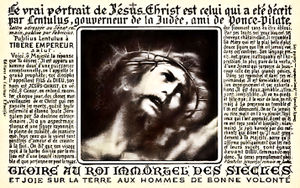
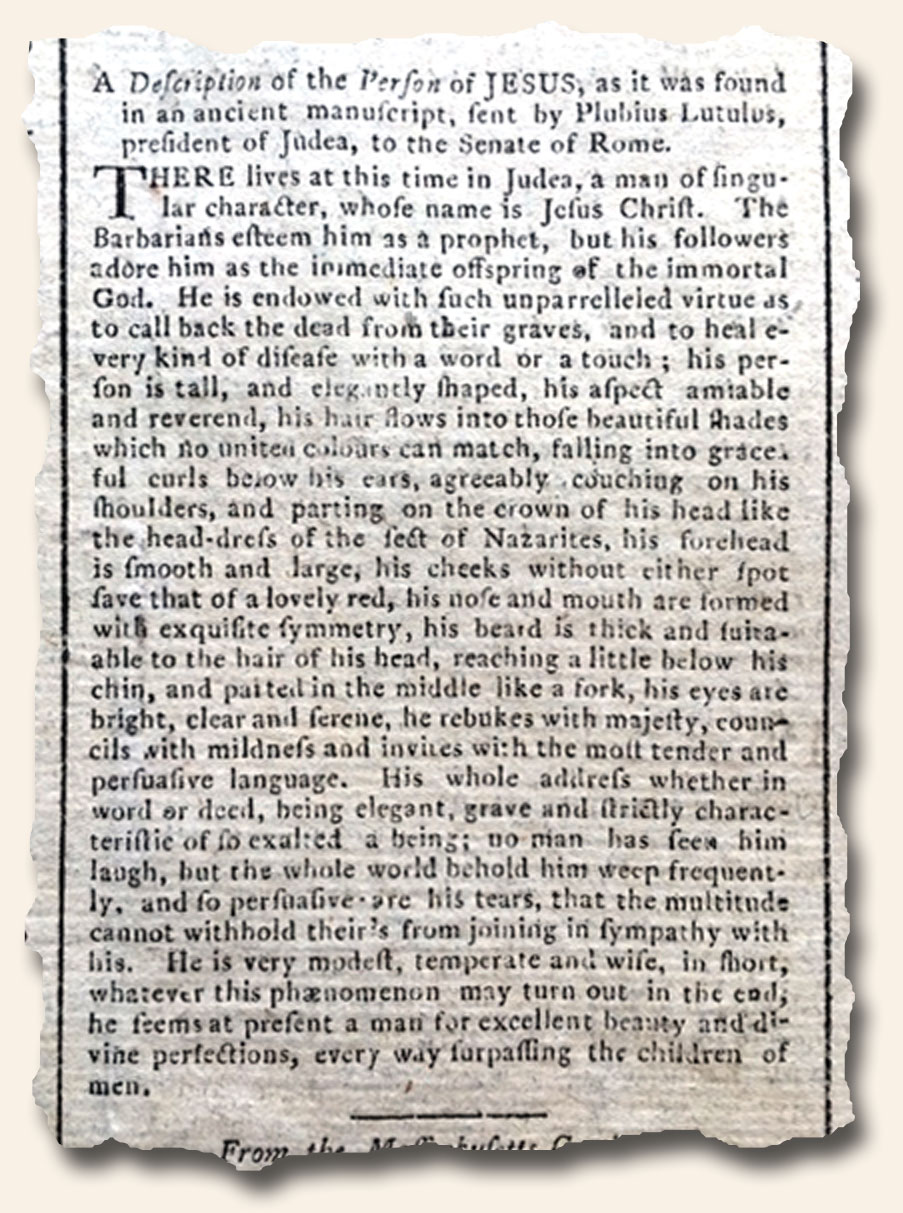
According to the Letter of Lentulus, Jesus is described as having “a noble and commanding presence,” with a body “remarkable for its symmetry.”
His hair is said to be the color of “ripe chestnut,” worn long and flowing, parted in the middle.
His face is depicted as serene and dignified, displaying no signs of vanity or arrogance.
The letter describes Jesus’s beard as short and neatly kept, matching the color of his hair.
His eyes are described as “variegated,” capable of conveying great depth and wisdom.
Lentulus notes that Jesus is of medium height, possessing an air of nobility that commands respect wherever He goes.
The letter became popular in medieval times, especially because it offered a visual portrayal of Jesus, which had been largely absent from early Christian tradition.
In the centuries that followed, artists used this description as a template for their portrayals of Jesus, contributing to the common depictions of Him with flowing hair, a symmetrical face, and an aura of gentleness and nobility.
However, despite its influence, scholars remain divided on the letter’s authenticity, as there is no definitive proof of its existence before the fifteenth century.
Pontius Pilate, the Roman governor who presided over Jesus’ trial, is another key figure in the narrative of Jesus’s life.
While Pilate is mentioned in multiple sources, including the New Testament, there are also apocryphal letters attributed to him.
One such letter, addressed to Emperor Tiberius, allegedly provides an eyewitness account of Jesus.
In this letter, Pilate describes Jesus as a striking figure with an aura of divinity and authority.
He notes Jesus’s calm demeanor during the trial, highlighting that Jesus did not show fear or anger despite the accusations against Him.
Pilate is said to have been impressed by Jesus’s wisdom and eloquence, describing Him as possessing a supernatural serenity that set Him apart from ordinary men.
The letter implies that Pilate had serious reservations about sentencing Jesus to death, hinting that he believed Jesus to be innocent.
However, Pilate ultimately caved to political pressure, allowing the Jewish authorities to have their way.
Another significant figure in relation to Jesus is Caiaphas, the Jewish high priest who played a key role in Jesus’s arrest and trial.
Caiaphas is described in the New Testament as the high priest who condemned Jesus for blasphemy and sought His execution.
Although he is believed to have written letters concerning Jesus, these writings have largely been lost to history.
One purported letter, addressed to the Roman authorities, describes Jesus as a dangerous figure gaining too much influence among the Jewish people.
Caiaphas viewed Jesus as a threat to the established religious order, accusing Him of false claims of divinity and miracles.
While no physical description of Jesus is found in Caiaphas’s writings, his actions significantly shaped the events leading to Jesus’s crucifixion.
Caiaphas’s hostility reflects the complex religious and political dynamics of the time, where Roman occupation and Jewish religious authority were in delicate balance.
Jesus’s growing popularity and His challenge to the status quo upset this balance, prompting Caiaphas and the Jewish authorities to take drastic action.
So what did Jesus really look like?
Despite the various apocryphal letters and writings, there is only one physical description of Jesus widely believed to have survived from antiquity: the letter from Publius Lentulus to the Roman Senate.
The original letter is dated to the reign of Emperor Tiberius, which lasted from AD 14 to AD 37.
However, there is little historical verification of this letter’s authenticity, and many scholars believe it to be a later forgery, as no contemporary sources mention Lentulus or his letter.
The lack of corroborating evidence, combined with stylistic and anachronistic elements, has led most historians to conclude that the description of Jesus in the letter is not a genuine historical account.
One of the most important historical sources mentioning Jesus is the “Antiquities of the Jews,” written by the Jewish historian Flavius Josephus.
Josephus refers to Jesus as a wise teacher and miracle worker, noting that He gained a significant following among both Jews and Gentiles.
He describes Jesus as being condemned by Pilate and crucified, but he does not provide a physical description of Jesus.
Josephus’s account focuses primarily on Jesus’s actions and the impact of His teachings, leading to speculation that he either did not consider Jesus’s physical appearance important or avoided descriptions that might encourage idolatry.
The Letter of Lentulus provides detailed descriptions of Jesus’s hair and facial features, aligning with traditional depictions in Western art.
His hair is described as long and flowing, while his beard is short and neatly trimmed.
The letter also mentions Jesus’s nose as well-proportioned and his mouth as “graceful,” with a soft and gentle voice.
Some interpretations suggest that Jesus possessed a “megalocephalic” quality, indicating an unusually large intellect for a man of his era.
This interpretation is based on descriptions of Jesus’s wisdom and eloquence, portraying Him as a figure of great intelligence and insight.
Jesus’s appearance and the early Church Fathers’ interpretations played a significant role in shaping how Christians viewed Christ.
Figures such as Justin Martyr, Origen, Saint Augustine, and Cyril of Jerusalem contributed various interpretations rooted in scripture, discussing Jesus’s physical characteristics and their theological implications.
In the second century, church fathers began addressing Jesus’s physical appearance due to the growing interest among Christian believers and the challenge of presenting Christ to a Greco-Roman world steeped in visual culture.
Justin Martyr, an early Christian thinker, referred to the prophecy in Isaiah 53:2, emphasizing that Jesus had no beauty or majesty to attract people to Him.
This interpretation highlighted that Jesus was not a worldly king but a humble, suffering servant, reinforcing His spiritual authority and divine mission.
Origen echoed Justin’s views, suggesting that Jesus’s ordinary appearance further emphasized the mystery of the Incarnation.
This humbling of the divine to take on human form was central to Origen’s theological reflections, underscoring that Jesus’s true power lay in His spiritual nature.
By citing Isaiah, early Christian thinkers engaged in theological apologetics, defending the idea that their savior could appear physically unimpressive in a world that valued beauty and power.
They inverted cultural expectations, showing that Jesus’s true majesty lay in His humility and spiritual authority.
While some early theologians emphasized Jesus’s humble appearance, others pointed to Psalm 45, which describes a glorious and exalted figure.
This dual understanding of Jesus as both humble and glorious played a significant role in Christian art and theology for centuries.
Saint Augustine, a pivotal theologian in the fourth and fifth centuries, acknowledged the scriptural references to Jesus’s humble appearance while emphasizing that His true beauty lay in His nature as the Word of God.
Augustine argued that true beauty is found not in the material world but in the soul and the divine, suggesting that even if Jesus appeared ordinary, His inner beauty made Him far more beautiful than any physical form could express.
Cyril of Jerusalem emphasized that Jesus became “all things to all people,” adapting His appearance to connect with humanity.
This idea of Jesus’s accessibility and compᴀssion shaped early Christian theology, suggesting that His humble form allowed Him to relate to people of all walks of life.
The fourth century marked a significant turning point for Christianity, particularly in how Jesus was depicted and understood.
Emperor Constantine played a crucial role in protecting and promoting Christianity, allowing for the development of artistic and theological depictions of Christ.
Under Constantine’s reign, Christianity evolved from a persecuted minority religion into the dominant faith of the empire, influencing how Jesus was portrayed in art and thought.
The blending of depictions, shaped by theology and imperial support, created a lasting legacy that would influence Christian art, thought, and worship throughout history.
As we reflect on the various interpretations of Jesus’s appearance, we are reminded that true beauty lies not in physical attributes but in the profound spiritual message He embodies.


