😱 The Ethiopian Bible Describes Jesus in Incredible Detail and It’s Not What You Think 😱
Imagine holding an ancient book, its cracked leather binding heavy with the weight of centuries of prayer.
This book, the Ethiopian Bible, is a treasure trove of Christian tradition that has been largely overlooked by the Western world.
Many people are surprised to learn that the Ethiopian Bible is not the oldest Bible, nor is it simply a translation of the King James Version.
In fact, it contains entire books that are missing from the modern Western canon, and its translations are nearly identical to those found in other ancient texts.
For over 1700 years, Ethiopian monks have preserved a unique Christian tradition, one that developed independently from the influences of Rome and the subsequent church councils.
Nestled in the highlands of northern Ethiopia, the monastery of Ura Kadani Morrett is a testament to this rich heritage.
Inside its walls, vivid wall paintings narrate the story of Ethiopia’s spectacular Christian legacy.
Christianity was declared the state religion in the 4th century, far removed from the political machinations of Rome.
This means that the Ethiopian church was able to safeguard manuscripts written in ancient scripts, preserving texts that would otherwise have been lost to history.
This is not a conspiracy or myth but a documented history, confirmed by leading scholars and scientific dating methods.
So, we must ask ourselves: what if the story we were taught about the origins of Christianity is incomplete?
What if the most complete and oldest Christian tradition on earth was never centered in Europe but instead flourished in Africa, quietly awaiting rediscovery?
To understand this, let us journey back in time to the year 330 CE.
The Roman Empire was undergoing a significant transition.

Constantine had recently made Christianity legal, ending centuries of persecution, but the great councils that would define Western doctrine had not yet convened.
Theologians across the Mediterranean were still grappling with fundamental questions about the nature of Jesus and the meaning of his teachings.
In contrast, thousands of miles to the south, in the kingdom of Axum, something remarkable was happening.
King Azana, one of the most powerful rulers of the ancient world, had formally adopted Christianity as the official religion of his empire.
This was not a tentative decision or a political compromise; it was a sovereign declaration that laid the foundation for his entire civilization.
While European theologians were still debating the nature of the Trinity, Axum had already built churches, ordained clergy, and translated scripture into their sacred language.
This African kingdom did not wait for Rome to lead; it forged its own path.
Axum was not some obscure backwater kingdom; it was a superpower that controlled vital trade routes connecting the Roman world to India and beyond.
Its merchants dealt in ivory, gold, incense, and exotic goods, creating fortunes across three continents.
Axum minted its own gold coins, a testament to its wealth and sophistication.
When Axum embraced Christianity, it did so with confidence and independence, answering to no one but itself.
The man credited with bringing Christianity to Axum was Fumentius, a Syrian missionary who had been shipwrecked on the African coast.
He rose to prominence in the Axumite court and eventually became the tutor of the prince who would become King Azana.
When Azana took the throne, Fumentius traveled to Alexandria to be consecrated as the first bishop of Axum, establishing a connection to the ancient Coptic church that would endure for centuries.
However, it is crucial to note that Fumentius did not bring a copy of Roman Christianity; he brought an early Eastern form of the faith that had developed along different lines.

Once it took root in Ethiopian soil, Christianity grew according to its own logic, shaped by African experience, expressed in African language, and preserved by African hands.
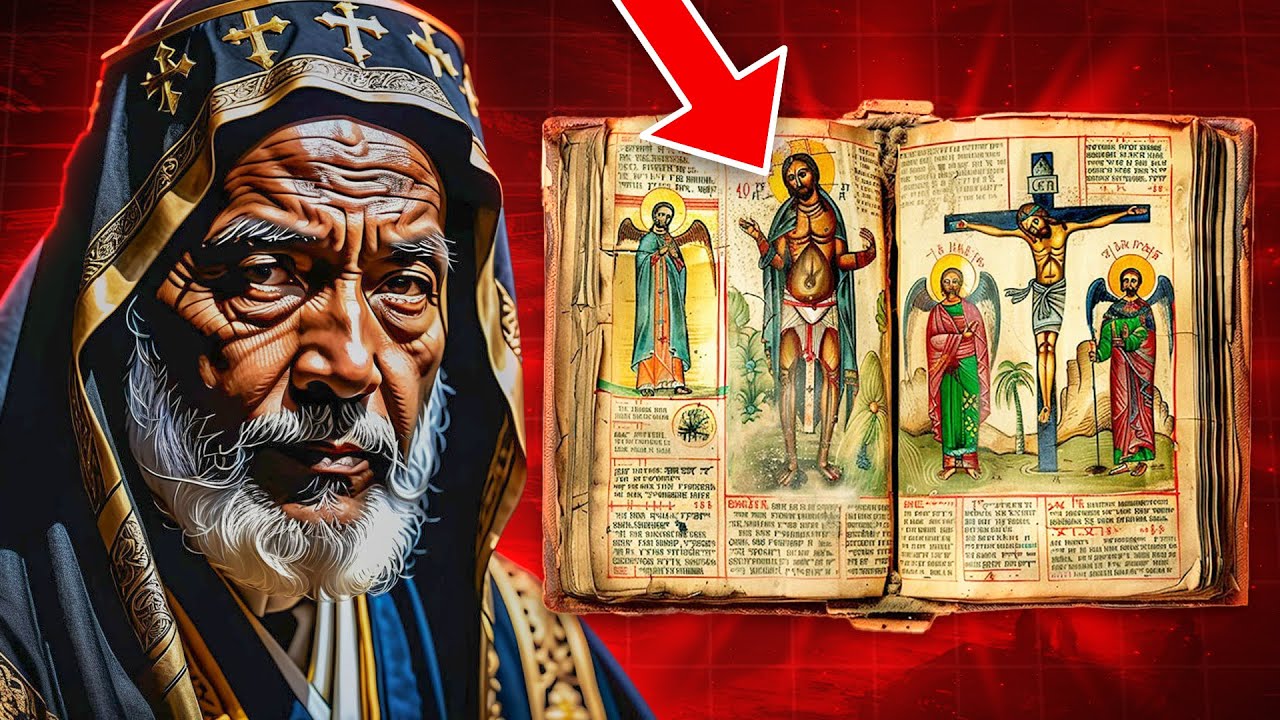
One of the most significant pieces of evidence of this history is the Germa Gospels.
These illuminated manuscripts, believed to be the oldest illustrated Christian texts, were created in Ethiopian monasteries during late antiquity.
Researchers have used radiocarbon dating to analyze the materials, revealing that the pages date from roughly the 4th to 7th century CE, with some sections possibly produced as early as 390.
This makes the Germa Gospels among the oldest surviving illustrated Christian gospel books anywhere on earth, predating the famous Book of Kells by at least 300 years.
While Europe was still emerging from the chaos that followed Rome’s collapse, Ethiopian monks were producing sacred art of extraordinary sophistication and beauty.
These manuscripts have been preserved in Ethiopian monasteries for centuries, read in liturgies that continued unbroken for over a thousand years.
They were never lost or hidden; the Western world simply did not know to look for them—or perhaps did not want to acknowledge their existence.
Recognizing what Ethiopia preserved means acknowledging that the story we were told about Christian origins was incomplete from the beginning.
It means admitting that Rome was never the only center of Christianity and that an African tradition running parallel to everything we thought we knew may hold answers the West forgot to ask for.
Now we arrive at the heart of the mystery: Ethiopia possesses complete surviving versions of two of the most debated and controversial ancient texts in religious history—the Book of Enoch and the Book of Jubilees.
Fragments of these works appear in Hebrew, Aramaic, and Greek, and portions were discovered among the ᴅᴇᴀᴅ Sea Scrolls.
This proves beyond doubt that these texts were not obscure fringe writings but central to early Jewish and Christian thought.
Scholars reconstructing the intellectual world of the Second Temple period cannot do their work without consulting Ethiopian manuscripts.
When they want to read Enoch or Jubilees in full, they have no other choice; the complete versions exist only in Ge’ez, Ethiopia’s classical sacred language.

Let that sink in.
Western scholars spent decades piecing together sentences from damaged scraps while Ethiopian monks were reading those same books cover to cover, teaching them in their monasteries.
The books were never lost; they were simply somewhere else, where the Western academic world was not looking.
The Book of Enoch unfolds like an ancient guide to the cosmic order, describing angelic hierarchies, divine mysteries, and a vision of the end times that would later influence much of what appears in the Book of Revelation.
The Book of Jubilees retells the stories of Genesis through a strict chronological and moral framework, reshaping how readers understand sacred time, divine law, and the origins of humanity.
These are not decorative additions; they are foundational texts that redefine origins, authority, and eschatology in ways that Western Christianity ultimately chose to set aside.
Ethiopia made a different choice, preserving these texts because they were considered essential for understanding the faith.
So why did the Western church remove these books from their canon while Ethiopia chose to preserve them?
The answer lies in priorities.
As Western Christianity consolidated under imperial authority, church councils and medieval theologians worked toward a unified doctrinal system.
Texts that complicated official creeds or blurred theological boundaries were gradually trimmed away.
Enoch and Jubilees did not fit neatly into the framework Rome was constructing.
Their visionary content and emphasis on direct encounters with the divine ran counter to what the Western church was trying to build.
Thus, they were set aside—not burned or suppressed, but simply deprioritized until they faded from memory.
In contrast, Ethiopian Christianity valued visionary writings, cosmic histories, and revelatory insights.

Preserving Enoch and Jubilees was a deliberate theological choice made by a community that never had to answer to Rome.
Now, let’s turn to a remarkable aspect of the Ethiopian biblical canon.
Within it exists a complete book describing private teachings given by Jesus after the resurrection.
This text, known as the Book of the Covenant or Mashafakaan in Ge’ez, records the risen Christ instructing his closest disciples during the 40 days between Easter and the Ascension.
The number 40 carries immense weight in Jewish and Christian memory.
Moses fasted on Mount Sinai for 40 days, Israel wandered the wilderness for 40 years, and Jesus himself was tempted in the desert for 40 days before beginning his ministry.
Yet the canonical New Testament provides almost nothing about what occurred during those 40 days after the resurrection.
The Book of Acts mentions it briefly but moves on.
What happened during those days?
What did Jesus reveal to his closest followers before ascending to heaven?
Ethiopian tradition preserved an answer.
The Mashafakaan gathers teachings that focus on inner transformation, contemplative prayer, and direct experience of the divine.
It emphasizes spiritual formation rather than insтιтutional rules.
The text describes how to pray, recognize angelic presence, interpret visions, and understand how the resurrection fundamentally changes the relationship between humanity and God.
Salvation is presented not as a legal correction but as a transformation of perception and an awakening to a reordered cosmos.

For Ethiopian monasteries and contemplative communities, this material has shaped devotional practice for over a thousand years.
It was never a secret kept from the world; it was simply part of a tradition that the world was not paying attention to.
As translations begin to circulate more widely, the West is finally starting to notice what Ethiopia has held all along.
This brings us to a crucial insight that changes everything.
Christianity did not develop as a single straight line from Jerusalem to Rome.
That is the story we were taught, but it is incomplete.
Very early on, perhaps within the first few centuries, the faith branched into multiple mature traditions, each asking fundamentally different questions about what religion was meant to accomplish.
Two of these branches survived intact into the modern era.
One became dominant; the other was largely forgotten.
Understanding the difference between them may be key to understanding why so many people today feel spiritually homeless.
The first path, which became dominant, centered on Rome and Constantinople.
It approached Christianity primarily as a challenge of unity and governance.
Early church leaders faced the existential question of how to hold together an enormous empire with diverse languages, traditions, and cultures.
The solution was standardization: creeds that established clear doctrinal boundaries, councils that settled theological disputes, and a canon of scripture carefully selected to support insтιтutional coherence.
This approach worked brilliantly for what it was designed to do.
It built one of the most enduring insтιтutions in human history.
It preserved Christianity through the fall of Rome, the chaos of the medieval period, and countless other catastrophes.
But it came at a cost.
Texts that complicated the official narrative were gradually set aside.
Mystical practices that could not be easily controlled were pushed to the margins.
The emphasis shifted from personal transformation to correct belief, from encounter to ascent, from experience to obedience.
This is not a conspiracy theory; these were reasonable decisions made in response to genuine challenges.
When trying to hold an empire-sized insтιтution together, clarity and boundaries are essential.
However, the choices made by Western Christianity were still choices, and every choice to include something is also a choice to exclude something else.
The second path took root in places like Axum and developed through the Ge’ez tradition in ways that the Western church never fully understood.
Ethiopian Christianity asked a completely different question: what happens when faith prioritizes direct encounter with the sacred over organizational management?
Ethiopia was never under Roman political control and had no obligation to adopt decisions made at councils convened by foreign emperors.
Its Christianity developed through its own language, liturgy, and spiritual logic, producing something remarkable.
The Ethiopian canon is larger, including books that the Western church excluded.
It preserves mystical and visionary texts that address concerns that Western Christianity deprioritized.

These texts explore angelic hierarchies, sacred calendars, cosmic architecture, contemplative practice, and direct experiential knowledge of God.
These were not additions made later; they were always part of the tradition, considered essential by Ethiopian Christians.
While Rome focused on maintaining unity, Ethiopia prioritized encountering the divine.
Both questions are valid, producing genuine faith and holiness, but they led in very different directions.
This is not about declaring one tradition superior to the other; it is about recognizing that both paths exist.
Christianity has always been wider and more diverse than the story told in Western textbooks.
The tradition you inherited represents one set of choices among many possible sets.
Ethiopian Christianity is not a footnote or a curiosity; it is an alternative archive, a parallel lineage walked faithfully by millions of African Christians for nearly 2,000 years.
If you have ever felt that something was missing from the version of faith you were handed, this parallel path may hold exactly what you have been searching for.
Now, you may wonder why any of this matters in the 21st century.
Ancient manuscripts, forgotten kingdoms, mystical teachings—what do they have to do with your life right now?
The answer is crucial.
Millions of people are leaving traditional churches every year.
Pews are emptying, cathedrals are becoming museums, and denominations that once commanded loyalty are watching their membership collapse.
However, these individuals are not leaving because they have stopped believing.

They are not rejecting God; they are rejecting an approach to God that feels bureaucratic, transactional, and lifeless.
They are searching for something real—experience, transformation, a genuine encounter with the sacred.
For millions, the version of Christianity they were handed simply cannot deliver that.
It was never designed to.
It was designed for insтιтutional coherence, doctrinal precision, and organizational survival.
Yet when these become the only things a tradition offers, people start looking elsewhere.
They seek experiences in meditation retreats, ayahuasca ceremonies, Eastern mysticism, new age spirituality, and psychedelic therapies.
They are desperate to touch something their own tradition could not give them.
For over 1700 years, Ethiopian monks have safeguarded texts that speak directly to this spiritual hunger.
These are not dry rule books filled with prohibitions; they are visionary, contemplative writings that ᴀssume the whole point of faith is inner transformation.
They teach practices for encountering angelic presence, describe the architecture of heaven, and offer guidance on prayer that transcends rote recitation.
Salvation is presented not as a legal verdict but as an awakening—a fundamental shift in how you perceive reality itself.
The questions modern spiritual seekers are asking—questions about mystical experience, direct knowledge of God, transformation of consciousness—are precisely the questions Ethiopian Christianity has engaged for nearly two millennia.

The tradition never lost its mystical core; it never prioritized organizational efficiency over lived experience.
This means it preserved something the Western church largely set aside: a complete spiritual path centered on direct experience rather than mere belief.
This is not about rejecting Western Christianity; it is about recognizing that the tradition many inherited was only one branch of a much larger tree.
The trunk is older and wider than we were taught.
Ethiopian scripture has been publicly available for decades.
In the 1960s, Emperor Haile Selᴀssie authorized the printing and wide distribution of the Ethiopian Bible.
These writings were never hidden or suppressed; they were simply somewhere else, and the Western world was not paying attention.
Now, the spiritual climate is ready to receive them.
At the same time that millions of Westerners are abandoning insтιтutional religion in search of genuine spiritual experience, a parallel Christian tradition that has prioritized experience for 17 centuries is finally becoming accessible.
Translations are circulating, scholars are publishing, and conversations are spreading beyond academic circles into popular awareness.
The doors that were closed for so long are creaking open.
What we are witnessing is not just a discovery; it is a convergence—centuries of preserved wisdom meeting a generation starving for depth, mystery, transformation, and encounter.
This may be exactly what this moment has been waiting for.

As we pause this journey, we must remember that the monasteries are still carved into stone, the manuscripts are still lifted by candlelight each morning, and prayers continue in a language that has carried sacred meaning for nearly 2,000 years.
Nothing here was lost, destroyed, or erased; it was simply left outside the story the modern world chose to tell.
This should trouble us.
If an entire Christian tradition—ancient, complete, and deeply influential—could survive in plain sight while the world looked elsewhere, then this isn’t just a story about Ethiopia.
It is a story about how history decides what matters, about which voices are amplified and which are allowed to fade into silence.
The manuscripts remain, the wisdom endures, and the questions they raise refuse to stay buried.
As these doors begin to open, the real tension begins.
What happens when the foundations of a familiar narrative start to shift?
What happens when traditions once dismissed as peripheral demand to be taken seriously?
If this chapter was never meant to exist, why did it survive?
And if it survived this long, what else might be waiting just beyond the edges of what we think we understand?
Because the past is not finished with us yet, and this story is only the beginning.


