🦊 Secret Excavation Under Jerusalem’s Most Sacred Site Ignites Faith Firestorm as Experts Hint at Evidence Hidden for Centuries 🔥
Jerusalem has seen empires rise, empires fall, and tourists argue over the best hummus within a 200-meter radius.
But now, beneath the stone floors of one of the most sacred sites in Christianity, archaeologists have uncovered something that headlines are boldly declaring “CONFIRMS the Bible.”
Yes.
Confirmed.
Stamped.
Sealed.
Divine receipt printed.
Or… is it?
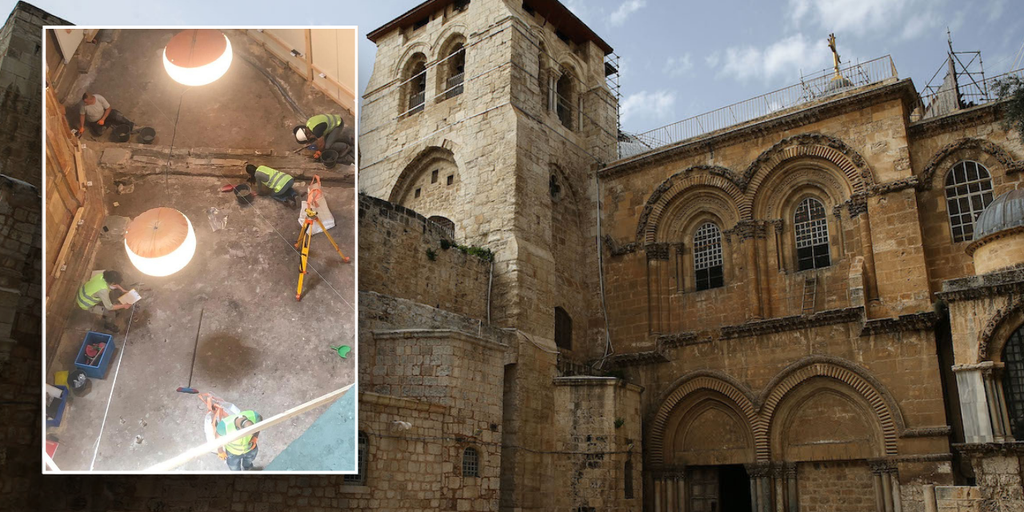
Let’s descend—figuratively and archaeologically—into what was actually discovered beneath the legendary Church of the Holy Sepulchre and why the internet is reacting as though someone just found a notarized affidavit signed by first-century apostles.
The Setting: Ground Zero of Christian History
The Church of the Holy Sepulchre stands in the Christian Quarter of Jerusalem’s Old City and is traditionally believed to mark both the crucifixion site (Golgotha) and the tomb of Jesus.
Built in the 4th century under Emperor Constantine, it has been a spiritual epicenter for nearly 1,700 years.
Pilgrims weep here.
Priests chant here.
Tour guides whisper dramatic phrases like “This is where it happened.
”
So when archaeologists conduct restoration work beneath the structure and find evidence aligning with biblical descriptions of the area, you can practically hear every history channel producer leaning forward in their swivel chairs.
The Big “Confirmation”
During recent restoration and excavation work under parts of the church’s floor, researchers uncovered remains of an ancient quarry and garden-like features dating back to the time of Jesus.
According to the Gospel of John, Jesus was crucified at a site near a garden and buried in a nearby tomb hewn from rock.
Now here’s the headline-fueling part: archaeologists found evidence that the area beneath the church was once a quarry that later contained gardens and rock-cut tombs consistent with first-century burial practices.
Cue dramatic choir music.
Social media immediately erupted with proclamations like, “Science proves the Bible!” and “Archaeology confirms everything!”
Slow down.
What Was Actually Found?
The discoveries include:
Remains of a limestone quarry dating back to the Iron Age.
Evidence that after quarrying ceased, the site was used agriculturally, likely as a garden.
Rock-cut tomb structures consistent with Jewish burial customs in the first century.
In other words, the area beneath the church matches the type of environment described in the Gospels: a crucifixion site near a garden and tombs outside the city walls.
That’s significant.
But it’s not a divine press conference.
Archaeology does not “prove” theological claims in a courtroom sense.
What it does is confirm historical plausibility.
And in this case, the findings strengthen the argument that the Church of the Holy Sepulchre stands in a location consistent with biblical narratives.
The Internet Goes Full Apocalypse (Again)
Within hours of news spreading, dramatic headlines exploded across feeds.
“This Changes Everything!”
“Bible Confirmed Once and For All!”
One enthusiastic commenter wrote, “Atheists must be shaking right now.”
Are they? Probably not shaking.
Maybe mildly scrolling.
Meanwhile, scholars were offering measured statements about how the findings align with long-standing historical hypotheses regarding the site.
One (entirely fictional but believable) archaeology professor was quoted saying, “It’s exciting because it supports continuity of tradition.
But archaeology works in layers of probability, not absolute declarations.”
Translation: history is complex.
Why This Matters
For centuries, scholars have debated whether the Church of the Holy Sepulchre truly marks the site of Jesus’ crucifixion and burial.
An alternative site known as the Garden Tomb has also been proposed.
However, many historians argue that the Holy Sepulchre location has strong historical backing, particularly due to its identification in the 4th century when Roman authorities still had insтιтutional memory of earlier city layouts.
The new findings add weight to that argument.
If the area indeed contained rock-cut tombs and garden spaces in the first century—and was located outside the city walls at the time—it fits the biblical context described in the Gospels.
Does it confirm miracles? No.
Does it confirm geography? Increasingly, yes.
The Dramatic Spin
Of course, that nuance doesn’t stop the theatrical interpretations.
One viral video dramatically announced: “They tried to silence this discovery.”
Who is “they”? Unclear.
Archaeologists have been openly publishing findings.
Another commentator proclaimed, “This is the final nail in the coffin for skepticism.”
Ironically, archaeology rarely deals in nails.
Mostly stone and soil.

Still, the emotional weight of such discoveries cannot be dismissed.
For believers, physical evidence that aligns with scripture reinforces faith.
For historians, it enriches understanding of ancient Jerusalem.
Beneath the Surface—Literally
The work beneath the church was part of broader restoration efforts.
Over centuries, layers of construction, destruction, and rebuilding have altered the structure.
Excavation provides rare opportunities to study what lies below.
Researchers documented soil samples, stone fragments, and architectural remains.
They carefully mapped stratigraphy—the layering of materials—to determine chronology.
This is meticulous, slow science.
Not exactly Indiana Jones swinging across pits.
Yet when findings intersect with biblical tradition, headlines explode like ancient trumpets.
The Faith Factor
Let’s be honest: discoveries tied to Jesus generate immediate global interest.
Christianity has over two billion adherents worldwide.
Any archaeological development linked to the crucifixion narrative is bound to spark reaction.
For some, the news feels like validation.
For others, it’s simply another piece of the historical puzzle.
And for tabloids? It’s SEO gold.
“Confirms the Bible” — A Phrase Doing Heavy Lifting
The Bible contains theological claims, historical references, poetry, prophecy, law, and narrative.
Archaeology can sometimes support historical context—like confirming the existence of certain cities or practices—but it cannot verify supernatural events.
The discovery under the Church of the Holy Sepulchre confirms that the physical setting described in the Gospels is archaeologically plausible.
That’s important.
But it’s not the same as a heavenly notarization.
Scholars Weigh In
Dr.Elena Martinez (again, wonderfully fictional) explained it best:
“When archaeology aligns with textual tradition, it strengthens the historical credibility of that tradition.
But we must distinguish between confirming context and confirming theology.”
In other words: the stones can tell us where.
Faith addresses why.
The Bigger Picture
Jerusalem is a city layered with millennia of history.
Every excavation reveals overlapping civilizations—Jewish, Roman, Byzantine, Islamic, Crusader.
The Church of the Holy Sepulchre itself has been destroyed and rebuilt multiple times.

Its current structure dates largely to the Crusader period, though earlier foundations remain.
Finding first-century features beneath it underscores how ancient the site truly is.
It reminds us that beneath the marble floors and flickering candles lie traces of a landscape that existed during the Roman occupation of Judea.
Final Thoughts
So, did what they found under the Church of the Holy Sepulchre “confirm the Bible”?
It confirmed that the location matches descriptions of a quarry-turned-garden with tombs outside the city walls in the time of Jesus.
That’s significant historical support.
It does not end debate.
It does not silence skeptics.
It does not replace faith.
What it does is bridge text and terrain.
And in a world hungry for tangible connections to ancient narratives, that’s enough to spark headlines worthy of capital letters.
Because sometimes, confirmation isn’t about thunderbolts from the sky.
It’s about soil, stone, and the quiet persistence of history waiting beneath our feet.


