Part I — The House on Alder Street
The house on Alder Street didn’t look like much.
No bars on the windows. No graffiti. No armed lookouts pacing the sidewalk. Just a two-story craftsman tucked between a daycare and a shuttered dental office, its lawn trimmed with almost unsettling precision. Neighbors described it as “quiet,” which in federal investigations often meant one thing: deliberate.
Special Agent Ethan Cole had stared at the property from the back seat of an unmarked sedan for nearly four hours, watching the pattern repeat itself like a broken metronome. A car arrived. Stayed seven minutes. Left. Another followed fifteen minutes later. No one lingered. No one spoke outside. No noise. No visible handoffs.
“It’s not a stash house,” Cole muttered.
Across from him, FBI Task Force Officer Lena Morales didn’t look away from her binoculars. “No,” she said. “It’s cleaner than that.”
Cole had been with ICE Homeland Security Investigations for eleven years. He’d worked ports, borders, airports, and underground financial networks. He knew chaos when he saw it. Alder Street wasn’t chaos.
It was control.
What unsettled him wasn’t what they saw — but what they didn’t.
No mistakes. No wasted movement. No paranoia. Whoever ran this place didn’t act like someone afraid of law enforcement.
They acted like someone who already knew where law enforcement would be.
Part II — The File That Didn’t Exist
The investigation had begun three months earlier with a routine anomaly: a seizure that should have happened — but didn’t.
A truck flagged at the Tacoma port vanished from secondary inspection after its file was mysteriously closed. No supervisor signature. No override record. Just… gone.
Then another shipment. Then another.
When Cole dug deeper, he found something stranger. The intelligence alerts had been issued correctly. The probable cause memos were solid. But every time enforcement action approached, the operation dissolved — as if warned.
“That doesn’t happen by accident,” Cole told his supervisor.
“Unless someone’s greasing palms,” the supervisor replied.
But Cole knew bribes didn’t explain the precision. Bribes caused sloppiness. Fear. Overcorrection.
This was surgical.
When financial analysts traced the money flow backward, the trail didn’t lead to shell companies or offshore havens.
It led to Alder Street.
And when Cole requested federal employee access logs related to the cancelled seizures, the request was denied — not rejected, denied — under a classification he hadn’t seen used in over a decade.
That was the moment the case stopped feeling like a drug investigation.
And started feeling like a warning.
Part III — The Man Who Never Panicked
The suspected ringleader was known only as Rafael “El Arquitecto” Cruz.
No cartel tattoos. No flashy lifestyle. No social media footprint. His name didn’t appear on most watchlists — which alone made him dangerous.
Informants described Cruz as a planner, not an enforcer. Someone who built systems and disappeared inside them. Someone who never raised his voice — because he never had to.
What made Cole uneasy wasn’t Cruz’s criminal record.
It was his travel history.
Every time Cruz crossed borders, his entries were flagged for secondary screening.
And every time, the screenings were waived — manually.
Always by the same user ID.
That ID belonged to a federal intelligence analyst ᴀssigned not to enforcement — but to oversight.
Someone who wasn’t supposed to be touching operational files at all.
Part IV — The Raid
The decision to raid Alder Street came fast — too fast for Cole’s liking.
Once the FBI joined the task force, the timeline compressed. Warrants were signed. Tactical teams ᴀssembled. No leaks, they said. Need-to-know only.
Cole didn’t believe them.
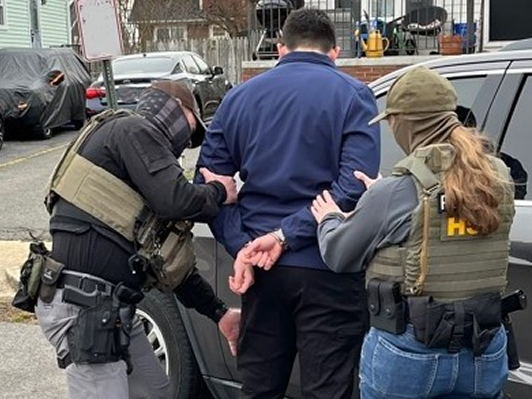
At 4:12 a.m., ICE and FBI vehicles rolled silently into position.
Cole stood at the threshold as breachers placed charges.
“Once we’re inside,” Morales said quietly, “everything changes.”
The door exploded inward.
What they found wasn’t chaos.
It was order.
Documents cataloged by date. Phones stored in signal-blocking cases. Ledgers written in code so elegant it took analysts weeks to decode. $155,000 in cash — not bundled, not hidden — stacked openly on a desk like a dare.
Cruz sat at the kitchen table, hands folded, coffee still warm.
“You’re early,” he said calmly.
Cole felt a chill crawl up his spine.
Men who expected arrest panicked. Men who didn’t… smiled.
Part V — The First Twist
Cruz didn’t deny anything.
He didn’t confess either.
Instead, he asked for one thing: a federal integrity officer to be present before he spoke.
Morales laughed. “You don’t get to make requests.”
Cruz looked at Cole — not Morales.
“You should already know,” Cruz said softly. “This house wasn’t protecting me.”
Cole frowned. “Then what was it doing?”
Cruz leaned back. “Filtering you.”
Hours later, while Cruz was processed, analysts uncovered a hidden parтιтion on one of the seized devices.
Inside were not cartel contacts.
They were internal federal communications.
Redacted memos. Surveillance schedules. Task force rosters.
Including names that weren’t supposed to exist outside classified systems.
Including Ethan Cole’s.
Part VI — The Leak
Internal Affairs descended within forty-eight hours.
Not to arrest Cruz.
To interview Cole.
Someone had flagged him as a potential exposure risk.
His financials were audited. His phone cloned. His movements reconstructed. Old cases reopened.
Cole realized too late what Cruz meant.
The house hadn’t been a shield.
It had been a mirror.
Whoever was leaking information wasn’t just protecting a cartel.
They were testing loyalty inside the federal system.
And Cole was now part of that test.
Part VII — The Second Twist
The corrupt federal employee wasn’t who everyone expected.
Not a low-level analyst. Not a border officer.
It was someone tied to case oversight — someone whose job was to ensure investigations stayed “within scope.”
Someone who signed off on Cole’s warrants.
Someone who now had the power to bury him.
When Cole confronted Morales, her expression told him everything.
“You already know, don’t you?” she asked.
“I know enough to be scared,” Cole said.
Morales hesitated. Then whispered, “This goes higher than one person. And Cruz isn’t the top.”
Part VIII — The Ending That Isn’t One
Cruz was transferred to a black-site holding facility before formal charges were filed.
The evidence room on Alder Street was sealed under national security review.
Cole was placed on administrative leave — not accused, not cleared.
Just… paused.
Before Cruz disappeared, he left one message for Cole, pᴀssed through a public defender who never asked questions.
You broke into the wrong house first.
The real door hasn’t been opened yet.
And when it is — they won’t come with badges.
Cole stood alone in his apartment that night, staring at the city lights, realizing the truth too late:
This case was never about drugs.
It was about who controls the system meant to stop them.
And somewhere above him, someone was already preparing to erase the next piece of the puzzle.


