Between Faith and History: The Story Fueling Talk of a “Forbidden” Text
High in the rugged highlands of Ethiopia, where monasteries cling to cliffs and centuries-old chants echo through stone corridors, stories endure with a life of their own.

Among the most intriguing is a tale whispered in documentaries, travel journals, and online forums alike: that monks once safeguarded an ancient manuscript connected in legend to Jesus, a text some claim authorities long ago ordered destroyed.
Historians caution that the narrative blends faith, folklore, and fragmentary history — yet its persistence speaks to humanity’s deep fascination with lost knowledge.
Ethiopia’s Christian tradition is among the oldest in the world, with roots stretching back to late antiquity.
Monastic communities developed not only as spiritual centers but also as guardians of manuscripts.
In an era when books were copied by hand on parchment, monasteries functioned as libraries, preserving theological works, liturgical texts, and local histories.

Many of these writings never traveled far beyond their regions, creating a rich but sometimes little-known literary heritage.
Within that context, it is easy to see how stories of “hidden” or “forbidden” texts arise.
Ancient libraries were vulnerable to war, climate, and political shifts.
Some works were lost; others survived in single copies tucked away in remote places.
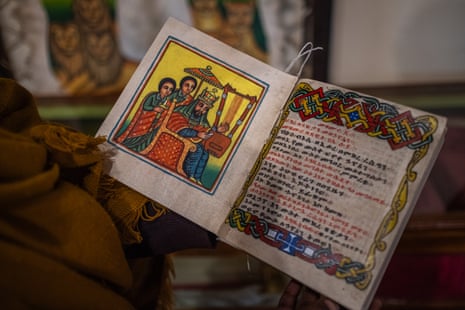
Over time, the boundary between documented preservation and legend can blur, especially when oral storytelling intertwines with written tradition.
Scholars who specialize in Ethiopian Christianity note that the country possesses a unique biblical canon and apocryphal literature, some of which differs from Western traditions.
That diversity has fueled speculation that unknown texts might still exist.
However, academic experts emphasize that extraordinary claims require strong evidence — verifiable manuscripts, dating analysis, and clear provenance.
So far, widely circulated stories about a singular, suppressed manuscript tied directly to Jesus remain in the realm of legend rather than documented discovery.
Yet legends matter.
They reveal how communities understand their past and their role as custodians of faith.
In many monastic narratives, the act of guarding texts symbolizes spiritual responsibility rather than literal secrecy.
Stories of protection against destruction can reflect historical experiences of invasion or upheaval, encoded in symbolic form.
The modern fascination with such tales also reflects broader cultural currents.
Audiences raised on historical thrillers and archaeological mysteries are primed to imagine hidden archives waiting to be uncovered.
Social media accelerates the spread of these ideas, often blending scholarship with speculation.
A single pH๏τograph of an aged manuscript or a monastery perched on a mountain can spark waves of interpretation.
Researchers stress the importance of respectful engagement.
Ethiopian monastic libraries are not relics of a forgotten past but living parts of religious communities.
Efforts to catalog and digitize manuscripts have grown in recent decades, often in partnership with local clergy, balancing preservation with cultural sensitivity.
The story of a “forbidden” manuscript, then, becomes less about a single document and more about the enduring power of narrative.
It invites questions about how history is preserved, who decides what is canonical, and how memory travels across generations.
Whether the specific legend proves factual or symbolic, it draws attention to a remarkable heritage of scholarship and devotion.
For visitors who make the journey to Ethiopia’s highland monasteries, the experience can feel like stepping into another era.
Stone walls bear the marks of centuries.
Shelves hold volumes copied long before the printing press.
In such settings, it is easy to sense how myths take root — and why they endure.
Ultimately, the tale reminds us that history is not only a record of events but also a tapestry of meaning woven by communities over time.
Between faith and documentation lies a space where imagination and idenтιтy meet.
It is there, perhaps, that the legend of the hidden manuscript continues to live.


