What you are about to hear happened on the night of Christmas 2024. A skeptical police officer, an unexpected discovery, and a transformation that no one could believe. This is the story of a miracle of the Virgin Mary that no one expected.
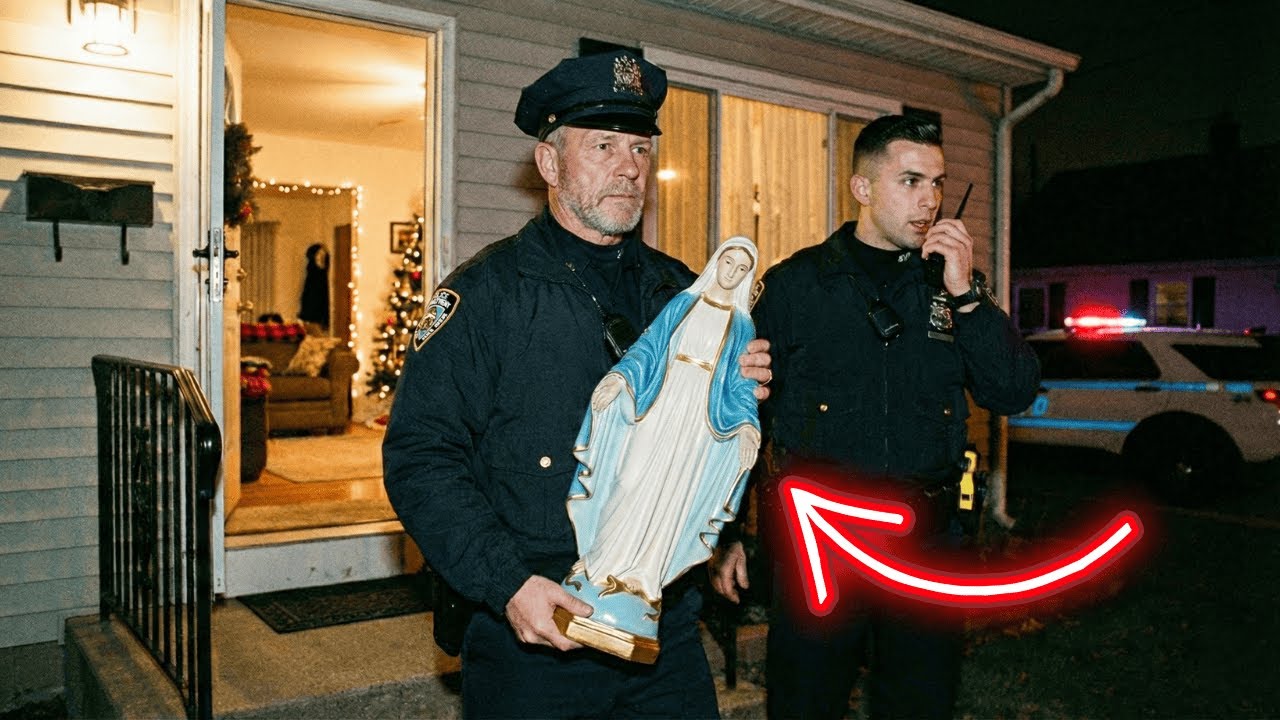
Tom Bennett was 47 years old and had nearly two decades on the Phoenix Police Force. You know that officer everyone respects, the one who doesn’t need to shout to be heard, who resolves tense situations with calm and authority. Tom was that officer, tall, broad-shouldered, hair starting to turn gray at the temples, the face of someone who had seen things most people only see in movies. But in his eyes, there was still something rare. Genuine attention. The feeling that when you spoke, he truly listened.
He worked the night shift. He liked the city when it was quieter. When the street lights cast those orange circles onto empty streets when the only people awake were the ones who needed to be, night workers, police officers, nurses, and people in trouble. Tom was not religious. He had been raised in a Catholic family, but he himself never felt that connection. He thought it was beautiful. He respected it, but it wasn’t for him.
“I believe in what I can see,” he used to say.
But December 24th, 2024 was about to challenge all of that.
It was 10:37 p.m. when the call came in. Tom was on routine patrol through a residential district. Those neighborhoods where houses have porches with rocking chairs and well-kept gardens where people leave Christmas lights blinking even after they’ve gone to sleep. The dispatcher’s voice came through the radio.
“We have a report of a domestic disturbance, neighbors reporting screaming and the sound of objects being broken.”
Tom picked up the radio.
“On my way.”
He knew that address. He had been there twice in the past six months. The Morrison couple, him in his 50s, her about 10 years younger. Always the same story. He drank, she screamed, neighbors called. Tom arrived, calmed everyone down. They promised it wouldn’t happen again. And it happened again.
Christmas. You would think that on Christmas people could hold themselves together a little better. But he had enough experience to know that holidays sometimes make things worse. Expectations, memories, families forced to be together when they can barely tolerate each other. When he pulled up in front of the house, he could hear the shouting from inside the car. Mrs. Morrison’s shrill voice cut through the cold night.
“You promised. You promised that this time it would be different.”
Tom turned off the patrol car and stepped out. The air was freezing. Phoenix doesn’t usually get that cold, but that night was particularly cold by the city’s standards. His breath formed white clouds as he breathed. He walked up to the front door. The house’s Christmas lights blinked red and green, those old lights that get warm to the touch. A Christmas wreath hung on the door, slightly crooked, as if it had been put up in a hurry. Tom knocked. Three firm knocks. The shouting stopped abruptly. Silence. He knocked again.
“Police. Mr. and Mrs. Morrison, I need you to open the door.”
Footsteps. The door opened, revealing Mrs. Morrison, disheveled blonde hair, holding a dish towel in her hands.
“Officer Bennett,” she said, and there was exhaustion in her voice. Not surprise, not embarrᴀssment, just deep exhaustion. “I’m sorry. The neighbors called again.”
“May I come in?”
She opened the door wider. Tom stepped inside. The house smelled of roasted turkey and spilled beer. In the living room, Mr. Morrison was sitting on the couch, his head in his hands. Three empty bottles sat on the coffee table. Have you ever been in a situation where you can actually feel sadness in the air? Tom had felt that,
“Mr. Morrison,” Tom said calmly. “Look at me,”
the man lifted his head, red eyes. He wasn’t drunk.
“I know,” he said before Tom could speak. “I know I messed everything up again.”
Tom pulled over a chair and sat down, bringing himself to the man’s level.
“Tell me what happened.”
And so began the same conversation Tom had already had hundreds of times. Mr. Morrison had lost his job in September. He was looking, but Phoenix was tough. The bills were overdue. The stress was destroying him. He just wanted to He just needed Tom listened because sometimes that’s what people need. Not advice, not lectures, just someone who listens without judging. 40 minutes later, the situation was resolved. Mr. Morrison promised to go to sleep. Mrs. Morrison promised not to yell anymore. Tom knew he would probably be back there in a few weeks, but for today it was settled.
He stepped out the front door, the cold air hitting his face like a slap. That’s when he saw it. On the sidewalk about 3 meters from the Morrison’s house, there were three trash cans lined up. It was Christmas Eve. The truck wouldn’t come tomorrow. The cans would stay there until December 26th. But that wasn’t what caught his attention. It was the glow, a soft blue glow coming from inside one of the cans.
Tom stopped, looked around. The street was empty, silent, only the distant sound of Christmas music coming from some house played on an out of tune piano. He walked up to the trash can, looked inside, and there it was, a statue of the Virgin Mary. It wasn’t large, maybe about 50 cm, but it was beautiful, detailed in a way you don’t see in ordinary statues. The Virgin Mary’s face was serene, eyes lowered, hands extended. And the mantle, the mantle was a deep blue that seemed to capture the light from the street lamps and turn it into something more, something that glowed softly.
Tom stood there just staring. Have you ever had that moment when something catches your attention and you don’t know exactly why? when you know you should keep moving, but something makes you stop. Tom had that moment. He reached out and picked up the statue. It was cold. Obviously, it had been in the trash on a freezing night, but it was heavy, solid, well-made. Tom turned the statue over in his hands, examining it. There were no signs of damage. It wasn’t broken. Why would someone throw this away?
And then he thought of his mother. Margaret Bennett was 68 years old and had been devoted to the Virgin Mary for as long as Tom could remember. Her porcelain statue of the Virgin Mary that had sat in the living room for decades had broken last month, falling off the shelf during cleaning. Margaret was devastated. That image had belonged to her grandmother, had been in the family for more than 60 years. Her faith was the most important thing in her life, more important than anything material. And his younger sister, Lisa. Lisa, who was Tom closed his eyes for a moment, the statue of the Virgin Mary still in his hands. No, he wasn’t going to think about that now. Not in the middle of his shift.
He looked at the statue again. His mother would love it. It would be a perfect gift for a Christmas lunch tomorrow. Tom walked to the patrol car and opened the back door. He carefully placed the statue on the seat, adjusting it so it wouldn’t fall if he had to break suddenly. He closed the door and stood there for a moment, looking through the window at the statue.
“What am I doing?” he murmured to himself.
The rest of the night pᴀssed in routine. Two more calls, one about loud music, resolved with a polite request. Another about a car parked in the wrong spot. The owner showed up and moved it. Nothing serious. At 6:47 a.m., Tom finally ended his shift. The sun was beginning to rise over Phoenix, painting the sky pink and orange. He drove home, a small apartment 20 minutes from the station. When he parked, he took the statue of the Virgin Mary from the back seat. In the morning light, it looked even more beautiful. The details of the face, the folds of the mantle, even the small stars carved into the base. Tom entered his apartment and placed the statue on the living room table. He kept looking at it as he took off his uniform.
“Trash,” he said out loud to the empty apartment. “Someone threw you in the trash.”
The statue obviously did not respond.
Tom slept for a few hours. that heavy sleep that comes after a night shift. He woke up at 11:30, showered, got dressed. He picked up the statue from the table, wrapped it carefully, and left. His mother’s house was 40 minutes away by car in the light Christmas Day traffic, a small but well-kept house with a front garden where his mother grew geraniums. When Tom arrived, there was already a car in the driveway. His older brother, James, had arrived with his wife and their two children and Lisa’s car. Tom sat in the car for an extra moment, looking at the house. He could hear children laughing inside. Music life. He picked up the wrapped statue and got out of the car.
The front door opened before he could knock. His mother, Margaret, was there with a flower-covered apron and a huge smile on her face.
“Tom, you came.”
She hugged him тιԍнтly.
“Of course I came, Mom. I always do.”
“I know. I know. But you worked all night. I thought you might be very tired.”
She looked at the bundle in his hands.
“What’s that?”
“A gift for you.”
Her eyes lit up.
“Oh, Tom, you didn’t have to.”
But she was already taking the package, opening it carefully. When she saw the statue of the Virgin Mary, she went completely silent.
“Tom,” she whispered. “She is. She is beautiful.”
“I found it last night. Someone had thrown it away. I thought you’d like it.”
Margaret held the statue as if it were the most precious object in the world. Her eyes, Tom could swear, were wet.
“It’s the most beautiful Virgin Mary I’ve ever seen. Look at the details. Look at her face.”
She gently touched the blue mantle.
“Where did you say you found it?”
“In the trash on a call, I responded to.”
Margaret shook her head as if she couldn’t understand.
“People don’t know the value of things, throwing something so sacred in the garbage.”
She looked at Tom.
“Thank you, my son. This means so much to me.”
She kissed him on the forehead, something she had done since he was a child, and went inside with the statue, calling out, “James, Lisa, come see what Tom brought.”
Tom followed his mother inside. The house smelled the way it always was smelled at Christmas. Roasted turkey, potatoes, that spice filled aroma his mother used in everything. The Christmas tree stood in the corner of the living room, lights blinking, presents underneath. James was in the kitchen helping with the food. He greeted Tom with a firm handshake. Tom’s nieces and nephews, Kevin, 8 years old, and Emma, six, ran over to hug him. He picked them up, one in each arm, making them laugh.
And then Tom saw Lisa. She was sitting on the living room sofa, a blanket over her legs, even with the heat on. She was 31 years old, but looked older. Her hair, once black and shiny, was now dull, tied back in a loose ponytail. Her face, once full and rosy, was thinner. But when she saw Tom, she smiled. And in that smile, he saw the little sister who used to follow him everywhere when they were kids. The girl who wanted to be a police officer just like her older brother, who laughed too loudly and dreamed too big.
“Hi, Tom,” she said, and her voice was weaker than Tom remembered from two weeks ago.
He set the children down and went to her, sitting beside her.
“Hi, Lee. How are you?”
“Fine,” she said, and they both knew it was a lie, but it was the necessary lie, the lie that allowed the family to keep functioning.
Lisa had amotrophic lateral sclerosis, ALS. The doctors had diagnosed it 18 months earlier. At first, it was just small muscle weaknesses, trouble holding cups, tripping a little more than usual, but ALS is progressive. It doesn’t stop. It doesn’t get better. It only gets worse. Now Lisa had trouble walking. She needed a cane on good days, a wheelchair on bad days. Her speech was beginning to be affected. Words that took a second longer to form. The doctors gave her 2 to 5 years, maybe less. And there was no cure, no treatment that reversed it, just things to ease the symptoms, to prolong the inevitable. Tom had researched everything, read every article, consulted every specialist he could get in touch with because that was how he worked. When there was a problem, he looked for solutions. But for the first time in his life, there was no solution.
Margaret came into the living room holding the statue with reverence.
“Look what Tom brought. Isn’t it the most beautiful thing?”
Lisa looked at the statue and something changed in her face. Her eyes, which had been tired and distant, suddenly focused with intensity.
“Mom,” she said softly, “May I may I hold it?”
“Of course, sweetheart.”
Margaret carefully placed the statue of the Virgin Mary in Lisa’s lap.
And it was at that moment that something strange happened. Lisa touched the blue mantle of the statue, her fingers tracing the carved folds. Then she closed her eyes.
“Lisa?” Margaret asked, worried. “Are you okay?”
But Lisa didn’t answer right away. She simply held the statue, eyes closed, breathing slowly. Tom watched, curious. His sister looked at peace in a way he hadn’t seen in months. After what felt like a long time, but was probably only 30 seconds, Lisa opened her eyes.
“Can I keep her?” she asked, looking first at Tom, then at Margaret. “I know it’s your gift, Mom, but u”
Margaret looked at Tom. He nodded slightly.
“Of course you can, sweetheart,” Margaret said gently, touching Lisa’s hair. “She’s yours,”
Lisa hugged the statue of the Virgin Mary against her chest.
“Thank you.”
Christmas lunch was like it always was in the Bennett family. loud, full of food with children running between the adults while James told stories from work. And Margaret kept serving more and more food, even when everyone was already full. But Tom couldn’t stop looking at Lisa. She had placed the statue on the table beside her, where she could see it. From time to time, she reached out and touched the blue mantle as if she needed to make sure it was still there.
“Are you okay?” Tom asked quietly when the others were distracted watching TV.
Lisa looked at him then at the statue.
“You’re going to think it’s strange.”
“Try me.”
“When I held her, I felt something like warmth. I don’t know how to explain it, but it was as if someone had put a hand on my shoulder and said, ‘Everything is going to be okay.’”
Tom didn’t know what to say. part of him, the logical part, the police officer part, wanted to say it was just imagination, psychological comfort. But another part, a part he didn’t know existed, wondered.
“If she makes you feel better,” he finally said, “Then I’m glad you kept her.”
Lisa smiled.
“Thank you for finding her, for giving her to me.”
When Tom left that night, it was already past 8:00 p.m. He hugged everyone, kissed his mother, and held Lisa for an extra moment.
“I love you, Lee,” he whispered.
“I love you, too, bro.”
On the way home, Tom turned on the radio. Christmas music was still playing on every station. He switched to a news station, preferring to listen to traffic and weather. But his mind kept going back to that moment. Lisa holding the statue of the Virgin Mary, eyes closed, that expression of peace.
“It was just imagination,” he said out loud to himself in the empty car.
But even as he said it, he didn’t fully believe it.
3 days pᴀssed. Tom worked his normal shifts, existed within the routine he had built for himself over the years. It was on the morning of December 28th that his phone rang. He was drinking coffee, still in his pajamas, when he saw his mother’s name on the screen.
“Hi, Mom.”
“Tom.” There was something in her voice. Fear. He couldn’t quite identify it. “You need to come here now.”
His heart sped up.
“What happened? Is it Lisa?”
“Just come, please.”
She hung up before he could ask anything else.
Tom got dressed in record time, grabbed his keys, and drove. His mind raced with possibilities. Lisa had gotten worse. She had fallen. She had when he arrived at his mother’s house. Tom practically ran to the door. Margaret opened it before he could knock.
“Mom, what?”
But she just grabbed his hand and pulled him inside. Lisa was in the living room standing. No cane, no support, just standing for a few seconds. And she was smiling.
“Hi, Tom,” she said, and her voice her voice was a little better.
Tom froze in the doorway.
“Lisa, you you’re standing.”
He looked at his mother, then back at Lisa.
“How? What happened?”
“I don’t know,” Lisa said, and there were tears in her eyes now. Tears of joy mixed with confusion. “I woke up this morning and I was better. My legs were stronger. I managed to stand up on my own for the first time in months.”
“That’s not possible,” Tom said automatically. “MS doesn’t It doesn’t work like that. It doesn’t get better.”
“I know.” Lisa was sitting down now. “I know it doesn’t make sense, but look at me, Tom. Look.”
He looked. And he had to admit, she looked different. Her face had more color. Her eyes were clearer. There was an energy in her that hadn’t been there for more than a year.
Margaret spoke behind him.
“It’s the Virgin Mary.”
Tom turned around.
“Mom, it”
is, she insisted, her voice firm. “Since Lisa kept that statue of the Virgin Mary, she’s been improving a little every day. At first, I thought it was my imagination. But u,”
Lisa interrupted.
Tom sat heavily on the couch, his police mind trying to process information that made no logical sense.
“You need to take her to the doctor,” he finally said. “run tests, find out what’s happening.”
“I already called,” Lisa said. “I have an appointment tomorrow.”
That night, Tom couldn’t sleep. He lay awake in the dark of his apartment, staring at the ceiling, trying to understand. He had seen his sister standing for a few seconds, speaking better. Coincidence?
He whispered into the darkness. “It has to be coincidence or a misdiagnosis or”
but he couldn’t finish the sentence because deep down in that place he rarely accessed that place where logic and reason couldn’t reach. He wondered what if it wasn’t coincidence.
On the day of Lisa’s appointment, Tom took time off and went with her and Margaret. They sat in Dr. Anderson’s waiting room while Lisa underwent the examination. 2 hours later, Dr. Anderson called them into his office. He was a man in his early 60s, hair completely white, thin-framed glᴀsses. He had that look of a doctor who had seen many things. Professional but human.
Dr. Anderson remained silent, staring at the screen for a few seconds longer than usual.
“Ms. Bennett. This doesn’t make sense,” he said finally.
Tom frowned.
“What do you mean?”
The doctor turned the monitor toward them.
“These are the tests from a few weeks ago. They showed a clear worsening, exactly what we expected to see.”
He switched to the most recent results.
“And these are today’s tests.”
Margaret held her breath.
“What changed?”
“The progression that should be here isn’t,” he replied. “The results don’t indicate advancement of the disease. In some areas, they show more stability than I would expect at this stage.”
Lisa felt her heart race.
“So, I’m getting better.”
Dr. Anderson hesitated.
“Clinically, you are more stabilized than you should be. And honestly, I don’t know how to explain it.”
On the way back, sitting in Tom’s car, no one spoke for several minutes. It was Lisa who broke the silence.
“It’s the Virgin Mary.”
Tom kept his eyes on the road.
“Lisa, I know how it sounds. Believe me, I do. But Tom,” she turned in her seat to look at him. “I was dying. The doctors gave me only a few years, and suddenly, just a few days after receiving that statue, “I’m improving in a way the doctor can’t explain.”
Margaret, in the back seat, spoke softly.
“Miracles happen, Tom. You may not believe, but they do happen.”
Tom тιԍнтened his grip on the steering wheel. Part of him, the part that had built his entire life on facts and logic, wanted to argue, wanted to insist there had to be a rational explanation. But another part, that small but growing part, remembered finding the statue of the Virgin Mary in the trash, the blue glow of the mantle, the feeling that he had to pick it up. The look of peace on Lisa’s face when she held it for the first time.
One week pᴀssed, then two. Each day, Lisa improved a little more. By early January, she could take a few steps. Her speech was much better. The weakness that had dominated her body for 18 months was going away. Tom visited almost every day now, part of him still searching for signs that this was temporary, that the illness would return.
It was on a Saturday afternoon, the second week of January, that the moment happened. The one that would change Tom forever. He was at his mother’s house. Lisa was in the kitchen helping Margaret prepare dinner, something she hadn’t been able to do for over a year. Tom could hear their laughter, the music playing on the radio, the sound of pots and pans. He was alone in the living room looking at the statue. Margaret had placed the Virgin Mary in a place of honor, a small table beside the window where the afternoon light illuminated the blue mantle.
Tom approached. He stood there just looking.
“I don’t understand you,” he said quietly. “I don’t know if you’re special. I don’t know if what’s happening to Lisa is because of you or coincidence or something science will eventually explain.”
He touched the blue mantle, his fingers tracing the same folds. Lisa had traced on Christmas.
“But if you if she” he paused, feeling ridiculous, speaking to a statue, “if the Virgin Mary is really here somehow, thank you. Thank you for my sister.”
And it was at that moment that it happened. The perfume, soft at first, then stronger. Roses, fresh roses, as if someone had just picked a bouquet and placed it beside him. But there were no roses in the house. Margaret had geraniums but no roses and this scent it was impossible to ignore. Real filling the room. Tom stepped back, his heart beating faster.
“Mom,” he called, but his voice came out weak.
The perfume grew stronger for a few seconds. Then, as gradually as it had come, it began to fade. After a minute, it had disappeared completely.
Tom stood there trembling slightly, staring at the statue. The eyes of the Virgin Mary, those painted eyes he had now seen hundreds of times, seemed to look directly at him, not with judgment, not with expectation, with compᴀssion.
“Tom,” Lisa was standing in the kitchen doorway, drying her hands on a towel. “Are you okay? You look pale.”
He looked at her, his sister he had been losing, and who now stood there alive and well.
“Lisa,” he said, his voice breaking. “I smelled roses.”
She walked slowly toward him, understanding immediately.
“I smelled them, too. That first morning when I woke up feeling better. The room was filled with that fragrance. As”
“But that’s not possible,” Tom.
She took his hand.
“Not everything has to be possible to be real.”
That night, Tom drove home in a state of deep contemplation. Everything he had built his life on, logic, reason, provable facts, was being challenged by something he could not explain but could not deny. He had smelled that perfume as real as anything he had ever experienced. And his sister was improving from an illness that had no cure.
When he arrived at his apartment, Tom did something he hadn’t done since childhood. He knelt beside the bed. He didn’t know exactly how to pray. He didn’t have the right words, the formal phrases his mother used. So, he just spoke from the heart.
“I don’t know if you’re listening. I don’t know if it works like this, but thank you, Virgin Mary, for Lisa, for making me find that statue. For” He paused, searching for the words. “for showing me that maybe the world is bigger than I thought.”
There was no answer, no scent of roses this time, no celestial sign. But Tom felt something he hadn’t felt in years. Peace.
February arrived. Lisa continued to improve. The doctors remained baffled. It was the last Friday of February when Tom made his final night patrol down that same street. almost exactly two months since that Christmas night. He pᴀssed the Morrison’s house. The lights were on. Through the window, he could see the couple sitting at the dinner table talking calmly. There were no shouts. There were no bottles. Tom smiled softly. Small victories.
When he pᴀssed the trash cans on the sidewalk, the same ones where he had found the statue, he stopped the patrol car. He looked at the spot, remembering that night, the blue glow, the feeling that he had to pick up that statue.
“Thank you,” he said quietly.
The following Sunday, the Bennett family gathered again. But this time, it wasn’t a holiday. It was just a regular Sunday lunch. Except there was nothing regular about it. Lisa ran awkwardly toward Tom when he arrived. Actually ran the way she had when she was a child. She hugged him тιԍнтly.
“Guess what?” she said, beaming.
“What? Dr. Anderson did more tests this week.”
“Normal, Tom. As if I had never had ALS.”
Margaret came out of the house smiling as well.
“Isn’t it wonderful?”
James arrived shortly after with his family. The children ran off to play in the yard. The adults sat on the porch drinking lemonade and talking about ordinary things, work, school, plans for the summer. Ordinary things that two months earlier had seemed impossible.
At one point Tom found himself alone in the living room, looking at the statue of the Virgin Mary on his place of honor. He touched the blue mantle once more.
“Maybe believing isn’t about certainty. Maybe it’s about being open to mystery,” he said softly. He heard Lisa’s laughter in the yard, loud, genuine, full of life.
“Thank you,” Tom whispered. “Thank you for giving my sister back.”
And in that moment, with the afternoon light illuminating the blue mantle of the statue of the Virgin Mary, Tom Bennett finally accepted that perhaps there were things in the universe greater than logic and reason, things like faith, like hope, like miracles.
The blue mantle shimmered softly in the sunlight. And if you asked Tom whether that glow was just a reflection or something more, he would have said it didn’t matter because his sister was alive. His family was reunited. And he had learned that sometimes the greatest miracle is not understanding, it is accepting.


