Alcatraz has long existed as more than stone walls and cold tides.
Rising from the fog of San Francisco Bay, the island has endured as one of the most enduring symbols of American incarceration.
For generations, it represented the final answer to defiance, a place where escape was believed to be impossible and survival itself was a test of will.
Yet more than sixty years after its most infamous night, Alcatraz remains a living riddle.
In recent years, new scientific analysis, resurfaced evidence, and renewed federal interest have reopened a question once thought settled.
Did the men who vanished in 1962 truly perish in the bay, or did they succeed in doing what history said could not be done.

Alcatraz Federal Penitentiary began its life as a military installation in the eighteen fifties before being transformed into a federal prison in 1934.
Isolated by more than a mile of open water, the island was chosen not only for its distance from shore but for the psychological impact of its location.
The prison was operated by the Federal Bureau of Prisons and intended to hold inmates considered uncontrollable elsewhere.
It was not designed for rehabilitation.
Its mission was discipline, deterrence, and total containment.
The prison complex itself was an engineering statement.
The main cellhouse contained four cell blocks, administrative offices, a dining hall, a hospital, and a small library.
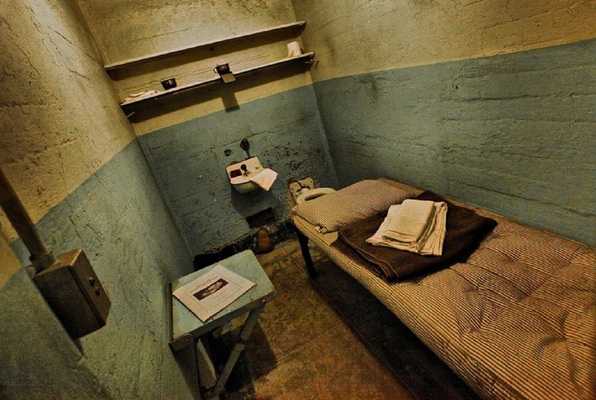
Cells were narrow, built from reinforced steel, and stripped of comfort.
Inmates were counted repeatedly each day, while guards maintained constant visual surveillance from elevated positions.
Privileges were rare and conditional.
Silence during meals was enforced, and isolation in the disciplinary block known as D Block was feared throughout the population.
Though the prison could hold over three hundred inmates, it rarely reached capacity.
During its twenty nine years of operation, Alcatraz housed some of the most notorious criminals in the nation.
Names like Al Capone and George Kelly contributed to its reputation, but it was the belief that no one could escape that elevated Alcatraz into legend.
Fourteen escape attempts were officially recorded.
Most ended in capture, injury, or death.
Those who disappeared into the water were presumed drowned.
The bay itself was considered the ultimate barrier, with freezing temperatures and unpredictable currents.
That certainty fractured on the night of June 11, 1962.
Frank Morris and brothers John and Clarence Anglin vanished from their cells without triggering alarms.
By morning, the prison staff discovered an absence that could not be explained.
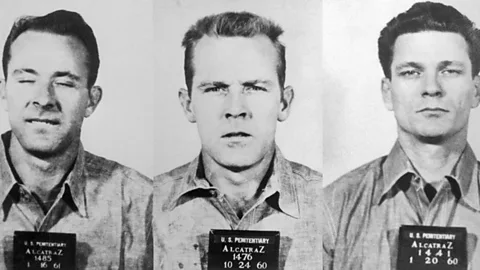
The escape shook the foundation of the Alcatraz myth and introduced a mystery that has never been fully resolved.
Frank Morris was the architect of the escape.
Raised in instability and insтιтutional care, he developed both resilience and exceptional intelligence.
His criminal record included repeated prison escapes, which ultimately led to his transfer to Alcatraz in 1960.
From the moment of arrival, Morris studied the structure, routines, and weaknesses of the prison.
He was housed near the Anglin brothers and Allen West, inmates he already knew from previous facilities.
Their proximity allowed quiet communication during night hours.
Together, the men identified a structural flaw behind the ventilation grilles beneath their sinks.
Decades of salt air had weakened the concrete.
Using stolen metal spoons, discarded saw blades, and a homemade drill fashioned from a vacuum motor, they slowly carved openings large enough to pᴀss through.
To avoid detection, they created false vent covers from cardboard and papier mache, painted to match the walls.
Noise from drilling was concealed during music hour, when Morris played an accordion.
Beyond the cell walls lay an unused service corridor and an upper level of the cellhouse that was unguarded.
There, the men built a hidden workshop.
Over several months, they constructed a raft and life vests using more than fifty raincoats stolen from prison supplies.
The rubber material was sealed using steam pipes, and a musical instrument was converted into an air pump.
Wooden paddles were ᴀssembled from scrap material.
Every step of the plan reflected precision and patience.
One of the most effective elements of the escape was deception.
The men crafted lifelike dummy heads using soap, toothpaste, toilet paper, and real human hair collected from the barbershop.
These were placed on pillows beneath blankets, giving the appearance of sleeping inmates.
During night counts, guards conducted visual checks only.
The illusion held until morning.
Allen West was unable to complete his escape tunnel in time and was left behind.
When the absence was discovered, he cooperated with investigators and provided detailed information about the plan.
His testimony formed the basis of the initial search, which focused on Angel Island as the intended destination.
Physical evidence surfaced in the days following the escape.
A paddle fragment and a sealed bundle of personal items belonging to the Anglin brothers were recovered from the bay.
Later, pieces of the raft and a life vest were found near the Golden Gate Bridge.
No bodies were ever recovered.
In 1979, the case was closed by the Federal Bureau of Investigation, and the men were declared legally ᴅᴇᴀᴅ.
However, the story did not end there.
Family members of the Anglin brothers reported receiving holiday cards years after the escape.
A pH๏τograph taken in South America in the mid nineteen seventies appeared to show the brothers alive.
In 2013, a letter sent to authorities claimed that all three men survived the escape and lived in hiding for decades.
Though forensic testing could not confirm its authenticity, the letter was credible enough to prompt renewed examination.
Scientific advances further complicated the narrative.
In 2014, researchers used computer modeling to reconstruct tidal conditions on the night of the escape.
Their findings suggested that if the raft had launched during a narrow window near midnight, currents could have carried it toward land rather than out to sea.
This contradicted earlier ᴀssumptions and demonstrated that survival was physically possible under precise conditions.
The United States Marshals Service ᴀssumed responsibility for the case and has continued to treat it as open.
In 2022, updated age progression images of Morris and the Anglin brothers were released, accompanied by public requests for information.
Officials acknowledged that while death remains a possibility, the absence of definitive proof leaves room for uncertainty.
Today, Alcatraz stands as a museum managed by the National Park Service, drawing more than a million visitors each year.
Its cellhouse, corridors, and workshops have been preserved as reminders of a time when control was absolute and escape was unthinkable.
Yet the events of 1962 transformed the island into something else.
It became a question mark etched into stone.
The enduring fascination with the escape reflects a broader cultural tension between authority and ingenuity.
The idea that individuals could exploit overlooked weaknesses in a rigid system continues to resonate.
Whether Morris and the Anglin brothers died in the bay or disappeared into ordinary lives remains unknown.
What is certain is that their escape altered the legacy of Alcatraz forever.
More than six decades later, the fog still rolls across the island, and the water still moves in powerful, unseen currents.
Beneath the silence, the question remains unresolved.
Alcatraz was built to end stories, but instead it created one that refuses to close.


