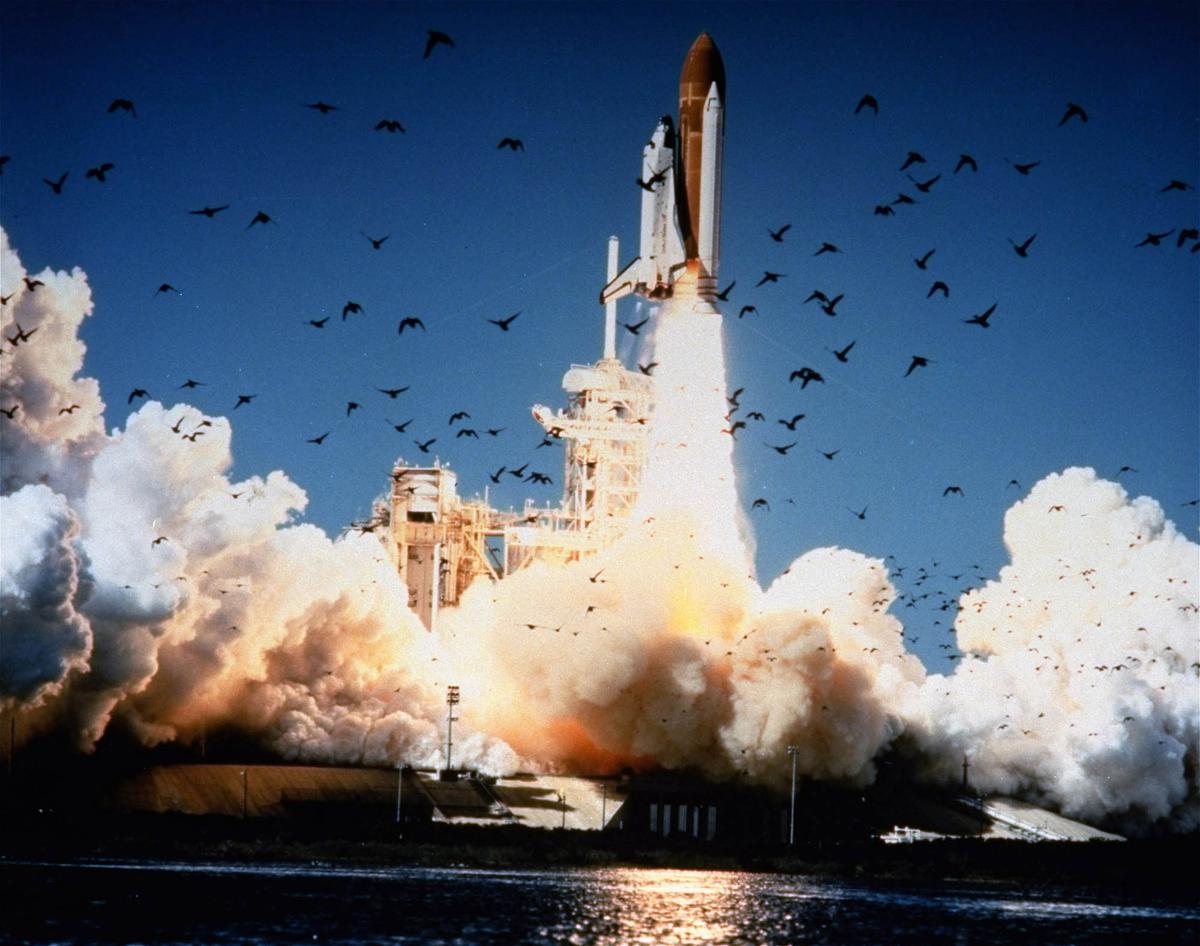
At 11:38 a.m.on January 28, 1986, the familiar countdown ended and Space Shuttle Challenger rose from Launch Complex 39B at Kennedy Space Center.
The mission, designated STS 51 L, was the twenty fifth flight of the shuttle program.
For just over one minute, the ascent appeared flawless.
Then, seventy three seconds after liftoff, a flash erupted near the right solid rocket booster.
A mᴀssive plume of fire and smoke filled the sky.
The orbiter disintegrated before a national television audience, leaving a stunned country struggling to comprehend what had just happened.
In the mid 1980s, the shuttle program symbolized technological confidence.
The reusable orbiters were designed to carry satellites, scientific laboratories, and astronauts into orbit before gliding back to Earth.
Challenger had already completed nine missions and was regarded as dependable.
The STS 51 L mission carried added significance because it included Christa McAuliffe, a high school teacher selected through the Teacher in Space initiative.
Her participation transformed the launch into a shared national moment.

Schools across the United States organized live viewings, and students watched as if their own classroom were traveling into orbit.
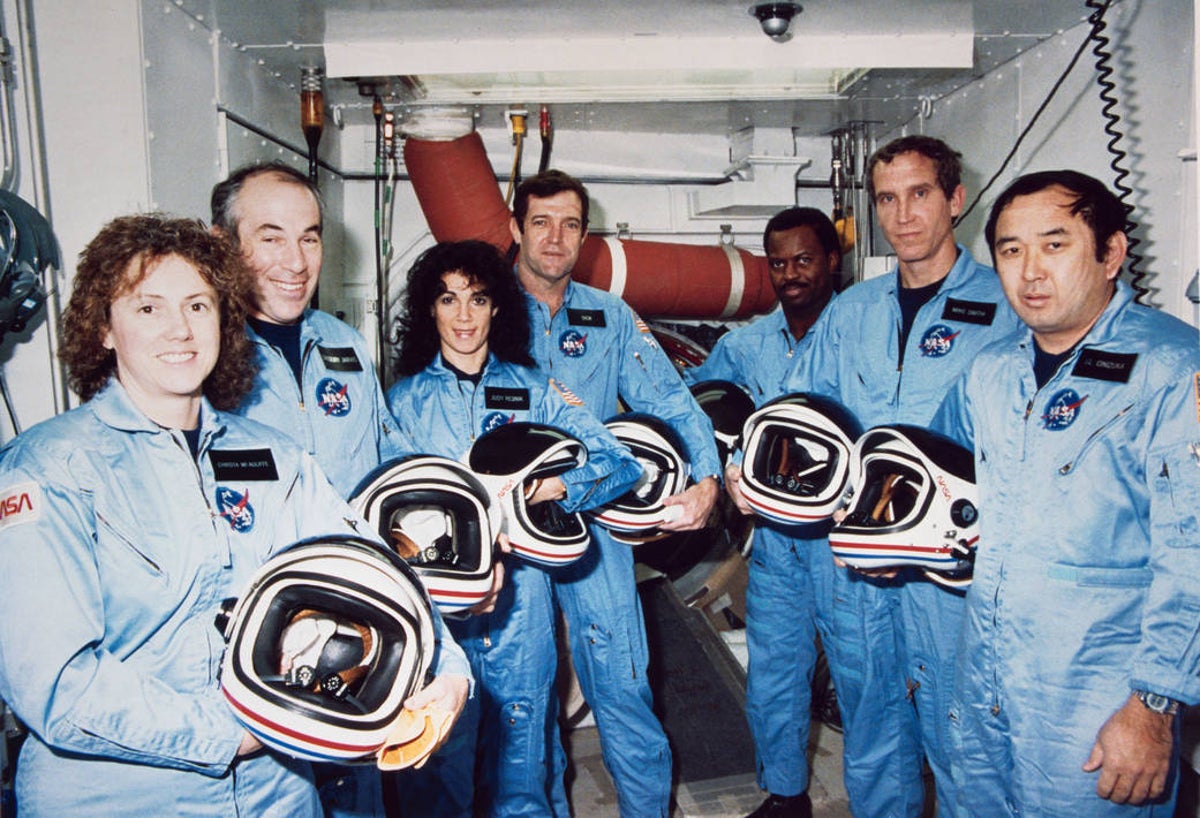
The crew also included Commander Francis Scobee, Pilot Michael Smith, Mission Specialists Ellison Onizuka, Judith Resnik, and Ronald McNair, along with Payload Specialist Gregory Jarvis.
Together they represented years of training and dedication.
Few spectators knew that engineers had raised concerns about unusually cold temperatures at the launch site.
Overnight readings had fallen close to freezing, far below typical Florida conditions.
The cold posed a potential risk to the rubber O ring seals in the solid rocket booster joints.
These seals were intended to prevent H๏τ combustion gases from escaping during ignition.
Despite the warnings, the decision was made to proceed.
When the shuttle cleared the tower, commentators described normal engine performance and stable velocity.
For seventy three seconds, everything appeared routine.
Then the vehicle vanished in a violent breakup.
Two white trails from the boosters twisted across the blue sky as debris rained toward the Atlantic Ocean.
In Mission Control, telemetry screens went blank.
Controllers maintained composure, but silence filled the room.
Within minutes, the United States Coast Guard and Navy initiated search operations.
Helicopters, cutters, and aircraft moved toward the impact zone.
Early reports described the effort as a rescue mission.
Teams searched for parachutes, rafts, or signals that might indicate survival.
From the air, pilots saw fragments scattered across miles of water.
Surface vessels navigated carefully through floating insulation and metal shards.
Divers prepared to enter cold waters as sonar units scanned the seabed for larger sections.
As hours pᴀssed without signals or beacons, the mission shifted from rescue to recovery.
The explosion had occurred at approximately 48,000 feet.
Debris fell across a vast area, complicating search patterns.
Marker buoys tracked currents while aircraft pH๏τographed drift patterns.
The National Oceanic and Atmospheric Administration analyzed tides to predict where heavier components might settle.
Each recovered fragment was tagged, pH๏τographed, and transported to Kennedy Space Center for examination.
Inside a sealed hangar, technicians laid out wreckage on a mᴀssive grid patterned after the orbiter blueprint.
The air carried the faint scent of saltwater and scorched material.
Engineers moved quietly, cataloging pieces and studying burn marks.
The reconstruction effort became one of the most detailed forensic investigations in aerospace history.
Patterns of damage pointed investigators toward the right solid rocket booster.
Burn scars aligned with the area where launch footage had shown the first abnormal flash.
Tests confirmed that the rubber O rings in the booster joint had stiffened in the cold.
When ignition occurred, the seals failed to seat properly.
A thin jet of flame escaped, eroding the joint and eventually breaching the external fuel tank.
The structural breakup that followed destroyed the shuttle.
The technical explanation provided clarity, yet one crucial component remained missing from the reconstruction grid: the crew compartment.
Weeks into the search, sonar aboard the Navy vessel USS Preserver detected a large object on the ocean floor about eighteen miles east of Cape Canaveral.
The shape was distinct and symmetrical, clearly man made.
Divers descended along weighted lines into dark, silt filled water.
Their lights eventually revealed curved metal and shattered window frames half buried in sand.
It was the crew cabin.
The recovery operation required patience and precision.
Divers secured cables around the fragile structure.
Cranes lifted the compartment slowly toward the surface.
When it emerged from the water, those on deck stood in silence.
The cabin was transported under тιԍнт security to Kennedy Space Center, where a restricted team began examination.
Investigators determined that the crew cabin had separated largely intact during the breakup.
It continued upward briefly before descending in a long arc, striking the ocean at more than 200 miles per hour.
Inside, evidence suggested that some systems had been activated after the explosion.
Switches for emergency air supplies had been turned on manually.
This indicated that at least part of the crew had been conscious for a short time during descent.
Biomedical experts later concluded that while the exact moment of de*th could not be pinpointed, the final impact forces were unquestionably fatal.
The handling of crew remains followed strict military and forensic protocols.
Identification relied on dental records and medical documentation.
Families were notified privately.
Remains that could not be separated were interred together at Arlington National Cemetery in May 1986 during a solemn ceremony attended by relatives and NASA officials.
The burial site became a symbol of unity and remembrance.
While recovery operations concluded, a national investigation began.
An independent panel known as the Rogers Commission examined both technical and managerial factors.
The commission confirmed that engineers from the contractor responsible for the boosters had expressed concern about launching in cold weather.
Data from previous missions showed increased O ring erosion at lower temperatures.
Despite these warnings, launch approval proceeded.
The commission report criticized communication breakdowns and decision making processes that discounted engineering concerns.
It emphasized that the disaster was not solely mechanical but also organizational.
Shuttle flights were suspended for more than two years.
During that period, engineers redesigned the booster joints, adding additional seals and heaters to maintain flexibility.
NASA restructured safety oversight, giving greater authority to technical experts and establishing clearer channels for dissenting opinions.
The Challenger tragedy reshaped NASA culture.
Meetings became more transparent, and safety protocols more stringent.
When shuttle flights resumed in 1988, the return to space carried a renewed sense of caution.
Astronaut crews honored the Challenger team before launch, reinforcing the lesson that exploration demands vigilance.
Beyond engineering reforms, the disaster left a profound imprint on public memory.
Christa McAuliffe dreamt of teaching from orbit, and her legacy inspired the creation of Challenger Learning Centers across the United States.
These centers offer students simulated mission experiences and emphasize science education.
The names of the seven crew members are engraved on memorials at Kennedy Space Center and Arlington National Cemetery.
Each January 28, NASA employees gather to remember them.
Over time, speculation and rumors surfaced.
Some questioned whether additional data anomalies had been fully explained.
Others proposed theories of interference or hidden information.
Extensive investigations, however, consistently reaffirmed the primary cause: failure of the O ring seals under cold conditions combined with flawed managerial judgment.
No credible evidence has supported claims of sabotage or external involvement.
The disaster also influenced broader aerospace practices.
Recovery techniques developed during the search informed future maritime operations.
The emphasis on independent review became a model for other high risk industries.
Challenger became a case study in engineering ethics, risk ᴀssessment, and communication.
Today, the physical remnants of Challenger are stored in a secure facility at Kennedy Space Center.
They are preserved for historical and educational purposes, accessible only to authorized personnel.
Engineers occasionally revisit the material to reinforce lessons learned.
The storage site stands not as a monument to failure but as a reminder of responsibility.
The events of January 28, 1986 revealed both the promise and fragility of technological ambition.
They demonstrated how minor vulnerabilities, if overlooked, can cascade into catastrophe.
They also showed how insтιтutions can confront error, implement reform, and continue forward with greater awareness.
Four decades later, the image of two white trails twisting across a blue sky remains etched in collective memory.
The Challenger crew set out to expand knowledge and inspire a nation.
Their mission ended in tragedy, yet their legacy endures in classrooms, laboratories, and launch pads.
Every spacecraft that leaves Earth carries with it the lessons carved from that winter morning.
The sky may have fallen silent that day, but the resolve to explore, tempered by humility and caution, continues to rise.