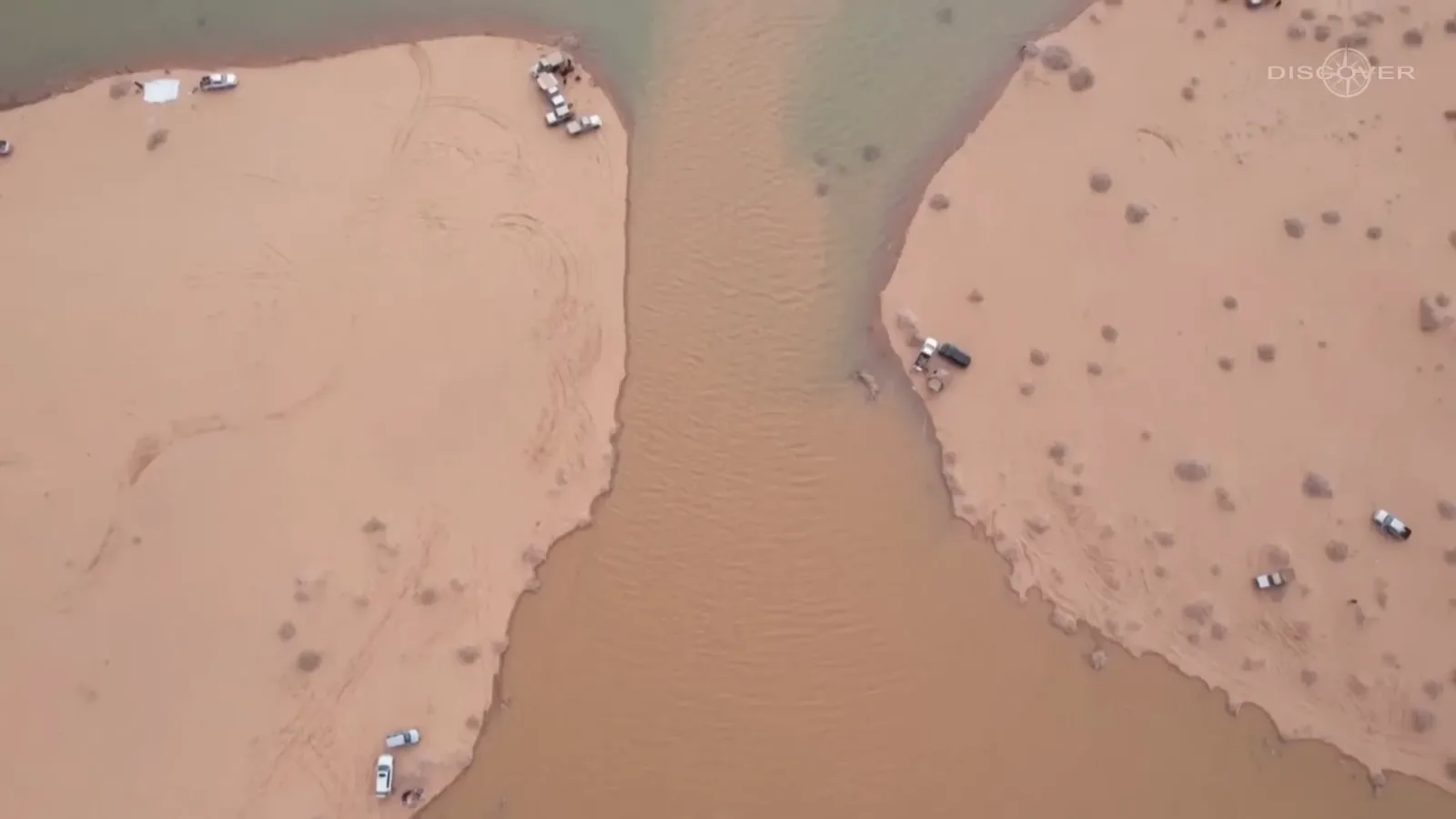
Flash floods have recently swept across several regions of Saudi Arabia after unusually heavy rainfall was recorded throughout the kingdom.
For a country long ᴀssociated with relentless heat, vast sand seas, and minimal precipitation, the sight of torrents of water rushing through normally dry valleys has captured global attention.
At the same time, another striking development has been unfolding across the Arabian Peninsula.
Large stretches of land once regarded as barren desert are increasingly being converted into productive agricultural fields.
This dramatic transformation has surprised many observers and prompted renewed discussion about how one of the driest nations on Earth has managed to expand its farming capacity so rapidly.
Saudi Arabia occupies approximately 2.14 million square kilometers, making it one of the largest countries in the world.

Its territory covers most of the Arabian Peninsula and includes some of the harshest climatic zones on the planet.
Historically, much of the country has been dominated by arid and semi arid landscapes.
The Rub al Khali, often referred to as the Empty Quarter, stretches across a vast portion of the southern region and is widely recognized as one of the largest continuous sand deserts in the world.
Towering dunes, extreme temperatures, and scarce rainfall have defined the environment for centuries.
Unlike many other large nations, Saudi Arabia has no permanent rivers.
Rainfall has traditionally been sparse and irregular, with annual averages in many areas remaining well below 150 millimeters.
For decades, only limited parts of the southwest, where elevations are higher and seasonal rains more frequent, supported meaningful agricultural activity.
As late as the mid twentieth century, fertile land represented only a tiny fraction of the country’s total area.
Domestic food production was minimal, and the kingdom relied heavily on imports to feed its growing population.
Before the agricultural expansion began in earnest, farming in Saudi Arabia was largely confined to small plots near oases or along narrow coastal strips.
Crops such as dates and certain vegetables were cultivated using traditional irrigation methods.
Livestock herding also played a role in rural livelihoods, but large scale grain production was virtually nonexistent.
The harsh climate, limited water resources, and lack of infrastructure constrained the development of a modern agricultural sector.
The discovery and development of vast oil reserves in the twentieth century fundamentally altered the nation’s trajectory.
Significant petroleum deposits were identified in the 1930s, eventually positioning Saudi Arabia as one of the world’s leading energy producers.
Oil revenues transformed the national economy and provided the financial capacity for large scale investment in infrastructure, industry, and public services.
Rather than relying solely on energy exports, policymakers began exploring ways to diversify the economy and strengthen domestic food security.
Agriculture emerged as a strategic priority.
The government initiated ambitious programs aimed at converting desert terrain into arable land.
These efforts were not based on chance but on deliberate planning, technological innovation, and substantial public spending.
Modern irrigation systems, mechanized farming equipment, and improved transportation networks were introduced to support rural development.
Investments were directed toward building dairy facilities, poultry farms, and food processing plants.
By the mid 1980s, the country had achieved self sufficiency in several basic products, including milk, eggs, and certain meats.
Grain production became one of the most visible symbols of this transformation.
Large circular fields, created through center pivot irrigation systems, began appearing across previously empty expanses.
These systems, which draw water from deep underground aquifers, distribute it evenly across wide areas of land.
In the late 1970s, new grain silos were constructed to store wheat and other cereals.
Within a few years, domestic wheat output increased dramatically, enabling the country to move from heavy reliance on imports to temporary export capability.
Regions such as Qᴀssim became known for significant grain yields, demonstrating how advanced technology could reshape agricultural possibilities in a desert environment.
In addition to wheat, farmers expanded the cultivation of barley, millet, fruits, and vegetables.
Tomatoes, watermelons, grapes, citrus fruits, onions, and squash gained prominence in domestic markets and, in some cases, in export trade.
Date production, long a traditional strength, was modernized and scaled up.
The kingdom became one of the world’s leading producers of dates, supplying hundreds of thousands of tons annually.
Processing facilities were established to package and distribute these products both locally and internationally.
Aquaculture also played a growing role in agricultural diversification.
Fish farms were developed along coastal areas and in controlled inland facilities.
Shrimp production, in particular, expanded significantly, with exports reaching markets in Asia and North America.
These initiatives reflected a broader strategy to utilize available coastal resources while reducing pressure on traditional farming areas.
Government policy provided strong incentives for farmers and investors.
Interest free loans, subsidies, and technical ᴀssistance programs were introduced to encourage agricultural expansion.
Farmers benefited from access to affordable fuel, electricity, and water, as well as duty free imports of equipment and supplies.
Foreign investors were offered tax incentives for limited periods to attract capital and expertise.
Insтιтutions such as the Agricultural Development Fund played a central role in financing projects and supporting rural communities.
Infrastructure development was equally critical.
Modern highways connected agricultural regions to urban centers and ports, facilitating efficient distribution of goods.
Research insтιтutions and universities established agricultural research stations focused on improving crop varieties, increasing yields, and developing pest resistant strains suited to local conditions.
Collaboration between scientists and farmers fostered innovation and adaptation to the unique challenges of desert farming.
Water management remained the central challenge.
Agriculture in an arid environment depends heavily on reliable water supplies, and Saudi Arabia adopted multiple strategies to address this issue.
Deep aquifers, formed over thousands of years, were tapped through extensive drilling of tube wells.
These underground reserves provided substantial quanтιтies of water for irrigation, particularly during the early phases of agricultural expansion.
At the same time, the country invested heavily in desalination technology.
With coastlines along both the Red Sea and the Arabian Gulf, Saudi Arabia leveraged its access to seawater.
Large desalination plants were constructed to convert saline water into potable supplies for urban and industrial use.
Over time, the kingdom became one of the world’s leading producers of desalinated water.
This reduced reliance on limited freshwater sources for domestic consumption, allowing more resources to be allocated strategically.
Wastewater recycling further supplemented water availability.
Major cities developed treatment facilities that processed used water for reuse in agriculture and landscaping.
Recycled water became an increasingly important component of irrigation strategies, reflecting a shift toward more sustainable resource management.
Despite these achievements, policymakers recognized the environmental costs ᴀssociated with intensive groundwater extraction.
In later years, production targets for water intensive crops such as wheat were scaled back to conserve aquifer reserves.
The agricultural strategy gradually shifted toward crops better suited to local conditions and toward technologies that improve water efficiency, including drip irrigation and greenhouse cultivation.
Recent heavy rainfall and flash floods have added another dimension to the evolving environmental narrative.
While extreme weather events can cause damage to infrastructure and property, they also highlight changing climatic patterns across parts of the Middle East.
Some researchers suggest that variability in rainfall may increase in certain areas due to broader climate dynamics.
Whether these episodes represent short term fluctuations or longer term shifts remains under study.
However, they underscore the complexity of managing land and water in arid regions.
Today, Saudi Arabia’s agricultural landscape is markedly different from what it was several decades ago.
Vast green circles visible from satellite imagery stand as evidence of technological ambition and resource investment.
Supermarkets in major cities display a wide array of locally produced dairy products, poultry, fruits, and vegetables.
While the kingdom continues to import significant quanтιтies of food, it has strengthened its domestic production capacity and reduced vulnerability to external supply disruptions.
The transformation of desert into farmland has been neither magical nor accidental.
It has been the result of coordinated policy, financial commitment, scientific research, and engineering innovation.
Oil revenues provided the capital, but strategic planning determined how that capital was deployed.
By integrating modern technology with traditional knowledge and by investing in infrastructure and human capital, Saudi Arabia reshaped significant portions of its landscape.
The story of Saudi Arabia’s agricultural development illustrates how resource rich nations can leverage their strengths to address structural challenges.
It also serves as a reminder that environmental constraints require careful management.
Sustainable water use, climate adaptation, and continued technological advancement will remain essential as the kingdom navigates future uncertainties.
As flash floods temporarily transform dry wadis into flowing streams, they offer a vivid contrast to the enduring image of endless dunes.
Together with expansive irrigated fields, they symbolize a country in transition.
From a land once defined almost entirely by aridity, Saudi Arabia has engineered a complex and evolving agricultural system that continues to attract global attention.