Mel Gibson: The Truth About the Creepy Baby in The Pᴀssion of the Christ
When Mel Gibson released The Pᴀssion of the Christ in 2004, audiences expected a brutal and uncompromising portrayal of the final hours of Jesus’s life.
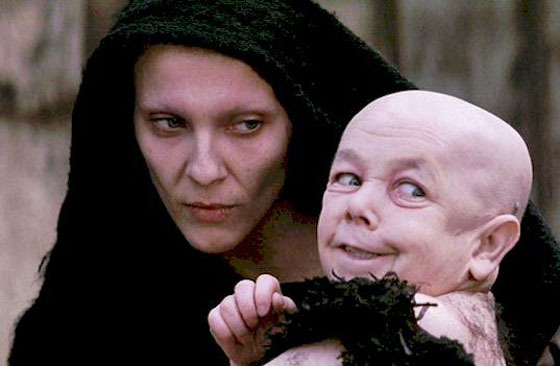
What they did not expect was one of the film’s most puzzling and unsettling images: Satan carrying a strange, unnatural baby during the walk to Calvary.
The moment pᴀsses quickly, but it lingers in the memory of nearly everyone who sees it.
Why would a filmmaker so committed to historical and biblical detail include such a disturbing and cryptic vision?
This scene has stirred debate for years, not only among film critics but also among theologians, pastors, and everyday viewers.
Was the child meant as a direct inversion of Mary holding the infant Jesus?
Was it a commentary on innocence corrupted by evil?
Or was it pointing towards something larger, a symbolic warning about the presence of counterfeit saviors and false hopes?
In this exploration, we will delve into three major interpretations of this haunting moment.
Each sheds light on the film’s deeper themes of suffering, temptation, and spiritual conflict.
By the end, you may see the infamous creepy baby not just as a shocking detail, but as one of the most thought-provoking choices in modern religious cinema.

The Inverted Madonna: Satan’s Mockery of Mary and Jesus
One of the most immediate ᴀssociations viewers make when they see the strange baby in The Pᴀssion of the Christ is the image of Mary holding Jesus as a child.
For centuries, Christian art has celebrated this theme through the Madonna and child motif.
From Renaissance paintings to stained glᴀss windows, the sight of a mother cradling her infant savior has been one of the most recognizable and tender symbols of faith.
It conveys not only the humanity of Christ but also the closeness of God to human life itself.
Mel Gibson flips this imagery on its head.
Instead of Mary carrying the son of God, we see Satan carrying a child that looks both infantile and grotesque.
Its features are oddly aged, almost mocking the innocence of a true newborn.
The result is jarring.
What is supposed to symbolize purity and divine love has been twisted into something unsettling and corrupt.
From a theological perspective, this makes sense.
Christian tradition often describes Satan not as a creator but as a corruptor, someone who takes what God has made good and distorts it into a parody.
The creepy baby can be seen as exactly that: a counterfeit version of the holy image that Christians hold sacred.
Just as Satan tempted Christ in the wilderness by twisting scripture, here he parades a distorted imitation of God’s most intimate gift, the incarnation.
This interpretation also fits with the larger visual strategy of the film.
Throughout The Pᴀssion of the Christ, Gibson doesn’t limit himself to literal biblical events.
He uses symbolism to heighten the drama and explore spiritual realities.
For example, Satan’s presence during Jesus’s agony in the garden, though not explicitly described in the Gospels, represents the unseen battle beneath the surface of the story.
The baby scene functions in a similar way.
It’s not about historical accuracy but about giving shape to the spiritual conflict raging around Christ’s suffering.
Consider the timing of the scene.
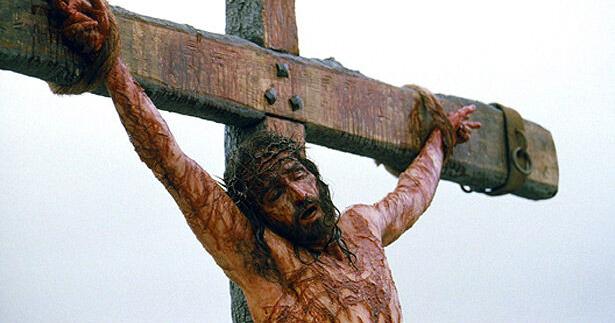
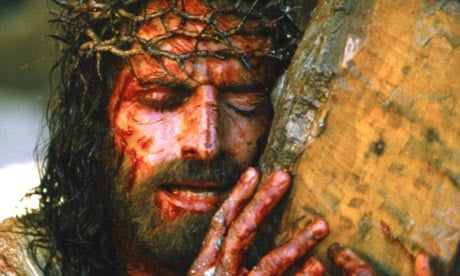
Jesus is carrying the cross, staggering under its weight, while Mary follows in anguish in that moment of intense maternal sorrow.
Viewers are given a parallel image: the true mother torn with grief and the false mother parading a smug and twisted child.
The juxtaposition is hard to miss.
By placing these images side by side, Gibson underlines the choice between truth and deception, light and darkness, authentic love and counterfeit love.
Art history supports this reading.
Many great painters used visual oppositions to highlight theological contrasts: light against shadow, holy figures against demonic ones, purity against corruption.
Gibson seems to be using film language in the same way.
The inverted Madonna becomes not just a shock tactic but a deliberate statement.
Evil mocks what is sacred, but it can never reproduce the true beauty of God’s work.
What makes the scene effective is that Gibson doesn’t explain it.
The film offers no commentary, no dialogue to guide the audience.
This silence forces viewers to interpret the image themselves, much like interpreting a piece of religious art in a museum.
The ambiguity has fueled years of discussion, keeping the moment alive in cultural memory long after the credits rolled.
Interestingly, viewers from different backgrounds respond differently to this interpretation.
Some Catholics see it as a direct challenge to Marian devotion since Mary is so central to their spirituality.
Protestants, while less focused on Marian imagery, still recognize the stark contrast with the biblical theme of Christ’s innocence as a child.
Even non-religious viewers sense the inversion.
Since mother and child imagery is universally understood as tender and protective, the scene unsettles precisely because it violates such a basic human ᴀssociation.
From a psychological perspective, the effectiveness of this inversion can also be explained.
Our minds are wired to find comfort in the sight of a mother protecting her infant.
When that image is disrupted, when the infant looks unnatural, when the mother is Satan, the brain reacts with a mixture of confusion and revulsion.
This taps into what psychologists call the uncanny valley effect—the discomfort we feel when something looks almost human but not quite.
By exploiting this instinct, the film makes the audience’s skin crawl in a way that logic alone could never achieve.
But perhaps the most striking element is what the scene suggests about spiritual warfare.
If Satan can mock even the image of God’s incarnation, then evil is not content to simply exist.
It seeks to counterfeit, to parody, to deceive.
The devil’s strategy is not always brute force; sometimes it is imitation.
The inverted Madonna becomes a cinematic way of showing that the greatest lies are those that look almost true.
Gibson’s scene then isn’t just about ancient symbolism; it’s a mirror held up to the dangers of deception in our own time.
By choosing to present this distorted version of Mary and Jesus, Gibson forces viewers to confront a central Christian truth: evil does not create; it only corrupts.
The scene shocks not for the sake of shock but to make us see how fragile the line is between authentic love and its counterfeit.
It is a reminder that discernment is always necessary—that we must learn to tell the difference between the true and the false, between what gives life and what only pretends to.
Corrupted Innocence: The Child as a Symbol of Humanity Twisted by Sin
If the first interpretation of the creepy baby in The Pᴀssion of the Christ sees it as a satanic parody of Mary and Jesus, the second takes a different angle.
The baby is a representation of innocence corrupted.
Babies naturally symbolize purity across cultures.
Infants represent fresh beginnings, trust, vulnerability, and the hope of the future.
A child does not yet carry the weight of cynicism or guilt.
So the sight of a newborn often moves people to awe.
Even in secular societies, the birth of a child is treated as sacred.
That’s why Gibson’s decision to present a baby with distorted, almost grotesque features is so unnerving.
The very image that should bring comfort instead inspires revulsion.
This inversion raises a sobering question: what happens when innocence itself is twisted by evil?
Christian theology would say that sin doesn’t just affect outward actions; it infects the very core of human nature.
The Apostle Paul wrote that all have sinned and fall short of the glory of God.
In that sense, the baby carried by Satan could represent humanity itself, created for goodness but marked by corruption.
The disturbing features of the child reinforce this idea.
Its aged face, oddly mature for an infant, suggests that innocence has been lost too soon.
Rather than growing naturally into wisdom, the child’s development has been accelerated into something unnatural.
This recalls the way sin prematurely burdens us with fear, shame, and brokenness.
What should have been tender is hardened.
What should have been new is already worn.
From a symbolic standpoint, this interpretation is powerful because it forces viewers to confront a truth about themselves.
The horror is not just on the screen; it points back at the audience.
If the child is humanity under the weight of sin, then the image is a mirror.
We are not spectators looking at a grotesque creature; we are, in a sense, looking at ourselves apart from redemption.
This symbolism resonates beyond theology.
Modern psychology has long studied the effects of trauma, abuse, and systemic evil on children.
Stories of child soldiers, victims of exploitation, or young people growing up in environments of violence demonstrate how quickly innocence can be lost.
The twisted baby could be seen as a cinematic embodiment of this reality—the way a soul meant for purity can be deformed by what it endures.
To ground this idea in real life, consider the writings of Viktor Frankl, a Holocaust survivor.
In his book, Man’s Search for Meaning, Frankl describes how evil stripped away human dignity, even from children.
Yet he also observed that even in the worst conditions, people could choose how to respond.
The creepy baby in Gibson’s film doesn’t offer such a choice.
It presents innocence already corrupted beyond recognition.
But by shocking us with that image, it forces us to consider the stakes.
Innocence is fragile, and when twisted, the results are monstrous.
Another way to think about this interpretation is through the lens of art history.
Many medieval depictions of sin use distorted or grotesque human figures to represent the soul weighed down by vice.
The baby in Satan’s arms fits this tradition.
It is humanity still bearing the form of God’s creation but marked by the disfigurement of evil.
This reading also adds depth to the timing of the scene.
As Jesus walks the Via Dolorosa, bearing the cross that will redeem humanity, Satan flaunts a vision of humanity without redemption—innocence corrupted, the future ruined.
The contrast could not be clearer.
While Christ carries the burden of salvation, Satan carries the product of sin.
It’s worth noting that this interpretation goes beyond individual sin.
The baby could also stand for the collective corruption of humanity across history.
Wars, exploitation, and injustice often leave the most vulnerable, the children, scarred.
Gibson may have been tapping into this broader sense of loss, showing evil not as an abstract idea but as something that directly wounds the innocent.
For audiences, this is perhaps the most haunting interpretation because it feels so close to reality.
Unlike the Antichrist theory, which deals with apocalyptic speculation, the image of corrupted innocence is something we witness daily in news reports and personal stories.
The creepy baby becomes less of a fantastical symbol and more of a commentary on the brokenness of the world we live in.
This is where the film’s spiritual message deepens.
Christianity teaches that Jesus’s suffering was not only to forgive sins but also to restore what was lost.
The contrast between the innocent yet corrupted baby and the suffering yet redeeming Christ highlights that restoration.
In other words, Gibson seems to be saying: this is what humanity looks like under sin.
But here is the one who will set it right.
As a mid-script reflection, think about how often we see images of innocence corrupted in everyday life: a child’s laughter drowned out by conflict, a teenager pressured into destructive choices, an entire generation growing up without hope.
The film’s grotesque baby scene distills all those tragedies into a single unforgettable image.
It’s not pleasant to look at, and that’s exactly the point.
In the end, the corrupted innocence interpretation makes the scene less about shock value and more about moral confrontation.
It forces the viewer to ask, “If this is what humanity becomes without redemption, where do I stand?”
The baby’s face lingers because it carries not just cinematic horror but existential weight.
It is the picture of what is at stake in the story of the Pᴀssion, foreshadowing the Antichrist, evil’s counterfeit savior.
The Antichrist: A Prophetic Symbol of the Ultimate Counterfeit Savior
A third interpretation of the disturbing child in The Pᴀssion of the Christ moves beyond parody and corrupted innocence.
Some viewers see the image as prophetic, an allusion to the rise of the Antichrist, the ultimate counterfeit savior.
In Christian tradition, the Antichrist is not just a figure of rebellion but one who imitates Christ to deceive the world.
Scripture describes him as a man of lawlessness who presents himself as divine, leading many astray.
If Satan is the father of lies, then the Antichrist is his greatest lie—the counterfeit Messiah designed to rival the true Son of God.
Within this framework, the grotesque infant becomes chillingly symbolic.
Just as Mary once cradled the infant Christ, Satan is shown carrying his own offspring, a perverse echo of the incarnation.
The baby’s unnatural features could represent the Antichrist’s hidden nature—outwardly human, inwardly distorted.
By showing this during Jesus’s walk to Calvary, Gibson may have been hinting that while Christ is redeeming humanity, evil is preparing its own deceptive plan for the future.
This reading has strong resonance in Christian eschatology.
The book of Revelation, along with later interpretations by church fathers and theologians, often emphasizes that evil will mimic the works of God to gain followers.
The devil does not invent; it imitates, twisting truth into a convincing lie.
The creepy baby could thus be seen as the embryonic stage of this deception—a symbol that evil will one day try to present its own messiah to the world.
Thematically, this interpretation fits with the film’s emphasis on contrasts.
As Jesus takes each painful step toward the cross, an act of ultimate sacrifice, the camera gives us a glimpse of the enemy’s alternative—not salvation, but counterfeit power.
The Antichrist theory underscores that history is not just about what Christ has done, but also about the ongoing struggle between truth and deception.
Consider the chilling insight of C.S. Lewis, who once wrote that the devil always sends errors into the world in pairs.
In other words, evil rarely appears as an obvious lie; it shows up as a distorted alternative that looks convincing enough to mislead.
The Antichrist interpretation of the baby echoes this point.
Just as Christ’s childhood was marked by humility and vulnerability, the devil’s child carries an uncanny resemblance to humanity but is stripped of innocence.
Psychologically, this taps into the same uncanny valley effect discussed earlier, but now layered with prophetic dread.
We are unsettled not just because the baby looks wrong but because it suggests a future where deception itself might look convincing, even holy.
In that sense, Gibson may be less interested in presenting a literal Antichrist than in provoking viewers to reflect on the power of deception in every age.
Midway through this interpretation, it’s worth pausing to reflect on how often counterfeit saviors appear in our personal lives.
They may not be global leaders, but they take the form of promises that sound good yet lead to disappointment.
A relationship that offers security but ends in control.
An ideology that offers freedom but demands conformity.
Or even material success that promises fulfillment but leaves emptiness.
The Antichrist baby, in this symbolic sense, stands for every false savior we are tempted to embrace.
This also explains why the image remains lodged in viewers’ memories.
Horror that is purely grotesque eventually fades.
But horror that carries symbolic depth continues to disturb.
The idea of Satan nurturing his own messiah is not just unsettling; it forces us to ask uncomfortable questions.
How do we recognize false hope when it comes dressed as truth?
What happens when humanity places its trust in what is counterfeit?
In the broader cinematic landscape, this is a rare example of a mainstream film directly engaging with apocalyptic symbolism.
Hollywood often shies away from overt religious imagery.
Yet here, Gibson leans into it, giving audiences a glimpse of something most have only encountered in theology or literature.
Whether or not he intended a direct reference to the Antichrist, the effect is the same.
The scene unsettles us by suggesting that evil’s plans go beyond the present moment, reaching into the future.
Ultimately, the Antichrist interpretation does not stand in opposition to the other two theories; it complements them.
The satanic parody of Mary and the theme of corrupted innocence both build toward the larger idea of a counterfeit savior.
If Satan’s goal is to mock, to corrupt, and to deceive, then the natural outcome is to present his own version of Christ.
The baby in the film becomes a condensed symbol of all these strategies: mockery of the holy, corruption of innocence, and foreshadowing of ultimate deception.
By placing this disturbing image right in the middle of Jesus’s path to crucifixion, Gibson forces the audience to recognize the stakes of the Pᴀssion story.
The cross is not just about one man’s suffering; it is about the cosmic struggle between the true savior and every counterfeit that seeks to replace him.
The creepy baby, in this sense, is more than a disturbing prop; it is a warning.

The creepy baby in The Pᴀssion of the Christ lasts only a few seconds on screen.
Yet, it has fueled debate for nearly two decades.
Few cinematic images manage to disturb and fascinate audiences so deeply, and that is precisely why it continues to be discussed long after the film’s release.
We’ve explored three major interpretations.
The first sees the baby as a satanic mockery of Mary and the infant Jesus, a grotesque inversion of the Madonna and child that highlights Satan’s role as corruptor rather than creator.
The second understands the child as a symbol of innocence twisted by sin, representing humanity disfigured by evil and robbed of its original purity.
The third, more eschatological view, interprets the image as a foreshadowing of the Antichrist, the counterfeit savior who deceives by imitating Christ.
Each interpretation adds a layer of meaning, and perhaps Gibson intended all three at once.
What unites them is the idea that evil does not simply oppose goodness; it mimics, distorts, and corrupts it.
The disturbing effect of the scene comes not from spectacle but from recognition.
We are witnessing something familiar turned inside out.
This raises a question that extends far beyond cinema.
How do we recognize the counterfeit in our own lives?
We encounter false promises constantly: offers of success without sacrifice, love without commitment, or freedom without responsibility.
Like Satan’s child, these things often look close enough to the real thing to attract us.
But beneath the surface, they lead to emptiness.
And maybe that’s the real genius of the moment.
The creepy baby is unforgettable because it resists closure.
It invites us into a dialogue about the nature of evil, the fragility of innocence, and the reality of deception.
It asks us to think, not just to watch.
So the next time you revisit The Pᴀssion of the Christ and see that haunting image, consider not only what it means within the story of the film but what it might be revealing about your own story.
Where do you need discernment?
What counterfeit promises do you need to recognize?
The scene’s unsettling power lies in this very challenge.
Evil may mock, distort, and deceive, but it cannot create truth.
And that is why, in the shadow of the grotesque child, the true Christ walking toward the cross shines all the brighter.


