WHAT DID JESUS WRITE IN THE SAND? A Forgotten Bible Mystery Found in an Ancient Ethiopian Manuscript
Have you ever stumbled upon a Bible story that left you speechless? There’s one moment—brief, silent, and haunting—that continues to puzzle believers and scholars alike.
It’s when Jesus, facing a crowd ready to condemn, knelt down and wrote in the sand.
A woman caught in adultery is thrown before him, and the Pharisees demand judgment.
Moses says, “Stone her. What do you say?”
But Jesus says nothing.
No debate, no defense.
He simply stoops and writes.
The Gospel of John records this act yet leaves out the words—nothing, not a single letter.
Why was it meant to stay hidden?
Or did it say something too powerful to be repeated?

Some claim he wrote a scripture only the Pharisees would recognize.
Others think he exposed their sins one by one.
Whatever it was, it struck a nerve because they all walked away, oldest to youngest.
And here’s where it gets even more mysterious: in some Bible versions, this entire story is missing.
Was it erased, censored, or protected?
Ancient texts like the Gospel of the Hebrews and early Christian writings offer theories, but no clear answers.
Now, a newly uncovered manuscript may hold a shocking clue—not just about what Jesus wrote, but why it matters today.
This isn’t just a forgotten detail; it’s a divine mystery buried for 2,000 years.
Before we explore the newly uncovered manuscript, let’s rewind nearly 1,800 years to the voices of early Christians who may hold forgotten clues to this mystery.
After Jesus walked the earth, believers began preaching, writing, and preserving stories—some of which never made it into the Bible.

Yet these writings may offer insight into what Jesus wrote in the sand.
Let’s begin with one of the earliest, the Didascalia Apostolorum, written around 230 AD.
This ancient church manual guided bishops and believers on how to live, pray, and handle discipline.
But hidden in its pages is something remarkable.
It directly references the story of the adulterous woman.
According to the Didascalia, Jesus, who seized the hearts of men, wrote down the sins of each accuser in the sand.
One saw his secret lust exposed.
Another, a hidden bribe.
Another, a buried lie.
One by one, ashamed, they walked away.
Now, imagine that moment: a Pharisee sees his darkest secret written on the ground—something he thought no one knew.
No wonder they dropped their stones.
Next, we meet Jerome, the church father from the late 4th century who translated the Bible into Latin.
He believed Jesus wasn’t just writing random words; he was fulfilling prophecy.
Jerome pointed to Jeremiah 17:13: “Those who turn away from you shall be written in the earth, for they have forsaken the Lord, the fountain of living waters.”
To the Jewish people, having your name written in the dirt symbolized judgment and rejection.
It meant your name wasn’t in the book of life—just dust to be blown away.
Jerome believed Jesus was writing their names in the ground, signaling their hardened hearts and spiritual betrayal.
Then comes Didymus the Blind, a brilliant 4th-century theologian from Alexandria.
Though physically blind, his memory and insight were unmatched.

He referenced a now-lost text, the Gospel of the Hebrews.
This Gospel, excluded from the Bible, also tells of Jesus writing in the sand.
Didymus believed this wasn’t just an act; it was a divine confrontation of hypocrisy and hidden sin.
All of these early voices—long buried, nearly forgotten—paint a powerful picture.
Jesus didn’t need to speak.
His silence and what he wrote said everything.
Though the Gospel of the Hebrews isn’t part of scripture, it was respected by some early Christians.
Didymus the Blind said this lost gospel included the story of the woman caught in adultery.
But in that version, Jesus speaks to her gently and asks a piercing question: “Have the elders condemned you, my daughter?”
This version hints at something deeper.

Jesus wasn’t just addressing her sin; he was confronting the hypocrisy of her accusers—the powerful abusing the broken.
Again, this text isn’t canonical, so we handle it with care.
But it shows that early believers wrestled with this story and believed it held more than what John recorded.
Now, let’s step into the world of history and law.
Some scholars believe Jesus was acting like a Roman judge.
In Roman courts, it was common for judges to write the charges before speaking the verdict.
Jesus, standing as both judge and savior, may have been doing the same.
The verdict?
Guilty, but forgiven.
Sinful, yet spared.

For the accusers, hypocrites walked away.
But there’s another glaring question: where was the man?
Leviticus 20:10 makes it clear: both the man and the woman caught in adultery were to be punished.
Yet only the woman was dragged into the temple courts.
Had he escaped, or was this a setup?
Was she used as bait—a pawn in their plot to trap Jesus?
Jesus didn’t just protect her; he exposed the injustice of the system.
He flipped the script on the powerful and showed them their own guilt.
And that’s why they left—not in compᴀssion, but in fear.
But here’s where things get even more shocking.
Did you know that this entire story—John 7:53 to 8:11—is missing from some of the oldest Greek manuscripts?

In the Codex Sinaiticus and Codex Vaticanus, two of the oldest complete New Testaments we have, this scene doesn’t exist.
Some scholars think early scribes may have removed it.
Perhaps they feared Jesus seemed too merciful and that his forgiveness might be misunderstood as permission to sin.
Others believe it was a beloved oral tradition that was eventually added later.
But here’s what matters most: by the fifth century, nearly all manuscripts included it.
More importantly, the early church preached it.
They accepted it.
They believed it revealed the heart of Jesus—truth, justice, and mercy in perfect balance.
The message was powerful.
The spirit of Jesus is all over this story.
Whether it was penned in the original manuscript or added by faithful hands later, one thing is clear: it reflects the heart of Christ—a heart that kneels, that writes in silence, and that shows mercy to the guilty.
Each ancient writing offers a clue, a theory, a tradition, a glimpse into what might have happened that day, but none give the full picture.
None offer a direct quote.
They suggest but never declare—until now.
Because there is one manuscript that dares to go further.
One tradition that didn’t lose the details because it was never touched by Roman hands.
It wasn’t edited by the West; it was preserved, protected, and hidden in plain sight.
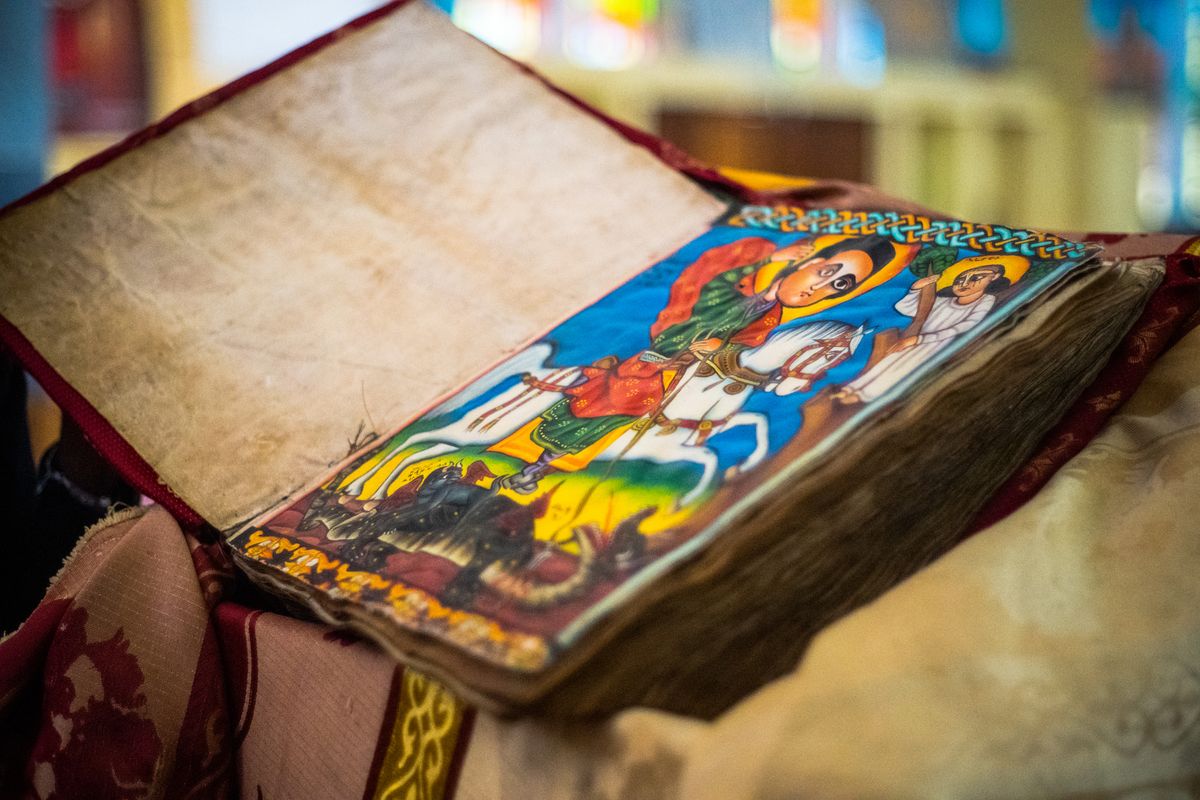
We’re talking about Ethiopia—one of the oldest Christian traditions in the world.
The Ethiopian Orthodox Church didn’t receive the gospel from Rome or the Crusaders.
They trace their faith back to Philip and the Ethiopian eunuch in Acts 8—a royal official reading Isaiah in his chariot, baptized by an apostle.

Since that moment, they’ve kept a tradition that is ancient, rich, and largely untouched.
Their Bible is longer; they preserve books like Enoch, Jubilees, and the Book of the Covenant.
They’ve safeguarded manuscripts written in Ge’ez, an ancient language barely known in the West.
And within those sacred texts is a version of John unlike anything we’ve seen.
It doesn’t end in silence; it speaks.
According to this ancient Ethiopian manuscript, Jesus didn’t write once; he wrote twice—just like in the Gospel of John.
But this version dares to say exactly what he wrote.
When Jesus first stooped, he wrote the names of the accusers—those holding the stones—and under each name, a hidden sin.
Not shouted aloud, not argued in court, but quietly exposed in the dust.
Johannes, greed.
Matias, unfaithfulness.
Shimeon, violence.
Reuben, deceit.
And when their eyes met the words, they trembled.
One by one, they dropped their stones—the oldest left first, then the younger, then silence, and then Jesus knelt again.
This time, Jesus wrote a single word—one that sits at the very heart of Ethiopian faith: mercy.
Not written on scrolls, not carved in stone, but in dust—the very substance God used to form us.
The message was clear: he knew their sins, yet still offered grace.
This wasn’t just forgiveness—it was restoration, a second chance offered from the ground up.
To the woman trembling before him, Jesus spoke the words that changed everything: “Where are your accusers?” She replied, “No one, Lord.”
And Jesus said, “Then neither do I condemn you. Go and sin no more.”

This version of the story doesn’t soften the moment; it amplifies it.
It brings out the rawness, the reality, and the mercy of Jesus in a way that makes this moment come alive.
Why does Jesus write in the dust?
In Ethiopian theology, dust is sacred.
God formed man from dust, and dust is where we return.
But before that return, God meets us there.
When Jesus writes in the dust, he is writing in our nature.
He is reaching into the fragile, temporary place we come from to write something eternal.
And because the names and sins were written in dust, they could be wiped away.

The Ethiopian manuscript brings out this mystery beautifully.
Even when God reveals what’s wrong with us, his goal isn’t shame; it’s healing.
That’s why after naming the sins, he wrote one word: mercy.
Not punishment, not judgment—mercy.
That’s the mystery of the gospel written with a finger in the dirt.
This version also reminds us of something else: only Jesus could do this.
He’s not just a teacher, not just a prophet; he is the Son of God.
The same one who wrote the law on stone at Sinai is now writing again—but not on stone.
This time, it’s dust—temporary, fragile—because Jesus didn’t come to carve commandments into stone again; he came to fulfill them.
He came to show that grace has a name, and that name is Jesus.
And grace is written where no one expects it: beneath our feet, in the dirt of our lives.
That’s what makes this Ethiopian manuscript more than just a curiosity.
It’s not just an old scroll; it’s a window, a holy lens that reveals a Jesus who knows, who sees, who writes, and who forgives.
No Western commentary brings this out like this.
No modern translation carries this weight.
But the Ethiopian tradition held on to it quietly, faithfully, patiently—until now.


