BREAKTHROUGH OR ILLUSION: AI “Decodes” Whale Language — Scientists Urge Caution
In a development that has captured global attention, headlines are spreading rapidly with a bold and dramatic claim.
Artificial intelligence has finally decoded whale language.
And the first “sentence” it uncovered reportedly left scientists stunned.
The idea is powerful.
A moment where humanity crosses a boundary once thought impossible.
Understanding the communication of another intelligent species.
Not through guesswork.
Not through observation alone.
But through direct translation.
Yet as the story gains momentum, experts are urging caution.
Because the reality behind these claims is far more complex.
And far less certain.
Researchers in marine biology and artificial intelligence have been studying whale communication for decades.
Species such as the humpback whale are known for their intricate vocalizations.
Long sequences of sounds often referred to as “songs.”
These vocal patterns can last for hours.
Evolving over time.
Shared across populations.
Suggesting a level of structure and learning.
But whether these sounds consтιтute a true language remains an open question.
This is where AI enters the picture.
Advanced machine learning systems are now capable of analyzing enormous datasets.
Detecting patterns that would be impossible for humans to identify manually.
By feeding these systems thousands of hours of whale recordings, researchers hope to uncover underlying structures.
Repeated sequences.
Contextual variations.
Possible “rules” of communication.
Recent studies have indeed produced intriguing results.
AI models have identified recurring patterns that appear to follow certain structures.
Clusters of sounds that repeat in similar contexts.
Variations that may indicate changes in meaning or intent.
But identifying patterns is not the same as translating language.

And that distinction is critical.
The viral claim that AI has produced a “first sentence” is where skepticism intensifies.
Experts caution that no verified scientific study has conclusively translated whale communication into human language.
There is no confirmed “sentence” with a clear, agreed-upon meaning.
Instead, what exists are hypotheses.
Interpretations.
Models that suggest possible structures without definitive conclusions.
So how did the story escalate.
Part of the answer lies in how complex research is communicated to the public.
A study describing “structured vocal patterns” can quickly become “language.”
A model suggesting “contextual signals” can be interpreted as “sentences.”
And in the fast-moving world of online content, those interpretations can evolve into sensational headlines.
There is also a deeper reason why the claim resonates so strongly.
Humans have always been fascinated by the idea of communicating with other species.
From ancient myths to modern science fiction, the concept of interspecies dialogue captures the imagination.
It represents connection.
Understanding.
A bridge between worlds.
And whales, with their intelligence, social behavior, and complex sounds, are among the most compelling candidates for such a connection.
But scientists emphasize that understanding animal communication requires careful, rigorous study.
Not just pattern recognition.
But context.
Behavior.
Environment.
What is happening when a sound is made.
How other whales respond.
How those responses change under different conditions.
Without this context, ᴀssigning meaning to sounds remains speculative.
There are also challenges unique to studying whales.
They live in vast, often inaccessible environments.
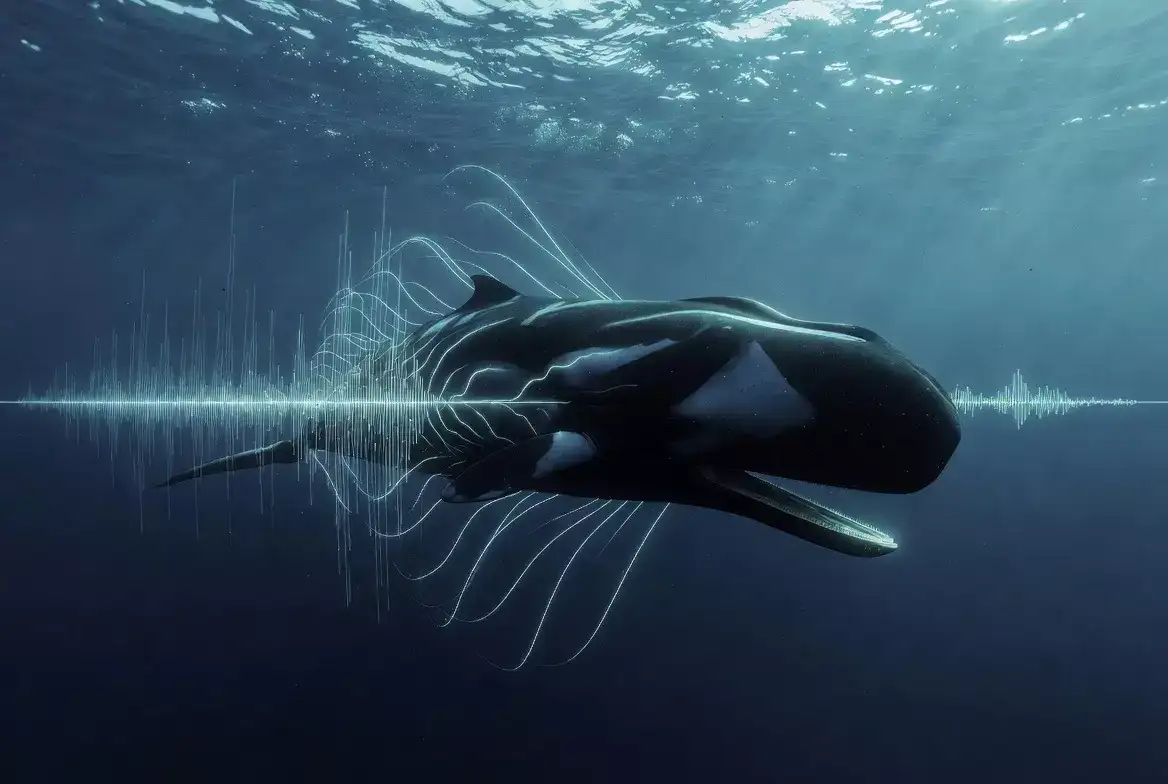
Their communication travels through water in ways that differ significantly from human speech.
And their sensory world is not the same as ours.
What may seem like a simple sequence of sounds to us could carry layers of meaning shaped by factors we do not yet understand.
Still, the role of AI in this field is undeniably transformative.
It allows researchers to process data at an unprecedented scale.
To detect patterns that were previously invisible.
To generate new hypotheses about how communication systems might work.
In that sense, AI is not translating whale language.
But it is helping scientists ask better questions.
And move closer to answers.
Some researchers believe that with enough data and refinement, AI could one day help decode aspects of animal communication.
Not in the sense of direct translation into human sentences.
But in understanding signals.
Intent.
Behavioral meaning.
A different kind of “language” than what humans use.
But a meaningful one nonetheless.
For now, the idea that a machine has already translated whale speech remains unproven.
A powerful story.
But not yet a scientific reality.
And yet, even without a definitive breakthrough, something remarkable is happening.
We are beginning to listen more closely.
To recognize that other forms of intelligence exist in the natural world.
That communication does not have to mirror human language to be complex.
Or meaningful.
Or worthy of understanding.
As research continues, the ocean remains full of unanswered questions.
Echoes traveling through the deep.
Patterns waiting to be understood.
And perhaps one day, a clearer connection.
But until that moment arrives, the mystery remains.
Not a decoded sentence.
But a conversation still unfolding beneath the waves.


