A Life Beyond the Spotlight: Sharon Stone’s Survival and Reinvention
At the height of the 1990s, Sharon Stone was untouchable. After her electrifying performance as Catherine Tramell in Basic Instinct, she became a global symbol of intelligence, sensuality, and power. Directors wanted her. Audiences were captivated by her. Hollywood crowned her as one of its most magnetic leading women. And then, suddenly, she was gone.
Behind the glamour and flashing cameras, Stone was fighting a battle that nearly ended her life.
Born on March 10, 1958, in the quiet town of Meadville, Pennsylvania, Sharon Vonne Stone’s journey to stardom was anything but typical.

The second of four children, she grew up in a modest household where money was тιԍнт but discipline was strict. Her father worked long hours as a tool and die manufacturer, while her mother balanced accounting work with raising the family.
From an early age, Stone stood out. Exceptionally gifted, she reportedly had an IQ of 154. She learned to read at a young age and skipped grades in school. But her brilliance often isolated her. Classmates labeled her a know-it-all.
She found comfort in books rather than playground games, already sensing she was different from those around her.

Yet her childhood carried darker shadows. In her memoir The Beauty of Living Twice, Stone revealed that she suffered abuse at the hands of her maternal grandfather—trauma she suppressed for decades. At home, her father’s volatile temper added another layer of fear. It wasn’t until a powerful confrontation at age 14 that the physical punishment stopped, marking a turning point in her young life.
Despite emotional wounds and a serious neck injury from a horseback riding accident, Stone excelled academically. She graduated high school at 15 and earned a scholarship to Edinboro University of Pennsylvania. But small-town life felt suffocating. She wanted more.
A local beauty pageant win changed everything. Encouraged by those who saw potential she struggled to recognize in herself, Stone moved to New York City to pursue modeling. The transition was overwhelming, but she persevered, eventually signing with Ford Modeling Agency and landing major campaigns. Still, modeling left her unfulfilled. She craved storytelling, complexity, emotional depth.

Acting became her new focus.
Her early roles were modest—an appearance in Woody Allen’s Stardust Memories and parts in lesser-known films throughout the 1980s. But Stone treated every opportunity as training ground. Then came 1992.
Basic Instinct transformed her overnight. Fearless and intelligent, she commanded the screen in a way few actresses had before. She wasn’t merely a Sєx symbol; she was a strategist, a presence, a force. The film’s success cemented her place in Hollywood history.

Throughout the 1990s, Stone continued building a strong career, earning critical acclaim for performances in films like Casino, which brought her a Golden Globe and an Academy Award nomination. On the surface, she had it all—fame, fortune, influence.
Her personal life, however, proved more fragile. Marriages and high-profile relationships came and went. Her 1998 marriage to journalist Phil Bronstein seemed promising, especially after they adopted a son in 2000. But by 2004, the union ended in divorce, followed by a painful custody battle that deeply wounded her.
Then came the most devastating blow of all.
In 2001, at just 43 years old and still in demand, Sharon Stone suffered a mᴀssive stroke caused by a brain hemorrhage that lasted nine days. Doctors gave her only a 1% chance of survival. For many, it would have been the end.
She survived—but survival was only the beginning.

The stroke robbed her of speech clarity, vision, hearing, and mobility. She had to relearn how to walk, read, write, and speak. Recovery took years of grueling therapy and determination. During that time, Hollywood moved on. Offers dwindled. Financial strain mounted. She later revealed she lost much of her fortune during her prolonged absence and medical crisis.
The industry that once celebrated her had quietly replaced her.
Yet Stone refused to see herself as a victim.
Her brush with death reshaped her priorities. She became a pᴀssionate advocate for stroke awareness, urging people to recognize symptoms early and seek immediate care. Long before her health crisis, she had already been deeply involved in philanthropy—particularly HIV/AIDS awareness, for which she received the Harvard Foundation’s Humanitarian Award.

Her charitable work expanded globally, supporting education initiatives in Africa and co-founding Planet Hope to aid homeless children.
Her influence began to extend beyond film. She was no longer just a movie star. She was a survivor, a humanitarian, a woman unafraid to speak her truth.
In recent years, Stone has also been candid about the realities of aging in Hollywood and the frustrations of modern dating. From being banned briefly on a dating app because users thought her profile was fake, to openly admitting she now values peace over partnership, she has embraced authenticity over illusion.
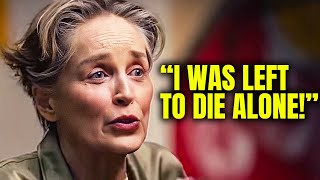
At 66, Sharon Stone is no longer chasing validation from an industry or from romance. She has rebuilt her life on her own terms—raising her children, nurturing close friendships, and continuing advocacy work that gives her purpose.
Her story is not one of disappearance. It is one of endurance.
The woman who once commanded the screen as an untouchable icon has emerged as something far more powerful: a testament to resilience, reinvention, and the unbreakable will to live fully—twice.


