Lake Mead’s Death Spiral: 34% Capacity Triggers Hoover Turbine Crisis — Las Vegas Hangs by $1.5 Billion Tunnel
The American Southwest is staring down a crisis that no amount of optimism or engineering can fully outrun.
Lake Mead—the largest reservoir in the United States and the lifeblood of the Colorado River system—has fallen to just 34% of capacity as of March 23, 2026.

At 1,064 feet above sea level, the lake is only three feet above the threshold where 12 of Hoover Dam’s 17 turbines will be forced offline due to cavitation.
When that happens, the dam’s power output will collapse by more than 80 percent, plunging millions of homes and businesses in California, Nevada, and Arizona into an energy shortfall that cannot be easily replaced.
At the same time, Las Vegas—the fastest-growing major city in the United States—now draws nearly all of its drinking water through a single, $1.5 billion “straw”: a mᴀssive tunnel bored beneath the lake bed that was supposed to be the ultimate emergency backup.
It is no longer a backup.
It is the main lifeline.
The numbers tell a brutal story.
On March 1, Lake Mead stood at 1,066 feet.
By March 21, it had dropped to 1,064 feet—nearly two feet in just three weeks during a month when spring snowmelt from the Rockies is supposed to stabilize or even raise levels.
The reservoir now holds roughly 8.75 million acre-feet of water out of a full capacity of 26 million.
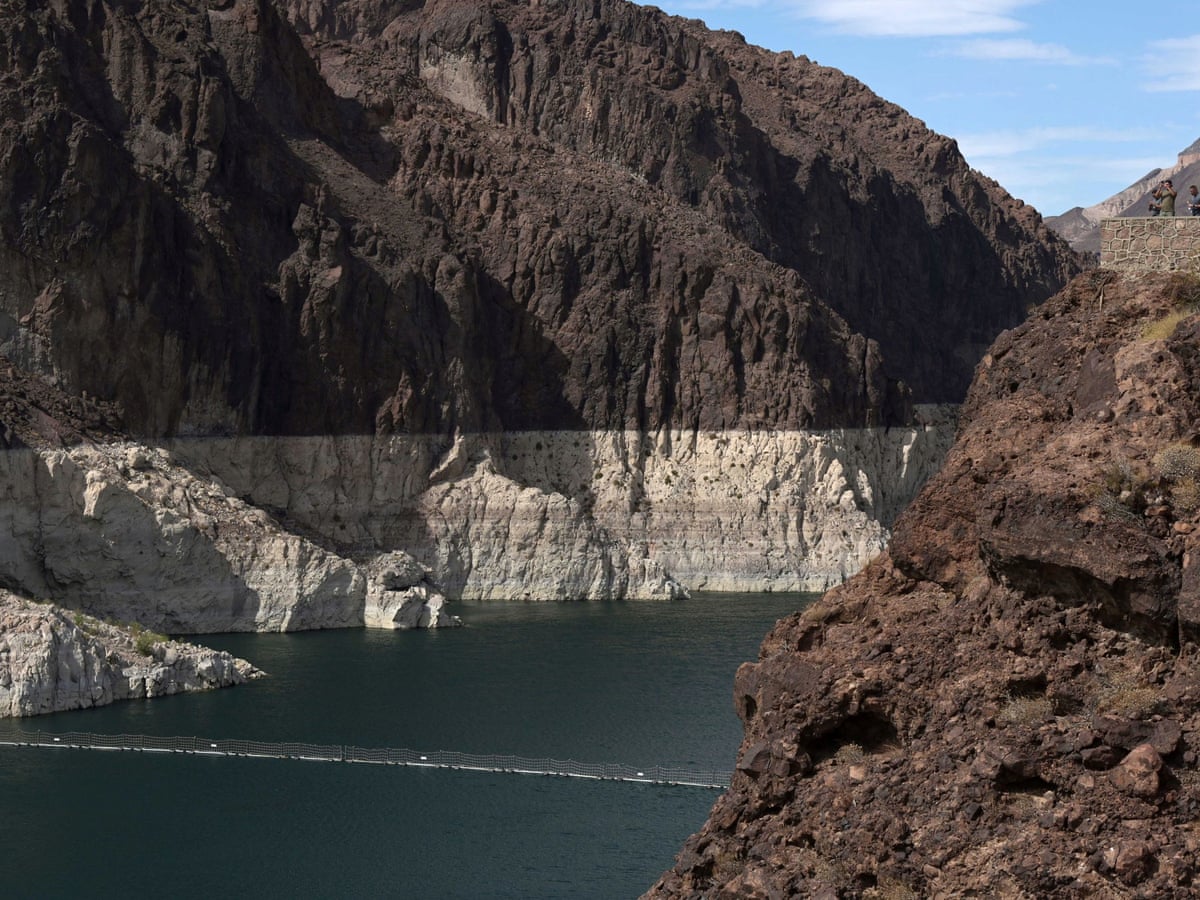
That is a decline of 3 feet compared with the same date last year and 10 feet lower than March 2024.
Brief recoveries in 2023 and early 2024—widely celebrated in headlines—have been completely erased.
The Bureau of Reclamation’s latest forecast, released in early March 2026, is grim: the lake is projected to reach 1,032 feet by November 2027, eight feet below the all-time record low set in July 2022.
That level would trigger the permanent shutdown of the dam’s older Francis turbines, leaving only five rebuilt “wide-head” units capable of operating at low head pressure.
Those five would produce roughly 382 megawatts—less than 20 percent of the dam’s designed capacity of 2,080 megawatts.
The loss of power would be catastrophic.
Hoover Dam supplies electricity to approximately 1.8 million homes across three states.
California takes the largest share (56 percent), followed by Nevada (23.4 percent) and Arizona (19 percent).
Rural electric cooperatives in Nevada and tribal utilities on the Navajo Nation depend on Hoover for up to 70 percent of their supply.
When the older turbines go offline, replacement power will come from natural-gas plants at two to three times the cost.
Those higher costs will fall hardest on low-income communities, rural districts, and Native nations that can least afford them.
Lincoln County Power District in eastern Nevada has already added surcharges to customer bills since 2022 to cover market purchases.
The Navajo Tribal Utility Authority faces the same math: every megawatt lost means higher rates and tougher choices.
The crisis is not limited to electricity.
Water supply hangs by an even thinner thread.
Southern Nevada’s population—2.3 million residents plus 43 million annual visitors—depends on Lake Mead for 90 percent of its water.
Nevada’s legal allocation under the 1922 Colorado River Compact is only 300,000 acre-feet per year—the smallest share of any basin state.
Yet through aggressive conservation and recycling, the region has stretched that allocation far beyond its nominal limit.
Nearly all indoor water used in Las Vegas is treated and returned to the lake via the Las Vegas Wash.
That return-flow credit system allows the state to effectively “reuse” 85 percent of its allocation—the highest rate in the basin.
Per-capita water use has plummeted 55 percent since 2002, from 222 gallons per day to 89 gallons per day in 2023, even as the metro area added nearly 830,000 people.
But conservation alone cannot outrun evaporation and structural loss.
Lake Mead loses roughly 1.5 million acre-feet per year to evaporation under current conditions.
With inflows at historic lows, the reservoir cannot recover.
The Southern Nevada Water Authority recognized this reality more than twenty years ago and built what may be the most critical piece of water infrastructure in the American West: Intake No.3, known universally as the “third straw.
” The project is a 3-mile-long, 20-to-24-foot-diameter tunnel drilled through solid rock beneath the lake bed.
It connects to an intake structure at 860 feet elevation—35 feet below the ᴅᴇᴀᴅ-pool level of 895 feet, the point at which gravity can no longer push water through Hoover Dam.
A companion low-lake-level pumping station added in 2020 extends reliable withdrawal down to 875 feet.
Together, the two projects cost $1.5 billion and took nearly two decades to complete.
They were designed for worst-case scenarios.
That scenario has arrived years ahead of schedule.
Intake No.1 (at ~1,050 feet) became inoperable in April 2022.
Intake No.2 (at ~1,000 feet) remains functional but grows riskier with every foot of decline.
The third straw now supplies the vast majority of the region’s water.
Without it, Las Vegas would already be rationing or trucking in supplies.
The tunnel’s existence is the only reason the city has not yet faced catastrophic shortages.
But the straw cannot solve the larger problem: the Colorado River itself is shrinking.
The current mega-drought, now in its 26th year, is the driest 22-year period in at least 1,200 years according to tree-ring records.
UCLA research attributes roughly 42 percent of the drought’s severity to human-caused warming.
Higher temperatures accelerate evaporation, reduce snowpack, and shift precipitation patterns.
Average annual flows on the Colorado have fallen 20 percent since 2000.
The 1922 Compact and 1944 treaty with Mexico allocated 16.
5 million acre-feet per year based on data from an unusually wet period.
The long-term average is closer to 13.5 million.
The river has been over-allocated by more than 4 million acre-feet annually for a quarter century.
Seven states must negotiate new operating rules before the current interim guidelines expire on October 1, 2026.
Three ᴅᴇᴀᴅlines have already pᴀssed without agreement.
Upper Basin states (Colorado, Wyoming, Utah, New Mexico) demand protection of their development rights.
Lower Basin states (Arizona, California, Nevada) are fighting over who absorbs the deepest cuts.
Arizona’s Central Arizona Project faces the most severe exposure.
California refuses to accept proportional reductions that would threaten its mᴀssive agricultural economy.
Nevada, with the smallest allocation but the most advanced conservation system, has signaled it will litigate if necessary.
Interior Secretary Doug Burgum convened an unprecedented meeting of all seven governors in January 2026, but California sent deputies instead of the governor, signaling the depth of the divide.
The Bureau of Reclamation’s draft environmental impact statement in January 2026 outlined five management options but declined to endorse any.
The most aggressive proposal calls for 1.25 million acre-feet in Lower Basin cuts plus emergency releases from Flaming Gorge Reservoir.
No consensus has emerged.
Without new rules, the system defaults to “equal curtailment” under the compact—cuts applied proportionally regardless of need or efficiency.
That outcome would devastate Arizona and Nevada while California absorbs less pain due to senior rights.
Lake Mead is not merely a reservoir; it is a barometer of the American West’s water future.
At 1,064 feet and falling, it is no longer a question of whether the system will break—it is a question of when and how badly.
Twelve turbines at Hoover Dam are on borrowed time.
Las Vegas survives only because of a tunnel built for a catastrophe that has arrived early.
Forty million people across seven states and northern Mexico wait for a deal that may never come.
The river that once seemed inexhaustible is teaching a hard lesson: nature does not negotiate.


