Sky Over Tel Aviv Burns as Iran’s Cluster Missile Barrage Shakes Israel
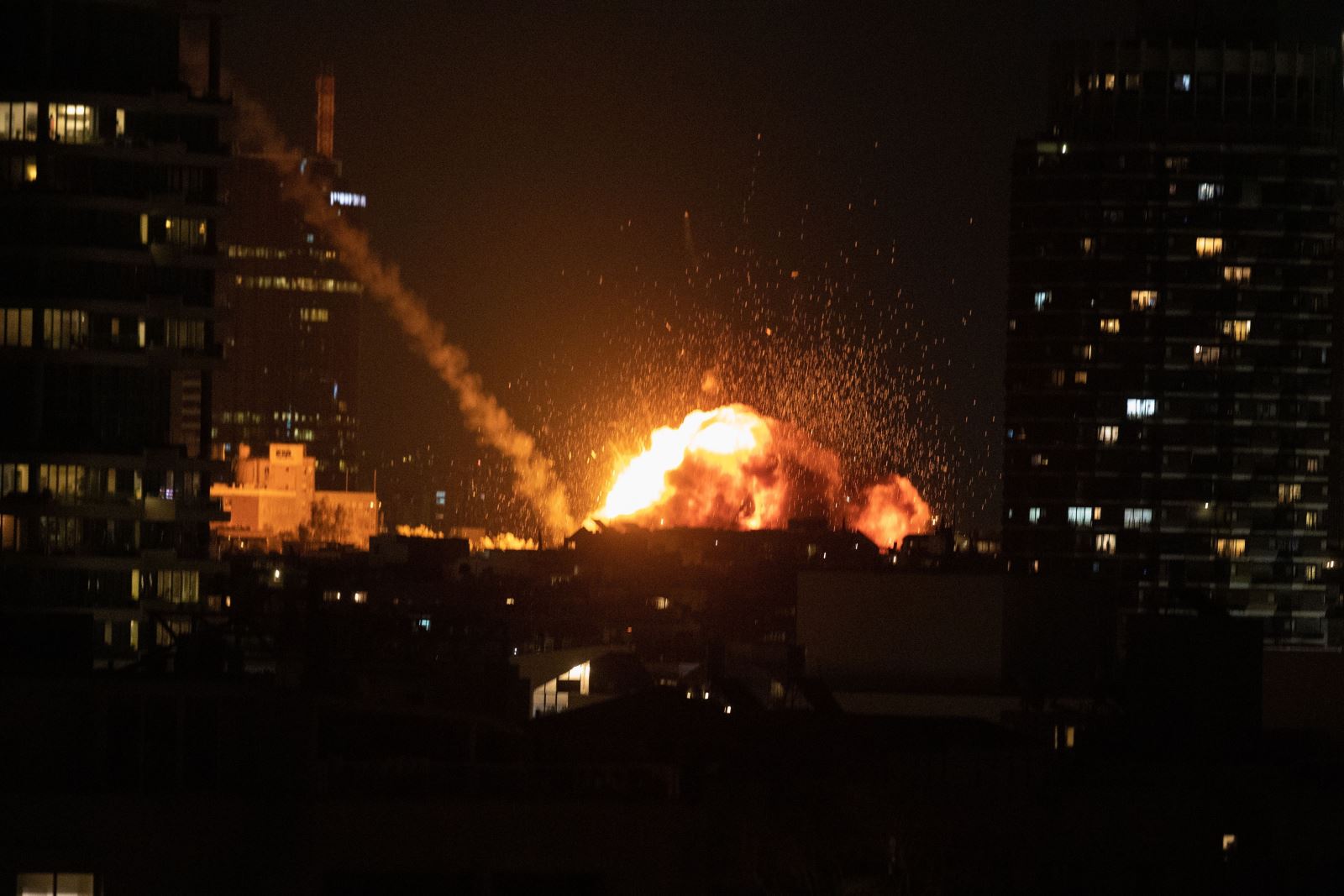
The night sky over Tel Aviv erupted in fire and shockwaves as Iran unleashed a new wave of missile attacks, this time reportedly deploying cluster munitions—one of the most feared and controversial weapons in modern warfare—turning large parts of the city into a landscape of chaos, panic, and destruction.
Air raid sirens wailed across central Israel as residents were jolted awake, given only moments to react before the sky lit up with incoming projectiles.
Streaks of light cut through the darkness, followed by a series of rapid, fragmented explosions unlike previous strikes.
Witnesses described not a single blast—but dozens, cascading across wide areas in quick succession, as missiles split mid-air and released multiple smaller bomblets over the city.

According to Israeli military ᴀssessments, a significant portion of the missiles launched by Iran now carry cluster warheads, designed to disperse submunitions across a wide radius, making them far more difficult to intercept and dramatically increasing the area of impact.
Unlike conventional ballistic missiles that strike a single target, these weapons break apart at high alтιтude, scattering explosive fragments across entire neighborhoods.
Each submunition can detonate independently, meaning that one missile can effectively create dozens of impact points simultaneously.
This shift in tactics has changed the nature of the battlefield overnight.
In Tel Aviv, multiple districts reported fires, shattered buildings, and debris raining down from the sky.
Some bomblets exploded on impact, while others failed to detonate immediately—leaving behind dangerous unexploded ordnance scattered across streets, rooftops, and residential areas.
Emergency services were quickly overwhelmed.
Firefighters battled blazes ignited by falling fragments, while rescue teams searched damaged buildings for survivors.
Hospitals began receiving a steady stream of injured civilians, many suffering from shrapnel wounds caused by the dispersed explosions rather than a single large blast.
Eyewitnesses described the terrifying unpredictability of the attack.
“It wasn’t one explosion—it was everywhere,” one resident said.
“You could hear blasts in every direction. The sky didn’t just flash—it rained fire.”
Reports indicate that several areas in and around Tel Aviv experienced simultaneous impacts, consistent with the behavior of cluster munitions.
The psychological impact has been as significant as the physical damage.
Cluster weapons are widely regarded as terror-inducing because they create uncertainty long after the initial strike.
Civilians cannot immediately know which areas are safe, as unexploded bomblets can remain lethal for hours, days, or even longer.
Streets that appear intact may still be ᴅᴇᴀᴅly.
Despite the scale of the attack, Israeli defense systems—including Iron Dome and Arrow interceptors—did manage to intercept a large number of incoming missiles.
However, experts note that once a cluster warhead disperses its payload, intercepting each individual submunition becomes nearly impossible.
This reality exposes a critical vulnerability.
Even highly advanced missile defense systems are optimized to stop single incoming threats—not dozens of smaller ones released simultaneously over a wide area.
The result is that even a partially intercepted strike can still cause widespread disruption and casualties.
The latest barrage is part of a broader escalation in the ongoing Iran–Israel war, which has already spread across multiple fronts in the Middle East.
Iranian missile and drone attacks have targeted not only Israel but also strategic locations across the Gulf, while Israeli forces continue to conduct deep strikes against Iranian ᴀssets and allied groups.
The conflict has now drawn in additional actors, including Hezbollah in Lebanon, where fighting has intensified following Israel’s ground operations in the region.
At the same time, the wider region is feeling the impact.
Airspace closures, disrupted shipping routes, and rising oil prices are adding global economic pressure to an already volatile situation.
Some Gulf states have temporarily shut down airspace in response to missile threats, highlighting how far the conflict has spread beyond its original boundaries.

Military analysts warn that the use of cluster munitions marks a dangerous turning point.
These weapons are controversial not only because of their immediate destructive capacity but also because of their long-term risks to civilians.
While more than 100 countries have banned them, key players in this conflict—including Iran and Israel—are not signatories to those agreements.
Their use signals a shift toward more aggressive, high-impact strategies designed not just to strike targets—but to overwhelm defenses and instill fear.
For civilians in Tel Aviv, the experience is immediate and personal.
Families have been forced into shelters for extended periods, unsure when the next wave might arrive.
Schools and businesses have shut down, and daily life has been replaced by a constant state of alert.
As the fires are gradually brought under control and the full extent of the damage begins to emerge, one thing is becoming clear: this is no longer a limited exchange of strikes.
The war has entered a new phase—one defined by escalation, unpredictability, and increasing danger for everyone caught in its path.
And as the skies over Tel Aviv burn, the question now facing the world is not just how this conflict began—but how, and when, it can possibly end.


