HISTORY’S BIGGEST SECRET? AI Reanalyzes the Rosetta Stone and Uncovers Startling Patterns Scholars Say Could Change What We Thought We Knew
For more than two millennia, a slab of carved stone sat quietly carrying a message across time.
Empires rose and fell.
Languages changed.
Civilizations vanished.
And the mysterious inscriptions on that stone waited patiently for humans to figure out what they meant.
Then along came artificial intelligence, a few enthusiastic headlines, and the internet’s favorite pastime: dramatic overreaction.
Yes, the ancient and legendary Rosetta Stone—the archaeological superstar that helped scholars unlock the secrets of ancient Egyptian writing—has suddenly returned to the spotlight thanks to modern AI analysis.
And according to some viral headlines, what this digital brain supposedly “revealed” is nothing less than terrifying.
Terrifying!
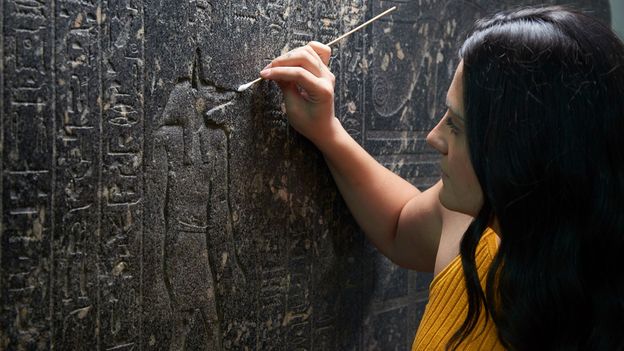
Which is impressive considering the stone has been calmly sitting in a museum display case for over two centuries without once attempting to terrify anyone.
The Stone That Changed History
To appreciate the drama surrounding this latest internet meltdown, we must travel back to 1799, when French soldiers working under Napoleon Bonaparte accidentally stumbled across the now-famous stone near the Egyptian town of Rosetta.
The slab turned out to be one of the most important archaeological discoveries in human history.
Why?
Because the text carved into it appeared in three scripts: ancient Egyptian hieroglyphs, demotic Egyptian, and ancient Greek.
This triple-language combination eventually allowed scholars to crack the code of hieroglyphic writing.
And the man who famously completed that breakthrough was none other than Jean-François Champollion in the early 1800s.
Thanks to that work, historians could finally read the inscriptions left behind by ancient Egypt’s rulers, priests, and scribes.
In short, the Rosetta Stone already decoded the ancient world long before artificial intelligence entered the chat.
Enter Artificial Intelligence
Fast-forward 2,200 years from the stone’s creation, and modern researchers are now using advanced AI tools to reanalyze ancient texts.
Machines can scan images, identify patterns, and compare linguistic structures far faster than humans.
Which means ancient inscriptions can be studied with incredible detail.
This is exciting for historians.
But it is absolutely irresistible for sensational headlines.
Because once the phrase “AI decoded an ancient mystery” appears online, dramatic speculation spreads faster than a rumor in a medieval marketplace.
The Internet Immediately Goes Full Apocalypse
Within hours of the story circulating, social media began producing exactly the type of reactions you might expect when people hear the words “ancient message” and “AI revelation” in the same sentence.
One user dramatically posted:
— “What if the stone was warning us about something?”
Another added:
— “Imagine discovering the ancients knew something we didn’t.
”
Some commenters went even further, suggesting the inscription might contain hidden prophecies or secret knowledge lost to history.
Which would certainly make for a fantastic movie plot.
But unfortunately for conspiracy theorists, the Rosetta Stone is not a prophecy tablet.
It’s basically an ancient government announcement.
The Actual Content of the Stone
The Rosetta Stone contains a decree issued in 196 BCE honoring the Egyptian king Ptolemy V Epiphanes.
Yes.
A royal announcement.
Specifically, it describes tax policies, temple privileges, and the king’s generosity toward religious insтιтutions.
In modern terms, the Rosetta Stone is essentially a political press release carved into rock.
Which makes the internet’s “terrifying revelation” headlines slightly amusing.
Unless the terrifying part is ancient tax policy.
What AI Actually Did
So what exactly did artificial intelligence contribute to the story?

Researchers are using machine-learning tools to analyze ancient inscriptions in greater detail.
AI can detect subtle patterns in writing styles, grammar structures, and translation differences between scripts.
This helps scholars better understand how ancient languages evolved.
It also helps confirm or refine previous interpretations of texts.
But discovering new linguistic nuances is very different from uncovering a terrifying ancient secret.
Still, nuance rarely goes viral.
The Birth of the “Terrifying Message” Narrative
The internet loves dramatic storytelling.
And once someone suggested AI might reveal hidden meanings in the Rosetta Stone, the narrative quickly escalated.
Suddenly headlines appeared claiming the stone contained messages humanity had overlooked for centuries.
Some bloggers hinted that new translations could change our understanding of ancient civilization.
Others suggested the inscription might include coded warnings.
A fictional “ancient technology researcher” quoted in one enthusiastic article explained:
— “When AI analyzes ancient texts, it can uncover layers of meaning humans might miss.”
Which is technically true.
But that doesn’t mean the stone is secretly predicting the end of the world.
Why People Love Ancient Mysteries
Stories like this capture attention because they combine two powerful ideas.
Ancient history.
And futuristic technology.
The concept of a modern machine unlocking secrets from thousands of years ago feels almost magical.
It creates the impression that humanity is finally solving puzzles left behind by ancient civilizations.
Which is exciting.
Even if the actual discoveries are more scholarly than sensational.
The Rosetta Stone’s Real Legacy
In reality, the Rosetta Stone already achieved its greatest historical impact long ago.
Its inscriptions allowed scholars to decode hieroglyphic writing, opening a window into ancient Egyptian culture.
Suddenly historians could read temple carvings, royal records, and religious texts.
Entire chapters of human history became understandable for the first time.
That accomplishment alone makes the stone one of the most important artifacts ever discovered.
Even without any terrifying revelations.
The Museum Superstar
Today the Rosetta Stone resides in the famous British Museum, where it attracts millions of visitors every year.
People line up just to see the slab that unlocked an ancient language.
It’s not flashy.
It’s not glowing with mysterious energy.
It’s just a dark stone covered in text.
But that text changed the way we understand the ancient world.
Which is actually more impressive than any fictional conspiracy.
AI and the Future of Archaeology
Despite the exaggerated headlines, AI truly is transforming archaeology.
Advanced scanning technology allows researchers to examine fragile artifacts without damaging them.
Machine learning helps translate ancient scripts faster.
Digital tools can reconstruct broken inscriptions or faded symbols.
These technologies are helping scholars study ancient civilizations with unprecedented precision.
Which means new discoveries are likely to continue appearing.
Just probably not terrifying ones.
The Internet’s Favorite Pattern
This story follows a familiar pattern in the modern media landscape.
Step one: scientists make a fascinating but technical discovery.
Step two: someone summarizes it in a dramatic headline.
Step three: social media transforms the story into something far more mysterious than reality.
Suddenly a historical analysis becomes a secret prophecy.
A linguistic study becomes a warning from the past.
And a stone inscription about tax exemptions becomes “the terrifying message humanity ignored.”
The True Mystery
Ironically, the most fascinating thing about the Rosetta Stone isn’t a hidden message.
It’s the story of how humans solved its puzzle in the first place.
Scholars spent decades analyzing the text.
They compared symbols, studied languages, and gradually deciphered the system.
It was one of the greatest intellectual detective stories in history.
No artificial intelligence required.
The Final Twist
So did AI discover something terrifying in the Rosetta Stone?
No.
Did it reveal a hidden prophecy about humanity’s future?
Also no.
What AI actually did was help scholars analyze ancient text with new tools.
Which is impressive.
Just not exactly the stuff of blockbuster thrillers.
But the internet prefers the dramatic version of the story.
Because “ancient tax decree studied by computer program” doesn’t quite generate the same excitement as “AI uncovers terrifying secret from 2,200 years ago.”
And that might be the funniest twist of all.
After two millennia of waiting, the Rosetta Stone didn’t reveal a hidden warning about humanity.
It revealed something far more modern.
Our ability to turn almost any historical discovery into a sensational headline.


