20 Feet a Year: The Ocean Is Swallowing the Outer Banks and Entire Homes Are Disappearing
A dramatic and unsettling transformation is unfolding along the fragile shoreline of North Carolina, where powerful ocean forces are steadily erasing sections of the famous barrier islands known as the Outer Banks.
Entire stretches of coastline are disappearing at an alarming pace, with some areas reportedly losing as much as 20 feet of land each year.
The relentless erosion has already claimed more than 30 homes, and many residents now fear that the sea is slowly advancing toward the rest of their communities.
For generations, the Outer Banks have been celebrated for their wide sandy beaches, historic coastal towns, and dramatic views of the Atlantic Ocean.
The chain of narrow barrier islands stretches for miles along the coast of North Carolina, acting as a natural shield that protects the mainland from powerful ocean storms.
But the same ocean that helped shape the beauty of the islands is now threatening their very existence.

Residents living along these barrier islands have watched the shoreline move closer year after year.
What was once a comfortable distance between homes and the ocean has, in many cases, shrunk dramatically.
Storm tides and waves now reach areas that were once dry land.
In several communities across the Outer Banks, houses that once stood safely behind dunes have been left dangerously exposed as those natural barriers slowly disappeared.
Some homes have collapsed into the ocean after losing the sand beneath their foundations.
Others have been condemned or dismantled before the water could reach them.
Local officials say more than 30 houses have already been lost as the shoreline continues retreating inland.
The process of coastal erosion has accelerated in recent years, driven by a combination of powerful storms, rising sea levels, and the natural movement of barrier islands.
Barrier islands like the Outer Banks are constantly shifting landscapes shaped by wind, waves, and tides.
Unlike rocky coastlines, these islands are built almost entirely from sand, making them highly vulnerable to the forces of the ocean.
During major storms, waves can wash away enormous amounts of sand in just a few hours.
When those storms strike repeatedly over several seasons, the coastline can retreat dramatically.
Residents remember when the beach in front of their homes stretched wide and far toward the horizon.
Now, in some places, the ocean is only a short distance away from buildings that were once considered safely inland.
Each year, the shoreline creeps closer.
Coastal scientists studying the erosion patterns say some sections of the Outer Banks are losing around 20 feet of land annually.
That rate may sound small at first, but over time it can dramatically reshape entire communities.
A stretch of beach that loses 20 feet every year will retreat more than 200 feet in a decade.
For homeowners, that kind of change can transform a peaceful seaside property into a structure at risk of being claimed by the ocean.
Storms have played a major role in accelerating the damage.
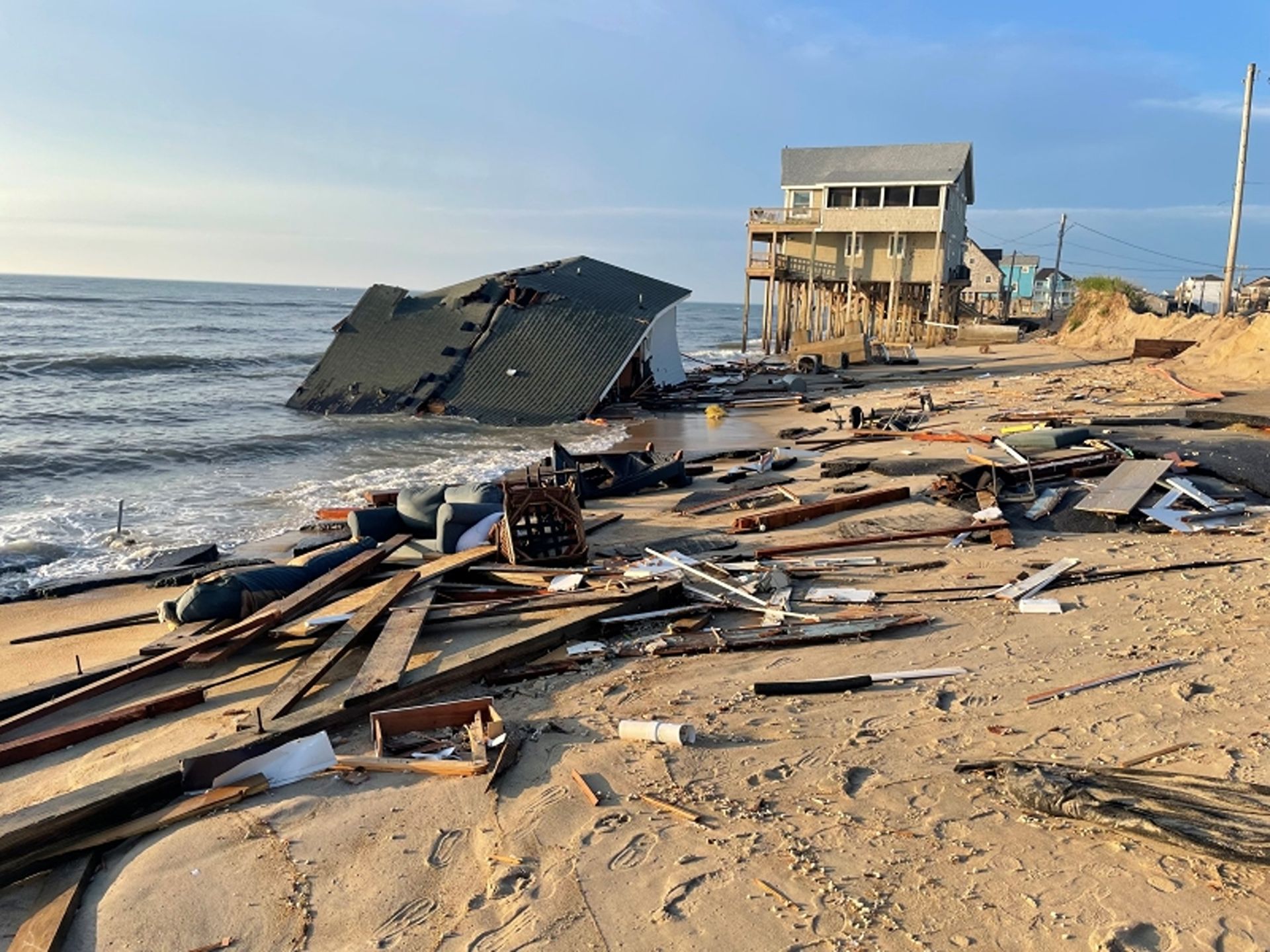
The Atlantic coastline regularly experiences powerful hurricanes and tropical storms, and each major storm can dramatically reshape the fragile islands.
High waves and storm surges push deep into the shoreline, stripping away sand dunes and carving steep edges along the beaches.
Those dunes once served as natural protection for homes and roads behind them.
When they disappear, communities become far more vulnerable.
Residents describe watching storms roll in from the Atlantic with a new sense of anxiety.
The crashing waves that once seemed distant now appear alarmingly close to their homes.
Some property owners have attempted to protect their houses by adding sandbags or reinforcing the ground beneath their structures.
Others have raised their homes on higher foundations to keep them above potential storm surge levels.
But experts warn that these measures can only slow the inevitable if erosion continues at its current pace.
Local authorities have already faced difficult decisions about how to respond.
In some cases, homes that are at risk of collapsing into the ocean must be demolished for safety reasons.
A collapsing house can scatter debris across the beach and into the water, creating hazards for nearby communities and wildlife.
Officials also worry about the impact of damaged infrastructure.
Roads, utility lines, and water systems located along the narrow islands could also become vulnerable if erosion continues pushing the shoreline inland.
Tourism is another concern.
The Outer Banks attract millions of visitors each year who come to enjoy the beaches, fishing, and historic coastal landmarks.
Those visitors support local businesses, H๏τels, and restaurants that depend heavily on the region’s natural beauty.
If the beaches shrink significantly, the local economy could face serious challenges.
Scientists studying coastal changes say the situation unfolding along North Carolina’s barrier islands reflects a broader pattern seen in many coastal regions around the world.
Sea levels have been gradually rising in recent decades, allowing waves to reach further inland than they once did.
Even small increases in sea level can significantly accelerate erosion along sandy coastlines.
At the same time, powerful storms appear to be occurring more frequently, bringing stronger waves and higher storm surges.

When these factors combine, fragile coastal landscapes like the Outer Banks can change quickly.
For residents, the changes are not just scientific statistics—they are visible realities.
Some longtime homeowners have already moved away after realizing the shoreline was approaching too quickly.
Others remain determined to stay, even as the ocean inches closer each year.
Walking along the beach in certain areas, visitors can see the evidence of erosion clearly.
Steep sandy cliffs line sections of the shore where waves have carved away the land.
Broken pieces of wood and debris from destroyed structures sometimes appear along the waterline.
These are reminders of homes that once stood there.
Despite the growing threat, many residents remain deeply connected to the islands they call home.
Families have lived along the Outer Banks for generations, building lives around fishing, tourism, and the rhythms of the Atlantic Ocean.
Leaving is not an easy decision.
For now, the battle between land and sea continues.
Each storm season brings new uncertainty as powerful waves reshape the coastline once again.
With erosion advancing at an estimated 20 feet each year in some locations, the future of many homes along the North Carolina coast remains uncertain.
The Atlantic Ocean keeps pushing forward.
And along the fragile sands of the Outer Banks, communities are watching closely as the shoreline slowly disappears into the sea.
🌊⚠️🏠


