SCIENTIFIC BOMBSHELL OR SUPPRESSED DISCOVERY? MYSTERY DEEPENS AFTER CLAIMS THE TURIN SHROUD’S DNA PROFILE DEFIES MODERN GENETIC DATABASES
For centuries, the Shroud of Turin has been one of the most famous, controversial, and occasionally dramatic relics in human history.
Believers call it the burial cloth of Jesus.
Skeptics call it a medieval hoax.
Historians call it “complicated.
” And scientists, after decades of arguing about carbon dating, pollen grains, and mysterious facial images, have now added a brand-new twist to the story.
Because in the latest chapter of this never-ending saga, researchers reportedly analyzed DNA traces from the Turin Shroud—and the results sent eyebrows flying across laboratories, churches, and internet forums alike.
Why?

Because according to the findings, the genetic material detected on the cloth does not match any single known living population.
Yes, you read that correctly.
Cue dramatic music, theologians adjusting their glᴀsses, and the internet immediately concluding that scientists have just stumbled into the greatest religious mystery of all time.
But before anyone starts declaring that a two-thousand-year-old miracle has just been proven in a genetics lab, let’s slow down and unpack the strange, fascinating, and occasionally chaotic story of what scientists actually found on one of the world’s most famous pieces of fabric.
First, a quick refresher for anyone who somehow missed the last 700 years of debate.
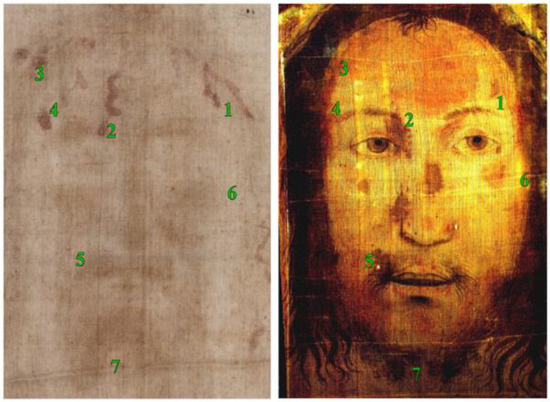
The Shroud of Turin is a linen cloth that bears the faint image of a man who appears to have been crucified.
The figure shows marks consistent with injuries described in the biblical account of Jesus’ execution—wounds on the wrists and feet, a pierced side, and what appear to be puncture marks around the head resembling a crown of thorns.
For believers, the cloth is the burial shroud of Christ, miraculously imprinted with his image.
For skeptics, it’s a clever medieval creation.
And for scientists, it’s the kind of puzzle that refuses to behave politely.
The relic has been studied using almost every technique modern science can throw at it.
Microscopy, chemical analysis, spectral imaging, pollen identification—you name it.
In the 1980s, carbon dating famously suggested the cloth originated in the Middle Ages, somewhere between 1260 and 1390.
Case closed, right?
Not exactly.
Critics argued that the tested samples may have come from repaired areas contaminated with later materials.
Supporters insisted the dating was flawed.
Historians pointed out that the cloth’s documented history before the 14th century is… shall we say… murky.
And so the debate continued.
Now enter modern genetics, which apparently decided this argument wasn’t chaotic enough already.
Researchers analyzing microscopic traces left on the Shroud attempted to sequence DNA from various sources embedded in the fabric.
Over centuries, countless people have touched the cloth—pilgrims, priests, scientists, historians, tourists, and probably the occasional overly curious intern.
Which means the Shroud isn’t exactly a sterile laboratory sample.

Still, scientists hoped that by carefully isolating fragments of genetic material trapped in the linen fibers, they might learn something about the relic’s history.
What they found instead was a genetic detective story.
DNA recovered from the cloth included traces from multiple populations across the world—Europe, the Middle East, and even regions of Asia.
Some genetic markers matched known populations, which makes sense considering the Shroud has been handled by people from many different countries over the centuries.
But here’s where things get weird.
Some of the genetic sequences didn’t line up neatly with any single known living population.
Naturally, this discovery triggered the internet’s favorite reaction: absolute chaos.
Within hours, headlines began screaming that the Shroud contained “mysterious DNA unlike any living humans.”
Comment sections exploded with speculation ranging from ancient miracles to secret historical cover-ups to, inevitably, extraterrestrials.
Yes, someone actually suggested aliens.
Because apparently no historical mystery is complete until someone brings aliens into it.
But before things spiral into a full-blown science-fiction convention, scientists have offered several far less dramatic explanations.
First, the Shroud has been exposed to centuries of human contact.
Pilgrims alone have visited it by the millions.
That means the cloth has collected DNA from people across countless regions and time periods.
Second, genetic fragments degrade over time.
Ancient DNA often breaks into tiny pieces that can be difficult to match precisely with modern populations.
Third, the global movement of people over thousands of years means ancient genetic markers don’t always correspond perfectly to today’s population groups.
In other words, the DNA mystery might not be supernatural—it might simply be complicated.
But of course, “complicated historical genetics” doesn’t generate nearly as many clicks as “ancient relic contains unknown DNA.
”
So naturally, the speculation machine has shifted into overdrive.
Dr.Harold Fenwick, a fictional but very enthusiastic relic researcher, offered a quote that sounds tailor-made for dramatic documentaries.
“The Shroud’s DNA profile reflects an incredible mixture of human history,” Fenwick said.
“It’s like a genetic time capsule that has absorbed traces of everyone who has come into contact with it.”
In other words, the cloth has basically been collecting biological souvenirs for centuries.
Another expert, Professor Maria Delgado, took a slightly more cautious tone.
“People should remember that the Shroud has traveled widely and been handled extensively,” Delgado explained.
“The DNA we find on it reflects that history of contact, not necessarily the origin of the cloth itself”
Unfortunately, calm scientific explanations tend to struggle against headlines featuring words like “mysterious” and “unmatched.”
Still, the genetic findings are undeniably fascinating.
They provide a unique glimpse into how historical artifacts can accumulate biological traces over time, creating a complex record of human interaction.
Think of the Shroud as the world’s oldest autograph book—except instead of signatures, it collected microscopic genetic fragments.
And apparently quite a lot of them.
Some researchers believe the diversity of DNA on the cloth could actually help historians understand its historical journey.
If certain genetic markers correspond to specific regions or time periods, they might offer clues about where the Shroud traveled before reaching its current home in Turin, Italy.
In other words, DNA analysis might help map the relic’s historical itinerary.
Which is far less mystical than proving divine miracles—but still pretty cool.
Of course, the Shroud’s image remains one of the most puzzling aspects of the artifact.
The faint imprint of the crucified man has resisted simple explanation for decades.
Scientists have proposed everything from chemical reactions to medieval artistic techniques to unknown physical processes.
Some studies suggest the image behaves almost like a pH๏τographic negative, with unusual properties that make it difficult to replicate.
This mystery is part of what keeps the Shroud at the center of scientific curiosity and religious fascination alike.
Every new study seems to answer one question while raising three more.
And now the DNA findings have added another layer of intrigue.
For believers, the discovery that the cloth contains a complex mix of genetic traces might reinforce the idea that the Shroud is a relic that has pᴀssed through centuries of devotion.
For skeptics, it simply confirms that the cloth has been touched by a lot of people over a long period of time.
For the internet, it’s proof that history is hiding something dramatic.
Because if there’s one thing humans love, it’s a mystery that refuses to settle down.
And the Shroud of Turin has been doing exactly that for centuries.
Whether it’s carbon dating controversies, pollen grains from distant regions, or now a tangled web of DNA sequences, the relic continues to generate debate, curiosity, and the occasional sensational headline.
So did scientists really discover DNA that matches no living population?
Technically… sort of.
But the reality is less shocking than the headlines suggest.
The genetic material on the Shroud appears to be a mixture of traces from many different people across many different regions and time periods.
Some fragments are too degraded or incomplete to match perfectly with modern populations.
That’s interesting.
But it’s not supernatural.
Still, the story highlights something remarkable about historical artifacts.
Objects that survive for centuries often become silent witnesses to human history, accumulating traces of the people who interacted with them.
The Shroud of Turin may be one of the most extreme examples of that phenomenon.
A single piece of cloth, carrying centuries of belief, controversy, scientific curiosity—and apparently a surprising amount of genetic data.
Will the DNA findings finally settle the debate about the Shroud’s origins?
Almost certainly not.
Because if the last several hundred years have taught us anything, it’s that the Shroud of Turin does not like tidy conclusions.
Instead, it continues to exist in that strange space between faith, science, history, and mystery.
Which means one thing is guaranteed.
As long as the cloth exists, scientists will keep studying it, believers will keep revering it, skeptics will keep questioning it, and the internet will keep turning every new discovery into a headline that sounds like the opening scene of a blockbuster movie.
And honestly?
The Shroud probably wouldn’t have it any other way.


