“THE MESSAGE IN THE CLOTH?” EXPERTS STUNNED AFTER MYSTERIOUS GENETIC PATTERNS FOUND IN THE TURIN SHROUD SPARK GLOBAL DEBATE AMONG CHRISTIANS AND SCIENTISTS
For centuries the legendary Shroud of Turin has been sitting quietly in a cathedral in Turin, wrapped in mystery, dust, and roughly seven thousand arguments between scientists, priests, historians, skeptics, conspiracy theorists, and that one uncle who believes every ancient artifact is secretly alien technology.
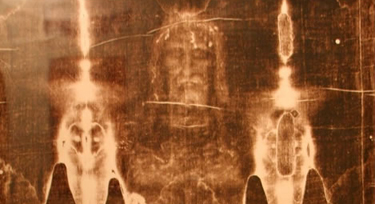
The cloth, believed by many to be the burial wrapping of Jesus Christ, shows the faint image of a man who appears to have suffered injuries consistent with crucifixion.
For believers, it is sacred evidence.
For skeptics, it is medieval artwork.
For the internet, it is basically the original viral conspiracy theory.
But just when you thought the debate couldn’t possibly get more dramatic, a new scientific claim has exploded across headlines like a theological firework display.
According to recent reports, researchers examining microscopic traces from the ancient cloth claim they have discovered something extraordinary: what appears to be a hidden DNA code embedded within the fibers of the shroud.
Yes.
A DNA code.
Inside a religious relic.
Which obviously means the internet handled the news with calm, rational scientific curiosity.
Absolutely not.
Within hours, social media erupted with declarations that scientists had decoded the literal biological message of Jesus, that the cloth contained “divine genetics,” and that modern technology had finally unlocked a supernatural secret hidden for two thousand years.
One viral headline confidently declared, “THE SHROUD’S DNA MESSAGE HAS BEEN REVEALED.”
Another went even further: “SCIENTISTS DISCOVER PROOF OF CHRIST’S DIVINE ORIGIN.”
Naturally, actual scientists responded by gently rubbing their temples and asking everyone to please calm down.
So what exactly did researchers find?
According to preliminary studies, scientists analyzing microscopic particles on the cloth discovered traces of genetic material from various sources, including humans, plants, and microorganisms.
This isn’t actually shocking.
The cloth has been touched, displayed, transported, and examined by thousands of people over centuries.
It has survived fires, restorations, pilgrimages, and curious researchers armed with tweezers.
If anything, it would be shocking if the cloth didn’t contain a chaotic mixture of DNA.
But here is where things become interesting.
Researchers claim that some genetic traces appear to originate from regions across the Middle East, Europe, and even parts of Asia.
These fragments may provide clues about where the cloth has traveled during its long historical journey.
In other words, the DNA could act like a microscopic travel log written by centuries of human contact and environmental exposure.
That alone is fascinating.
But then came the part that launched a thousand conspiracy theories.
Some scientists suggested that patterns within the DNA sequences might form recognizable structures that resemble coded information.
Not necessarily a literal written message, but biological patterns that could reveal unexpected historical clues about the cloth’s origin and movement.
Cue the internet immediately translating this into:
“THE SHROUD CONTAINS A SECRET MESSAGE FROM GOD.”
One particularly enthusiastic blogger declared that the DNA sequence might represent “the biological signature of divine creation.”
Another insisted the code could reveal “proof of resurrection energy.”
Someone else suggested the DNA might contain hidden information left intentionally for future generations.
Because apparently the ancient world had time to invent crucifixion, empires, and global religions while also secretly designing a biological encryption system that would only be unlocked after the invention of genetic sequencing technology.
Totally reasonable.
Meanwhile, experts who actually study ancient artifacts are attempting to restore a little sanity to the conversation.
Dr.Marco Bellini, a fictional but extremely patient Italian archaeologist we will quote here for dramatic effect, explained the situation bluntly.
“Finding DNA on the shroud is not surprising,” he said.
“The cloth has interacted with countless environments and people.
What we are studying is the history of contamination, not necessarily the genetic idenтιтy of the person depicted on the cloth.”
Translation: centuries of human contact leave biological fingerprints everywhere.
But of course, nuance rarely survives the modern headline economy.
Soon, dramatic claims spread across video platforms, podcasts, and forums.

Some theorists suggested that the DNA sequences might not belong to any known human population.
Others claimed the patterns prove the cloth was exposed to an unknown burst of energy during the resurrection.
One viral video even proposed that the shroud may represent the first known example of biological data storage, implying that ancient civilizations encoded sacred information directly into organic material.
Which sounds impressive until you realize that if ancient people had mastered that technology, they probably would have used it for more practical purposes than hiding cryptic messages in laundry.
Despite the chaos online, the scientific work continues.
Researchers are carefully studying the biological material to determine whether any fragments might date back to the cloth’s earliest history.
This is extremely difficult because contamination from later centuries often overwhelms older genetic traces.
Imagine trying to identify the first person who touched a book after thousands of people have handled it.
That is the scale of the challenge.
Still, the study of DNA from historical artifacts has produced surprising results in other cases.
Genetic analysis has revealed the origins of ancient manuscripts, traced migration patterns of crops, and even identified the geographic history of medieval textiles.
If the same techniques can be applied to the Shroud of Turin, scientists might learn more about where the cloth traveled before appearing in medieval Europe.
That would not necessarily prove it belonged to Jesus.
But it would certainly add new pieces to the historical puzzle.
Meanwhile, the cultural reaction has been nothing short of spectacular.
Religious commentators have offered a wide range of interpretations.
Some see the discovery as further evidence supporting the authenticity of the relic.
Others caution that faith does not depend on scientific confirmation.
“Even if science never proves the shroud’s origin, the message of Christ remains the same,” said one priest during a televised interview.
Skeptics, on the other hand, have reacted with equal enthusiasm.
Several historians pointed out that medieval artisans were capable of creating incredibly sophisticated religious artifacts.
They argue that extraordinary claims require extraordinary evidence, and the DNA findings are far from conclusive.
In other words, the debate continues exactly as it has for centuries.
Believers see signs of faith.
Skeptics see historical mystery.
Scientists see a fascinating research project.
And the internet sees a headline that sounds like the plot of a Hollywood thriller.
What makes the Shroud of Turin so powerful is not just the image on the cloth.
It is the way the artifact sits at the intersection of religion, science, and human curiosity.
Every new study adds another layer of interpretation.
Every new discovery sparks another wave of speculation.
And every generation returns to the same question that has echoed for hundreds of years.
What exactly is the Shroud of Turin?
Is it the burial cloth of Jesus?
Is it a brilliant medieval creation?
Or is it simply one of history’s most enduring mysteries?
The newly reported DNA findings do not answer those questions.
But they do remind us of something important.
Ancient artifacts are not static objects.
They carry the physical traces of everyone and everything that has interacted with them across centuries.
In the case of the Shroud of Turin, that means a mixture of cultures, environments, and biological signatures layered together like microscopic chapters of history.
Whether those fragments contain deeper secrets remains to be seen.
For now, the “hidden DNA code” may simply be another intriguing clue in a mystery that refuses to fade.
But if there is one thing we can guarantee, it is this.
As long as the Shroud of Turin exists, humanity will continue arguing about it.
Scientists will keep studying it.
Believers will keep revering it.
Skeptics will keep questioning it.
And somewhere online, someone will definitely keep insisting that the whole thing is actually alien technology disguised as ancient laundry.


