“THIS WASN’T SUPPOSED TO EXIST!” ADVANCED AI DECODES THE MYSTERIOUS ANTIKYTHERA MECHANISM AND UNCOVERS SECRETS THAT COULD REWRITE WHAT WE KNOW ABOUT ANCIENT TECHNOLOGY
Every few years the internet rediscovers a historical artifact and collectively gasps, “Wait… how did people build THIS two thousand years ago?”
This year’s star of the “ancient technology that makes modern humans feel slightly inadequate” show is none other than the mysterious Antikythera Mechanism, a corroded bundle of bronze gears that spent nearly two millennia relaxing on the seafloor before scientists dragged it back into the spotlight.
And now, thanks to modern artificial intelligence, researchers have taken another deep dive into the device.
The results?
Let’s just say historians are simultaneously fascinated, impressed, and mildly annoyed that ancient engineers appear to have been shockingly good at mechanical design.
Because according to the latest analysis, the Antikythera Mechanism was not just some decorative gadget or ancient maritime paperweight.
It was a mind-bendingly sophisticated astronomical calculator.

In other words, two thousand years ago someone built what might be the world’s first mechanical computer.
Yes.
A computer.
And they did it with bronze gears and patience.
The Shipwreck That Started the Mystery
The story begins in the year 1901 when sponge divers exploring the waters near the Greek island of Antikythera stumbled upon a shipwreck.
At first the divers thought they had found statues.
And they were correct.
The wreck contained an extraordinary cargo of ancient Greek sculptures, pottery, and other artifacts.
But buried among the treasures was a lump of corroded metal that looked about as exciting as a rusty door hinge.
That lump would later become famous as the Antikythera Mechanism.
Once researchers began examining it, they realized something strange.
Inside the corroded fragments were tiny gears.
Lots of them.
Not two gears.
Not five.
Dozens of precision-cut gears.
Which is the sort of discovery that causes historians to immediately spill coffee on their research notes.
Because complex gear systems were not supposed to exist in ancient technology.
At least that was the ᴀssumption.
The Ancient Gadget That Refused to Behave Like Ancient Technology
Over the decades scientists slowly pieced together the fragments of the mechanism.
X-ray scans revealed an intricate network of bronze gear wheels.
Some had dozens of teeth.
Some had inscriptions.
All of them were arranged with remarkable precision.
Eventually researchers realized what the device likely did.
It predicted astronomical events.
Yes.
The machine could track the movements of the Sun and Moon.
It could calculate eclipses.
It may even have predicted planetary motions.
All of this from a hand-cranked device built sometime around 100 BCE.
Which is roughly the moment in history when most people ᴀssume engineers were still figuring out how to build decent door hinges.
Instead, someone apparently decided to construct a mechanical model of the cosmos.
Enter Artificial Intelligence
Fast forward to the present day.
Modern scientists armed with advanced scanning technology and artificial intelligence have begun re-analyzing the mechanism’s design.
Their goal?
Reconstruct how the device originally worked.
Because unfortunately the artifact did not survive in pristine condition.
It spent centuries underwater.
Saltwater is famously rude to bronze machinery.
Large sections of the device are missing.
Others are badly corroded.
So researchers have been using AI models to simulate the missing pieces.
And the results are impressive.
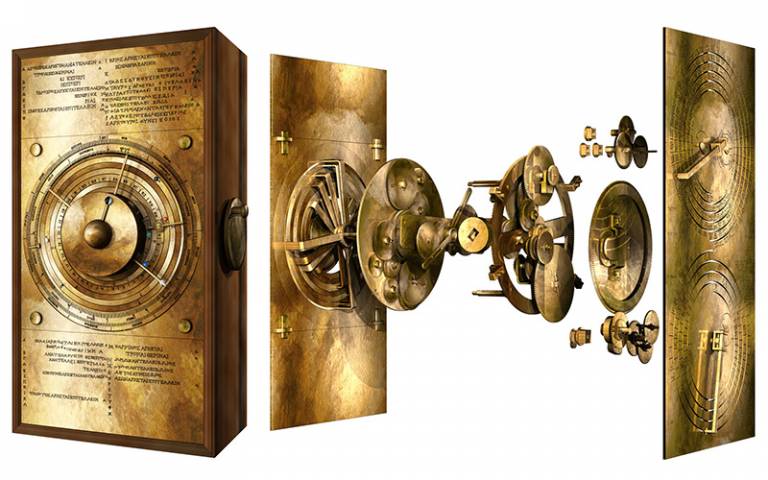
The AI reconstruction suggests the mechanism used a complex series of gear ratios to simulate celestial cycles with surprising accuracy.
One gear tracked the lunar cycle.
Another modeled the Greek eclipse prediction system known as the Saros cycle.
Others may have represented planetary movements.
In other words, the device was not just fancy.
It was mathematically brilliant.
Experts Attempt to Stay Calm
Dr.
Helen Markos, a classical historian studying ancient Greek engineering, described the moment researchers began understanding the mechanism’s complexity.
“At first we thought it was a simple astronomical calculator,” she said.
Then she paused.
“And then we realized it was… not simple.”
That is academic language for “we underestimated ancient engineers.”
Meanwhile, computer scientists analyzing the gear system have expressed admiration for the device’s elegant design.
One researcher joked that the ancient inventor probably would have enjoyed modern engineering conferences.
Although he might have asked why everyone now uses laptops instead of gears.
The Internet Immediately Goes Full Conspiracy Mode
Naturally, as soon as news spread that AI had analyzed the Antikythera Mechanism, the internet reacted in the most predictable way possible.
Calm curiosity?
No.
Measured historical discussion?
Also no.
Instead, online commentators began asking dramatic questions like:
“Did ancient civilizations have advanced technology?”
“Was this knowledge lost?”
“Were the Greeks secretly building computers while everyone else was still inventing chairs?”
One particularly enthusiastic conspiracy channel suggested the device might prove the existence of a forgotten high-tech civilization.
Historians, meanwhile, politely responded with the academic equivalent of an eye roll.
Because while the Antikythera Mechanism is astonishing, it does not require aliens or lost super-civilizations to explain.
It simply demonstrates something historians already know.
Ancient Greek scientists were extremely smart.
The Real Mystery
Perhaps the most fascinating question about the Antikythera Mechanism is not how it worked.
It is why technology like it seemingly disappeared for centuries.
Mechanical gear systems of comparable complexity did not appear again in Europe until medieval astronomical clocks many centuries later.
So where did the knowledge go?
Some historians suspect the device may have been part of a tradition of advanced scientific instruments used by Greek astronomers.
If that tradition existed, most examples may have been lost over time.
Bronze objects were often melted down and reused.
Shipwrecks destroyed others.
Libraries vanished.
History, unfortunately, has a terrible habit of losing things.
The Genius Behind the Machine
While the idenтιтy of the Antikythera Mechanism’s inventor remains unknown, some scholars have speculated about possible influences.
Ancient Greek astronomers like Hipparchus developed detailed models of planetary motion centuries before modern telescopes existed.
The mathematical knowledge required to design the mechanism likely came from this tradition of Greek astronomy.
Which means the device may represent the practical engineering application of sophisticated theoretical science.
In simpler terms: ancient scientists had big ideas, and someone decided to build a machine to demonstrate them.
The Machine That Predicted the Sky
Based on reconstructions, the Antikythera Mechanism likely featured a hand crank.
Turn the crank, and the gears rotated.
Those gears drove small pointers across dials marked with astronomical cycles.
The result?
A mechanical simulation of celestial movements.
Want to know when the next eclipse might occur?
Turn the crank.
Curious about lunar phases?
Turn the crank.
Basically, ancient astronomers built a portable cosmic calendar.
Which is extremely impressive considering they did it without electricity, digital displays, or YouTube tutorials.
The Dramatic Legacy
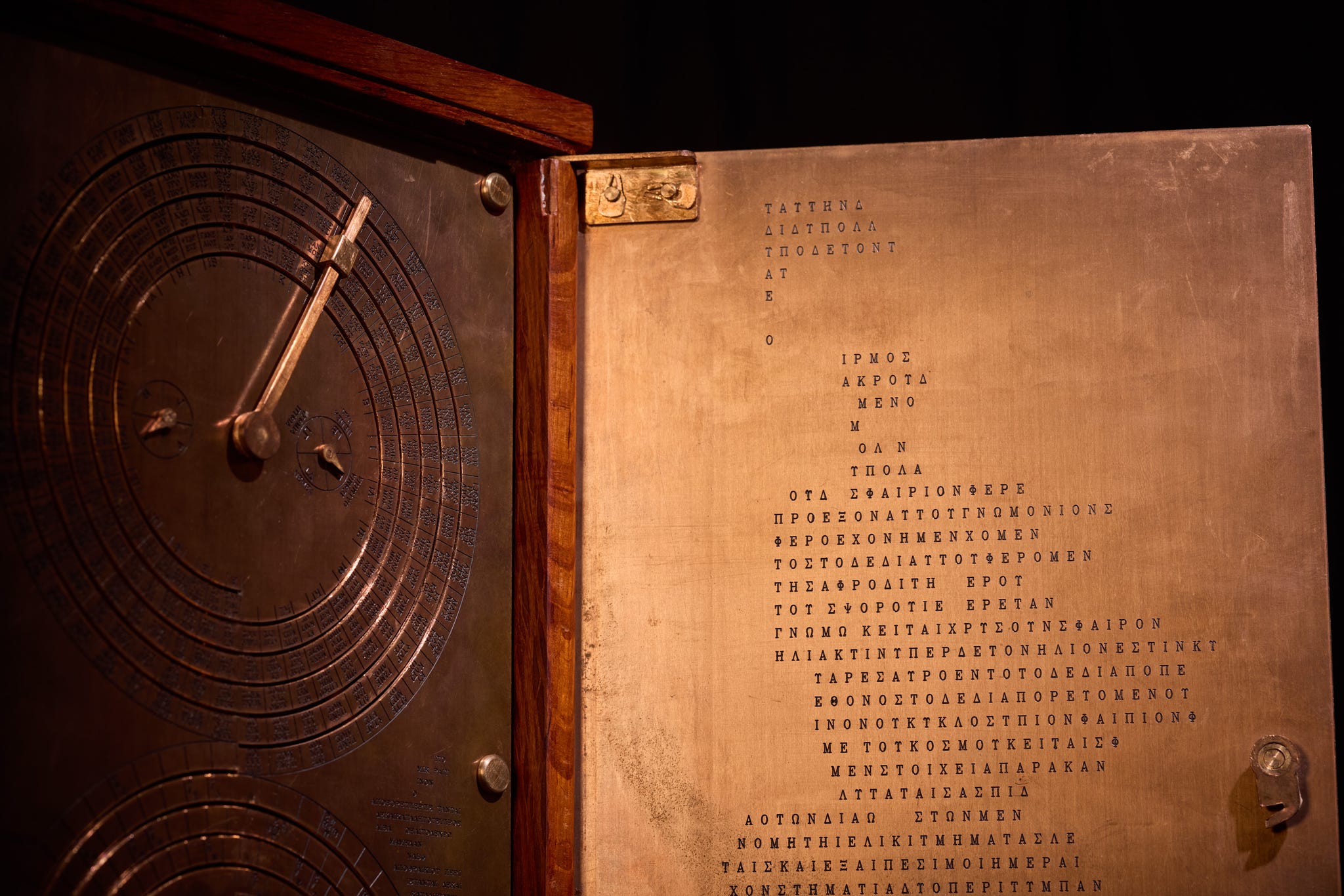
Today the Antikythera Mechanism sits in the National Archaeological Museum Athens, where visitors stare at the corroded fragments and attempt to imagine the device in its original glory.
Modern replicas demonstrate how the gears once moved.
The effect is strangely mesmerizing.
Watching the mechanism operate feels like glimpsing a moment where ancient craftsmanship meets modern engineering.
Because the truth is both simple and extraordinary.
Humans have always been clever.
Even two thousand years ago.
AI’s Final Verdict
So what did artificial intelligence ultimately reveal?
Not aliens.
Not lost super-technology.
Not secret ancient computers controlling the universe.
Instead, AI helped confirm something historians already suspected.
The Antikythera Mechanism was a masterpiece of ancient engineering.
It was a scientific instrument built by brilliant minds who understood mathematics, astronomy, and mechanical design.
And they did it with bronze gears.
Which is both inspiring and slightly embarrᴀssing for modern humans who sometimes struggle to program their microwave clocks.
The Artifact That Refuses to Stop Amazing People
More than a century after its discovery, the Antikythera Mechanism continues to fascinate scientists and historians.
Each new technological analysis reveals more about how it worked.
And each revelation reminds us that ancient civilizations were far more advanced than people often ᴀssume.
Because while modern technology has given us smartphones and satellites, the curiosity driving human innovation is timeless.
Two thousand years ago someone looked at the night sky and wondered how to track the movements of the heavens.
Then they built a machine to do it.
And centuries later, we are still trying to fully understand how they did it.
Which might be the most impressive part of the story.
Not that the Antikythera Mechanism existed.
But that its creator understood the universe well enough to build a working model of it.
Using nothing but gears, bronze, and a very patient mind.


