An 11-Minute Naval Clash That Never Happened—But Raises Real Questions
A gripping narrative has circulated online describing an Iranian commando ᴀssault on the USS Abraham Lincoln in the Persian Gulf—48 fast attack boats, 320 special forces personnel, and an 11-minute clash that supposedly reshaped naval strategy in the region.
It is important to state clearly: there is no public record of such an attack occurring. The scenario appears to be a fictionalized or dramatized war simulation. However, the story draws on real-world military doctrines, capabilities, and tensions that have long defined the Persian Gulf.
And that’s what makes it compelling.

For decades, Iran has invested heavily in asymmetric naval tactics. Rather than attempting to compete directly with U.S. carrier strike groups in conventional naval power, Iran’s Islamic Revolutionary Guard Corps Navy (IRGCN) has focused on:
-
Fast attack boats capable of swarm tactics
-
Coastal missile batteries
-
Naval mines
-
Submarines designed for littoral (shallow water) warfare
The idea behind swarm tactics is simple: overwhelm advanced defenses with numbers, speed, and unpredictable attack vectors.
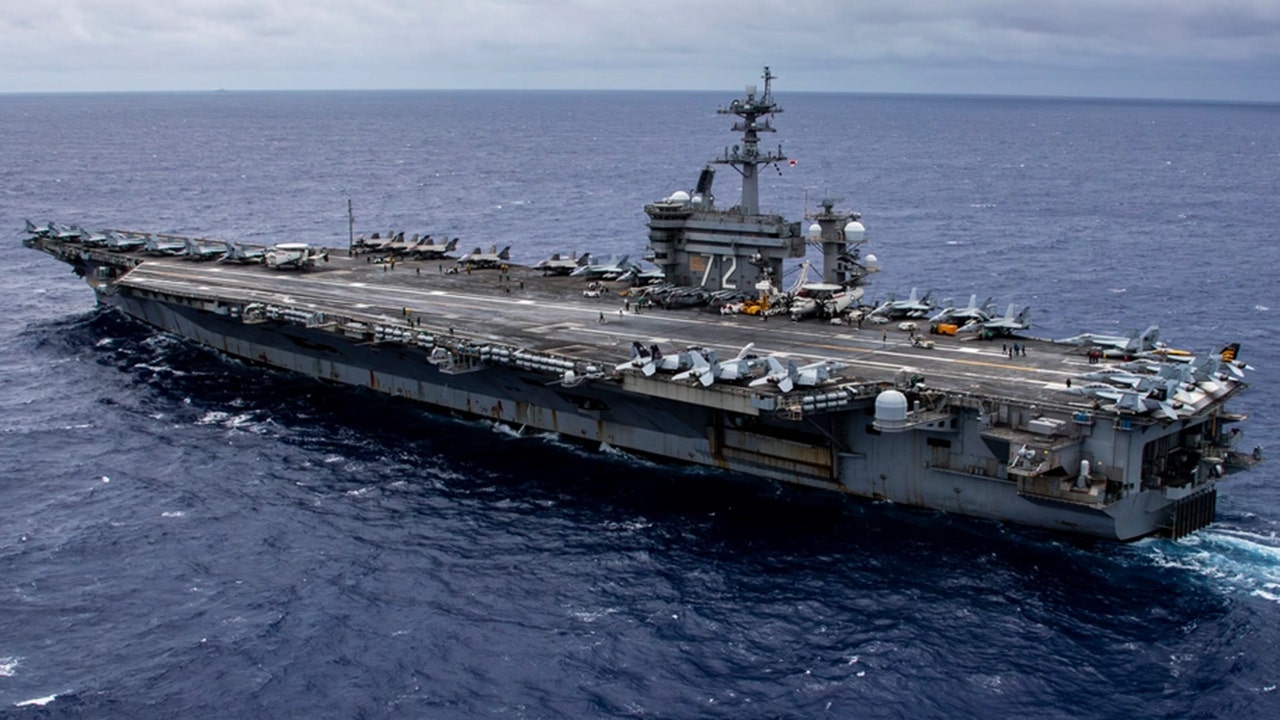
The fictional account amplifies this concept dramatically—depicting 48 boats converging simultaneously from multiple directions in an attempt to close distance with a U.S. aircraft carrier.
While exaggerated in scale and cinematic in execution, the tactical logic reflects real defense analysis debates.
U.S. aircraft carriers are among the most heavily defended military ᴀssets in existence. A carrier strike group typically includes:
-
Guided missile destroyers and cruisers with Aegis combat systems
-
Advanced radar and targeting systems
-
Close-in weapon systems (CIWS) for last-ditch defense
-
Combat air patrol aircraft
-
Electronic warfare capabilities
-
Submarine escorts
The narrative’s emphasis on layered defense—destroyers engaging at range, aircraft striking from above, and automated close-in systems activating at critical proximity—accurately reflects how U.S. naval doctrine approaches high-speed threats.
In real-world exercises, U.S. forces regularly train against swarm scenarios, particularly in confined waters like the Strait of Hormuz.
Roughly 20–21 million barrels of oil pᴀss through the Strait of Hormuz daily. Any confrontation in these waters carries immediate global economic implications.
That’s why even hypothetical engagements spark strong reactions. The story’s mention of oil futures spiking and regional recalculations mirrors how markets typically respond to even minor escalations in the Gulf.
The region has seen past incidents involving:
-
Small boat harᴀssment
-
Drone shoot-downs
-
Seizures of commercial tankers
-
Missile and rocket exchanges via regional proxies
However, no confirmed event resembling a full-scale commando ᴀssault on a U.S. supercarrier has occurred.
Even fictionalized depictions serve a purpose in strategic discussion.
They highlight:
-
The limits of asymmetric tactics against layered modern defenses
-
The risks of escalation in congested maritime zones
-
The psychological dimension of deterrence
-
The role of speed and decision-making in naval combat
Modern warfare is no longer just about firepower—it’s about coordination, electronic dominance, and split-second command decisions.
An 11-minute engagement in real life would not just be a tactical event. It would be a geopolitical earthquake.
In actual military strategy, deterrence is built on two pillars:
-
Capability — the ability to respond effectively
-
Credibility — the demonstrated willingness to act
Naval presence in the Persian Gulf is designed to reinforce both.
At the same time, regional stability depends on avoiding miscalculation. High-speed encounters between armed vessels in narrow waterways carry enormous escalation risk. That is precisely why communication channels, maritime deconfliction protocols, and rules of engagement are so critical.
The viral narrative frames the event as a decisive turning point that permanently altered the balance of power. In reality, naval deterrence in the Gulf is an ongoing, evolving dynamic—not something resolved in 11 minutes.
Technology advances. Tactics adapt. Political calculations shift.
What remains constant is this: any real engagement between Iranian forces and a U.S. carrier strike group would have consequences far beyond the immediate exchange of fire.
It would affect energy markets, regional alliances, global diplomacy, and potentially the broader balance of power.
The story may be fictional. The stakes it illustrates are very real.


