“THIS SHOULDN’T BE POSSIBLE!” — UNEXPLAINED SIGNALS FROM DEEP SPACE SPARK URGENT DEBATE AS VOYAGER 2 SENDS BACK BAFFLING DATA!
It finally happened.
After nearly half a century of politely minding its own business, cruising through the cold cosmic suburbs, NASA’s most introverted spacecraft has apparently “met something” at the edge of the solar system — and according to dramatic corners of the internet, it defies physics itself.
Cue the ominous soundtrack.
Cue the shaky YouTube thumbnails with glowing red arrows.
Cue at least twelve influencers whispering, “They’re not telling us everything.”
Let’s breathe.
The object of today’s cosmic hysteria is none other than Voyager 2, the legendary probe launched in 1977, back when disco was dominant, Star Wars was brand new, and no one imagined their washing machine would one day connect to Wi-Fi.
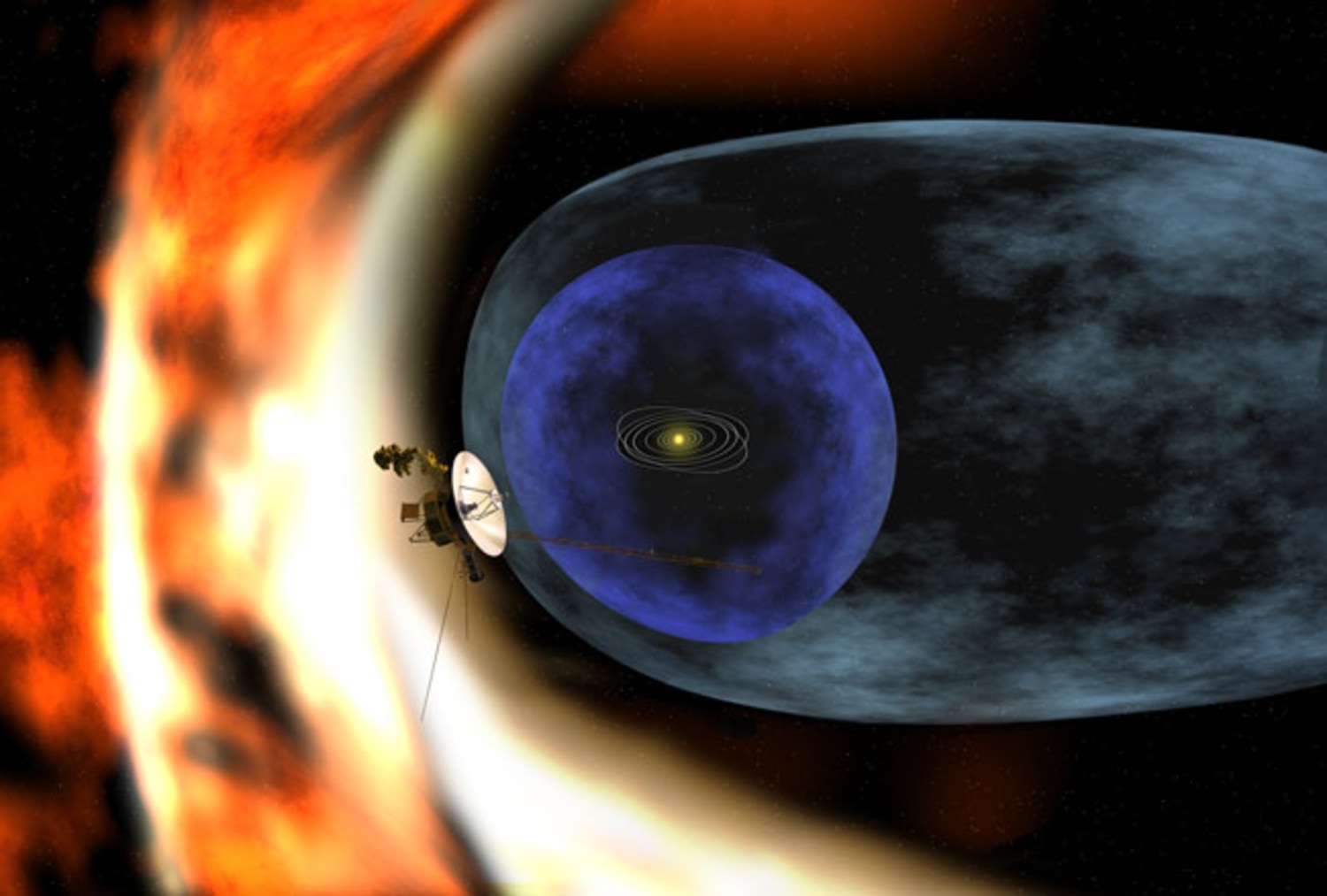
Voyager 2 has since traveled more than 12 billion miles, survived planetary flybys, and in 2018 officially crossed into interstellar space — the region beyond the heliosphere, where the Sun’s influence weakens and the galaxy starts to feel a little less neighborly.
And now? It has detected something unusual in that deep, dark frontier.
The phrase circulating online — “defies physics” — sounds like the beginning of a science fiction blockbuster.
In reality, what Voyager 2 encountered was an unexpected behavior in plasma waves and magnetic field measurements near the boundary between the heliosphere and interstellar space.
Not aliens.
Not a cosmic dragon.
Not a wormhole swirling with neon light.
Plasma.
Magnetic fields.
Subtle anomalies.
But try selling that in a headline.
Here’s what actually happened.
As Voyager 2 journeyed through the heliopause — the boundary where the solar wind meets interstellar medium — its instruments recorded changes in particle density and magnetic field orientation that did not perfectly match existing models.
The data suggested the boundary is more complex and dynamic than scientists had anticipated.
Instead of a clean, simple transition, the region behaves more like a turbulent cosmic shoreline.
Shoreline is poetic.

“Physics-defying anomaly” is viral.
Within hours of reports surfacing, the internet did what it does best: sprinted directly toward the most dramatic interpretation possible.
“Voyager 2 encounters unknown force at solar system edge,” one viral post claimed.
“NASA silent after spacecraft detects impossible phenomenon,” declared another.
NASA, for the record, was not silent.
NASA scientists calmly explained that the spacecraft detected variations in plasma density and magnetic field strength that help refine our understanding of interstellar space.
Which is exactly what space probes are designed to do.
But calm explanations rarely trend.
To understand why this matters — and why it does not signal the collapse of physics — we need context.
The heliosphere is essentially a giant bubble carved out by the Sun’s solar wind.
Inside that bubble, solar particles dominate.
Outside, the interstellar medium — a sparse soup of plasma, gas, and cosmic rays — takes over.
The boundary between them is not a neat line drawn in cosmic chalk.
It’s messy.
It fluctuates with solar activity.
It ripples.
When Voyager 2 crossed that boundary, it provided humanity with direct measurements of conditions beyond the Sun’s protective bubble.
That alone is historic.
Now, years into its interstellar journey, Voyager 2 continues sending back faint signals about particle densities and magnetic structures.
Recently analyzed data revealed that plasma waves in this region behave in ways that challenge simplified textbook diagrams.
The density gradients and field orientations appear more structured and less chaotic than expected — or, depending on interpretation, more chaotic than predicted.
Science thrives on such surprises.
The phrase “defies physics” typically means “does not match our current models,” not “rewrites the laws of reality.
” There is a difference.
A big one.

One leads to updated equations.
The other leads to alien invasion memes.
Guess which one went viral.
Within 24 hours, online commentators had already drafted entire narratives.
Some claimed Voyager 2 had “hit a barrier.
” Others insisted it encountered “an energy wall.
” A particularly dramatic livestreamer suggested, without blinking, that the spacecraft had reached “the edge of a simulation.
”
A simulation.
Somewhere, a theoretical physicist quietly closed their laptop.
In truth, the anomaly involves plasma oscillations — essentially vibrations in charged particles — behaving in ways that reveal more about the interstellar medium’s structure.
It’s complex.
It’s subtle.
It’s profoundly interesting if you enjoy astrophysics.
It is not a cosmic brick wall.
Let’s not forget that Voyager 2 carries instruments designed in the 1970s.
The fact that they are still functioning at all is borderline miraculous.
The spacecraft operates on diminishing power from a radioisotope thermoelectric generator.
Engineers have been carefully shutting down nonessential systems to preserve energy.
Every bit of data it sends back feels like a whisper from a distant era.
And now that whisper says, “Hey, interstellar space is weird.
”
Shocking.
One enthusiastic commentator declared, “This changes everything we know about the universe!” It does not change everything.
It refines our understanding of one region of space.
Physics remains intact.
Gravity still works.
Your coffee still falls downward when spilled.
What makes the story compelling isn’t that physics has collapsed.
It’s that we are still learning at the very edges of our reach.
Voyager 2 is effectively a time capsule with antennas, drifting farther from Earth each second, yet still contributing to cutting-edge science.
There is poetry in that.
Still, the drama refuses to die.
A popular conspiracy forum argued that if the data truly defied physics, NASA would “never admit it.
” This argument is impressively self-sealing.
If NASA explains it, that’s part of the cover-up.
If NASA doesn’t explain it, that’s proof of secrecy.
Meanwhile, astrophysicists continue analyzing particle flux, magnetic reconnection zones, and plasma wave frequencies like the professionals they are.
One researcher described the new findings as “a puzzle piece that forces us to reconsider boundary models.
” Notice the lack of screaming.
Another explained that the heliopause appears to interact with the interstellar medium in layered, dynamic ways.
Imagine wind hitting water.
The surface isn’t static.
It churns.
That complexity can produce measurements that initially look surprising.
Surprising is not supernatural.
But the phrase “defies physics” is irresistible.
It suggests we’ve reached the edge of understanding.
It implies a crack in reality.
It hints at secrets.
In fact, science advances precisely when observations don’t perfectly match predictions.
That tension is the engine of discovery.
If Voyager 2 had reported exactly what models predicted, the story would be, frankly, boring.
Instead, it reported something slightly off-script.
And that’s exciting.
Let’s talk about scale for a moment.
Voyager 2 is more than 120 astronomical units from the Sun.
Light from Earth takes over 18 hours to reach it.
Its signals are faint, requiring NASA’s Deep Space Network to capture and interpret them.
The idea that such a small, aging machine can still detect subtle plasma phenomena at that distance is extraordinary.
Yet online discourse turned it into a cosmic cliffhanger.
“Is Voyager 2 in danger?” some asked.
Not particularly.
It’s in deep space, which is inherently harsh, but it’s not about to crash into a galactic wall.
“Has it found evidence of another dimension?” No.
“Did it meet something?” In a sense, yes — it encountered variations in plasma and magnetic structures.
Not a handshake.
Not a glowing enтιтy.
More like drifting through invisible ripples.
The romantic part of us wants the edge of the solar system to feel dramatic.
A boundary.
A line.
A moment where space itself changes color.
Reality is subtler.
It’s gradients and fields and densities.
And yet, the subtlety is magnificent.
For the first time in human history, we have instruments directly sampling the interstellar medium.
Before Voyager, this region was theoretical.
Now it’s measured.
The anomalies being discussed suggest that the Sun’s influence extends in complex ways.
Magnetic fields may twist differently than expected.
Plasma densities fluctuate in structured patterns.
These insights help scientists understand not only our heliosphere but also how other stars interact with the galaxy.
So yes, it’s a big deal.
Just not the “physics has broken and the universe is glitching” kind of big deal.
Still, one cannot ignore the cultural moment.
We live in an era obsessed with boundaries — physical, digital, philosophical.
The idea of a spacecraft reaching the “edge” resonates deeply.
It feels like myth.
Like ancient explorers sailing toward unknown horizons.
Voyager 2 is our cosmic Magellan.
Except instead of wooden ships and sea monsters, it navigates magnetic fields and charged particles.
And occasionally triggers viral panic.
If there’s a twist in this saga, it’s this: the anomaly does not diminish physics.
It enriches it.
It reminds us that our models are approximations, constantly evolving.
The universe is not obligated to behave exactly as our diagrams suggest.
That doesn’t mean it’s breaking the rules.
It means our understanding is still growing.
The real shock is not that Voyager 2 met something at the edge of the solar system.
The real shock is that, nearly 50 years after launch, it’s still talking to us at all.
Somewhere in the darkness, powered by a fading nuclear battery, a probe built before the internet existed continues to transmit data that reshapes astrophysical conversations.
That’s not terrifying.
That’s astonishing.
So the next time you see a headline screaming about physics being defied at the edge of space, remember this: plasma waves are dramatic only if you squint hard enough.
The universe is vast.
The heliopause is complex.
Voyager 2 is brave in its silent, mechanical way.
And physics? Physics is doing just fine.


