Campi Flegrei & Vesuvius: A Hidden Connection 8KM Below — 3 Million People Living Right Above It?
Beneath the restless ground west of Naples, instruments have been listening more closely than ever.
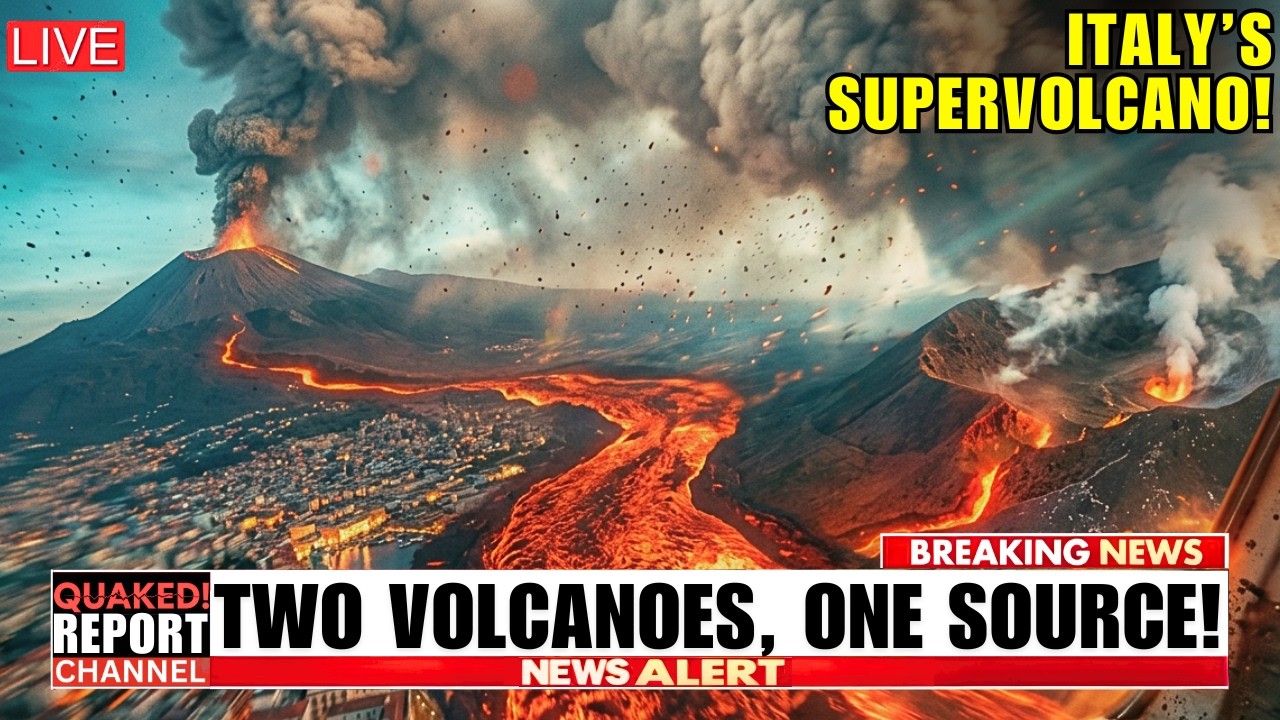
What they are picking up is subtle, almost hesitant — a tremor here, a pulse there — yet persistent enough to unsettle even seasoned volcanologists.
At roughly eight kilometers below the surface, where rock softens into something less solid and more suggestive, data points appear to trace a pattern no one is eager to name too quickly.
The space between Campi Flegrei and Mount Vesuvius may not be as separate as once believed.
For decades, these two volcanic systems were treated as neighbors sharing the same skyline but not the same bloodstream.
Campi Flegrei, the sprawling caldera with its history of slow uplift and gas emissions, has long been regarded as unpredictable, even temperamental.
Vesuvius, infamous for its catastrophic eruption in AD 79, stands with an entirely different reputation — direct, explosive, historically lethal.
They are different personalities carved into the same landscape.
Or so it was ᴀssumed.
Recent geophysical surveys, however, have begun to blur that comfortable distinction.
Seismic tomography — a method that turns earthquake waves into three-dimensional maps of underground structures — is revealing anomalies at depth.
These anomalies suggest zones of partially molten rock that seem less isolated than previously modeled.
In certain simulations, pressure changes in one region appear to influence stress fields in the other.
It is not proof of a shared magma chamber in the simplistic sense.
It is something more ambiguous, and perhaps more troubling: the possibility of a deep magmatic corridor, a subtle exchange network operating beyond the reach of surface observation.
The depth matters.
Eight kilometers is far enough down to conceal movement from casual detection, yet shallow enough to influence what happens above with unsettling speed.
Magma at that level can migrate.
It can accumulate.
It can transfer heat and gas through fractures invisible to the human eye.
If two volcanic systems are connected, even indirectly, pressure does not remain politely confined within one boundary.
It redistributes.
No official body has declared an imminent crisis.
Monitoring agencies continue to stress that fluctuations in Campi Flegrei are not new.
The caldera has experienced bradyseism — slow ground uplift — for decades, sometimes raising the surface by centimeters within months.
Gas emissions vary.
Minor quakes cluster and then fade.
Vesuvius, meanwhile, has been in a state of relative dormancy since its last eruption in 1944.
On paper, both are being watched carefully.
Risk levels are calibrated.
Emergency plans exist.
Yet paper does not always capture the sensation of standing in Pozzuoli at dusk, aware that the pavement has risen beneath your feet more than once in your lifetime.
Nor does it reflect the uneasy quiet surrounding Vesuvius, whose slopes are now threaded with roads, vineyards, and dense neighborhoods.
Nearly three million people live in the broader metropolitan region that lies within potential reach of one or both systems.
They commute, build, renovate, celebrate weddings, open cafés.
Daily life rarely pauses for magma that might or might not be exchanging whispers underground.
The controversial element is not the presence of magma.
That has never been in question.
The controversy lies in interpretation.
Some researchers argue that what appears to be connectivity is merely a reflection of shared tectonic architecture — two volcanic systems born from the same subduction dynamics but not actively feeding each other.
Others are less certain.
They point to the geometry of melt pockets and the alignment of fault lines as hints that stress changes in Campi Flegrei could, under specific circumstances, alter the mechanical stability beneath Vesuvius.
Not trigger an eruption outright, perhaps, but adjust the equation.
In volcanology, timing is everything.
Pressure can build silently for years before releasing in hours.
A caldera can swell gradually and then fracture abruptly.
The idea that two volatile systems might be linked introduces a layer of unpredictability that models struggle to accommodate.
It complicates hazard scenarios.
If Campi Flegrei were to experience a significant eruptive phase, could pressure redistribution accelerate processes at Vesuvius? Or would the systems dampen each other, diffusing energy across a broader zone and reducing the chance of singular catastrophe? The honest answer, repeated in careful interviews, is that no one knows with certainty.
What fuels public anxiety is not a clear warning but an incomplete picture.
Satellite measurements have documented ongoing uplift in parts of the Campi Flegrei caldera in recent years.
Microseismic swarms occur intermittently, sometimes numbering in the hundreds within weeks.
Gas composition shifts slightly, suggesting evolving conditions at depth.
None of these indicators alone signals imminent disaster.

Together, they sketch a system that is active, dynamic, and responsive to forces that extend downward into that ambiguous eight-kilometer layer.
Vesuvius remains quieter, at least on the surface.
Its crater emits gases at levels consistent with a dormant but not extinct volcano.
The slopes attract tourists.
The view from the rim, on clear days, stretches across the Bay of Naples in postcard perfection.
It is easy to forget that the mountain’s history includes plinian columns that darkened skies and pyroclastic flows that erased entire settlements.
The possibility that its plumbing might intersect, however subtly, with the more restless Campi Flegrei challenges the comforting notion that risks can be compartmentalized.
Emergency planners in the region have long prepared for worst-case scenarios involving either volcano independently.
Evacuation zones are mapped.
Siren systems have been tested.
Traffic simulations attempt to calculate how quickly populations could move if given sufficient warning.
The underlying ᴀssumption in most models is that each system behaves according to its own internal clock.
A deep magmatic link complicates that ᴀssumption.
Simultaneous or cascading events are statistically rare, but rare does not mean impossible.
Some scientists caution against sensationalism.
They emphasize that interconnected magmatic systems exist in other parts of the world without leading to synchronized eruptions.
Geological structures are complex, and apparent connections at depth may represent ancient pathways now largely solidified.
Data resolution decreases with depth; what looks continuous in one model may fragment under higher precision.
The call for restraint is grounded in experience: overinterpretation can erode public trust and distort policy decisions.
Still, uncertainty carries its own weight.
In interviews, a few researchers admit, off record, that the evolving picture beneath Naples feels less stable than it did a generation ago.
Not because of a single alarming spike, but because of cumulative shifts.
Incremental uplift.
Recurrent quakes.
Subtle changes in gas ratios.
Now, the suggestion of connectivity.
Each element alone is manageable.
Together, they form a mosaic that resists tidy conclusions.
At night, seismic stations continue to record vibrations too faint for human senses.
Algorithms convert them into waveforms and color-coded maps.
Deep below, rock endures immense pressure and temperature, behaving in ways that defy everyday intuition.
Magma does not rush like a river; it creeps, stalls, accumulates, sometimes reverses.
A shared reservoir is not a simple underground lake but a network of pockets and channels that evolve over time.
Connectivity may wax and wane, opening under stress and sealing as minerals crystallize.
The question lingering over Naples is not whether eruption will ever occur again.
History answers that with uncomfortable clarity.
The question is how systems interact in the decades leading up to such events.
If Campi Flegrei and Vesuvius are exchanging heat or pressure at depth, even intermittently, hazard ᴀssessments may need recalibration.
The timeframe remains unknowable.

It could be centuries.
It could be less.
Public communication walks a narrow line.
Understate the risk, and accusations of complacency emerge after every tremor.
Overstate it, and economic and social consequences follow immediately.
Tourism declines.
Property values fluctuate.
Anxiety spreads faster than magma ever could.
The region’s idenтιтy is intertwined with its volcanic heritage; living under shadow has become normalized.
Yet normalization does not neutralize physics.
What makes the current discussion unsettling is not a siren or an ash plume.
It is the quiet convergence of data sets that once seemed independent.
When models begin to overlap, when stress fields appear to align across supposed boundaries, experts must ask uncomfortable questions.
Are these correlations coincidental? Are they artifacts of improved imaging techniques? Or are they glimpses of a deeper system reorganizing itself?
No definitive statement has been issued declaring that Campi Flegrei and Vesuvius share a single magma chamber at eight kilometers.
That phrasing oversimplifies what the data suggest.
The more accurate description is nuanced: zones of partial melt beneath both systems may be hydraulically or mechanically linked under certain conditions.
To the public ear, nuance often sounds like evasion.
To scientists, it is precision.
Three million people continue their routines above this ambiguity.
Children attend school drills that mention earthquakes more often than eruptions.
Cafés fill with morning conversations that rarely drift toward magma dynamics.
Life persists with characteristic Italian vibrancy.
And beneath it, at a depth unreachable without specialized equipment and advanced mathematics, processes unfold slowly, perhaps interacting, perhaps not.
The earth does not broadcast its intentions in plain language.
It offers patterns, probabilities, and occasional shocks.
Whether the connection at eight kilometers proves to be a critical conduit or merely a geological curiosity will only become clear with time and continued observation.
For now, the instruments keep listening, the models keep adjusting, and the debate continues — restrained in official statements, more speculative in private corridors.
In a region shaped by fire and memory, the most unsettling possibility is not an imminent eruption but a shift in understanding.
Two volcanoes once treated as separate threats may, at depth, be part of a more intricate design.
If that design тιԍнтens under pressure, the consequences would not respect administrative boundaries or historical classifications.
They would unfold according to the laws of rock, heat, and gravity.
And so Naples waits — not in panic, but in watchfulness.
The ground rises by millimeters.
Quakes flicker and fade.
Data accumulates.
Somewhere around eight kilometers down, where stone yields to molten persistence, the story is still being written.


