Fields to Frontlines: Why Brussels Is Facing an Agricultural Uprising
The low rumble began before sunrise — not the hum of commuter traffic or the distant echo of construction, but the grinding roar of heavy engines rolling across cobblestone streets.

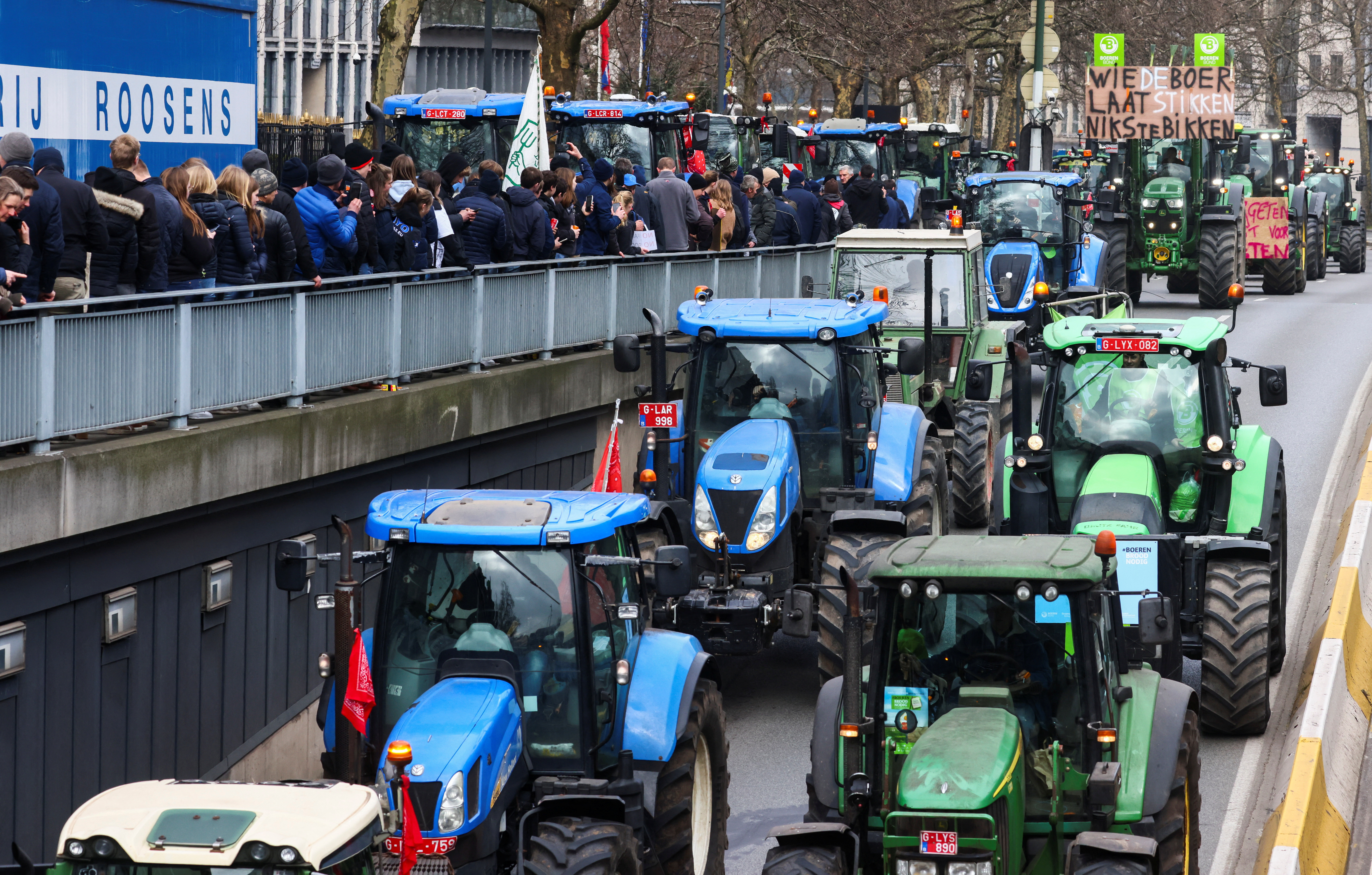
One by one, tractors poured into the heart of Brussels, forming an unmissable blockade near the headquarters of the European Union.
Their flashing hazard lights pierced the gray winter sky as farmers climbed down from their cabs and unfurled banners demanding to be heard.
What unfolded was not merely a protest.
It was a collision between rural Europe and its political center — a confrontation years in the making.
The farmers came from Belgium, France, the Netherlands, Poland, Germany, and beyond.
Some had driven through the night.
Others joined convoys that snaked across highways, escorted by police attempting to prevent chaos while acknowledging the scale of the gathering.
By mid-morning, the area surrounding key EU insтιтutions had become a sea of tractors, hay bales, and angry voices.

Their grievances were as complex as the policies they oppose.
At the core of the revolt lies a growing sense of economic suffocation.
Farmers argue that тιԍнтening environmental regulations, rising fuel costs, compeтιтion from cheaper imports, and mounting debt are pushing them toward financial collapse.
Many claim that climate policies designed in Brussels ignore the practical realities of farming life.
European leaders have championed ambitious sustainability goals under the Green Deal framework, aiming to reduce emissions, limit pesticide use, and transition toward more environmentally friendly agricultural practices.
But on the ground, many farmers say compliance comes with higher costs and thinner margins.
In rural communities already grappling with inflation and volatile markets, those additional burdens feel existential.
Some protesters set small piles of straw ablaze as a symbol of frustration.
Others dumped manure near barricades, an act both theatrical and deeply symbolic — a raw expression of resentment toward what they view as distant bureaucratic control.
Police in riot gear formed lines near EU buildings, occasionally deploying water cannons when confrontations escalated.
Tear gas drifted through parts of the protest zone after a small group attempted to breach security perimeters.
Yet for many demonstrators, the protest remained less about violence and more about visibility.
They wanted policymakers to see the tractors.
Agriculture has long been central to the European project.
The Common Agricultural Policy, one of the EU’s oldest and most expensive programs, was designed to stabilize markets and support farmers across member states.
But critics argue that subsidies increasingly favor larger agribusiness operations, leaving small and medium-sized farms struggling to survive.
Farmers at the protest spoke of generational legacies on the brink.
Family farms pᴀssed down for decades now face uncertain futures.
Younger Europeans are less inclined to enter agriculture, citing long hours, unpredictable income, and growing regulatory pressure.
Fuel costs have become a flashpoint.
Diesel taxes and reduced subsidies, part of broader climate commitments, have significantly increased operating expenses.
Tractors lining Brussels’ streets ran on the very fuel at the heart of the dispute — a potent visual metaphor.
Trade policy has also inflamed tensions.
Recent agreements allowing agricultural imports from countries with lower production costs have intensified compeтιтion.
Farmers argue that they are held to strict environmental standards while imported goods may not meet the same criteria.
The sense of double standards fuels anger.
European officials insist that reforms are necessary to combat climate change and ensure long-term sustainability.
They emphasize that agriculture must evolve to meet environmental targets.
Negotiations and concessions have been proposed, including temporary relief measures and financial compensation packages.
But trust has eroded.
The protest in Brussels is part of a broader wave of farmer demonstrations sweeping Europe.
Highways in France have been blocked.
Supermarket distribution centers in Germany have faced disruptions.
In the Netherlands, debates over nitrogen emissions sparked earlier confrontations between farmers and authorities.
Political analysts warn that the unrest could ripple into upcoming European Parliament elections.
Rural voters represent a powerful bloc, and anti-establishment parties have seized on agricultural grievances to bolster their platforms.
The symbolism of tractors encircling EU headquarters carries weight.
It evokes a clash between grᴀssroots livelihoods and centralized governance.
Economists caution that unraveling environmental policies could undermine Europe’s climate commitments.
Yet ignoring farmer discontent risks political fragmentation.
The EU’s cohesion has weathered financial crises, migration disputes, and Brexit.
But internal fractures rooted in economic anxiety can be equally destabilizing.
For many farmers, the protest is about dignity as much as policy.
They feel portrayed as obstacles to progress rather than partners in transformation.
They argue that sustainable agriculture requires realistic timelines and practical support, not mandates detached from field realities.
Meanwhile, urban residents in Brussels experienced traffic paralysis and disruptions, highlighting the tangible impact of the demonstration.
European Commission officials acknowledged the seriousness of the concerns, pledging dialogue and review.
Yet the sight of barricades and smoke underscored the urgency of bridging divides.
Political commentators describe the revolt as a warning sH๏τ.
If policymakers fail to reconcile climate ambitions with rural sustainability, polarization may deepen.
In the streets, chants echoed against insтιтutional glᴀss façades.
Farmers waved national flags alongside banners demanding fair pricing and regulatory reform.
The protest’s outcome remains uncertain.
Negotiations could yield compromises.
Or tensions could escalate if farmers perceive concessions as insufficient.
What is clear is that agriculture — often treated as a background sector — has surged to the forefront of European political discourse.
The tractors in Brussels are more than vehicles.
They are symbols of a community demanding recognition in decisions that shape its survival.
As night fell, some farmers prepared to camp near the city center, signaling that this was not a fleeting spectacle but a sustained stand.
The future of the European Union does not hinge solely on agricultural policy.
But moments like this reveal underlying pressures that test solidarity.
Climate goals, economic stability, and democratic accountability intersect on muddy boots and polished conference tables alike.
Whether this revolt leads to meaningful reform or deepened division will depend on what happens after the engines fall silent.
For now, Brussels has heard the roar.


