FRANCE UNDERWATER? Rivers Leap 6 Meters Overnight, Saintes Vanishes Beneath a Relentless Surge
In the early hours before dawn, when most of Saintes was still asleep, the river began to behave in a way residents say they have never quite seen before.

At first, it was subtle — a slow swelling against stone embankments, a restless current brushing higher along the quays.
Then something shifted.
Within hours, water levels surged dramatically, rising close to six meters in certain monitored sections.
By sunrise, entire streets in this historic southwestern French town were gone, erased beneath a thick, opaque sheet of brown water that reflected neither sky nor reᴀssurance.
Officials described it as an extreme but not unprecedented weather event.
Heavy rainfall across the Charente basin, compounded by saturated ground and upstream pressure, they said, had triggered rapid overflow.
The explanation sounded clinical, almost rehearsed.
But along the flooded boulevards of Saintes, where thousands of homes now sit partially submerged, that clarity feels distant.
What unfolded overnight has left behind not just damage, but a lingering sense that the sequence of events moved faster than anyone publicly anticipated.
The river — typically a quiet thread weaving through Roman arches and limestone facades — did not roar at first.
It crept.
Residents in low-lying districts recall checking their phones at 3 a.m, seeing flood advisories that suggested caution, not catastrophe.
By 5 a.m, some were already wading through knee-high water in their living rooms.
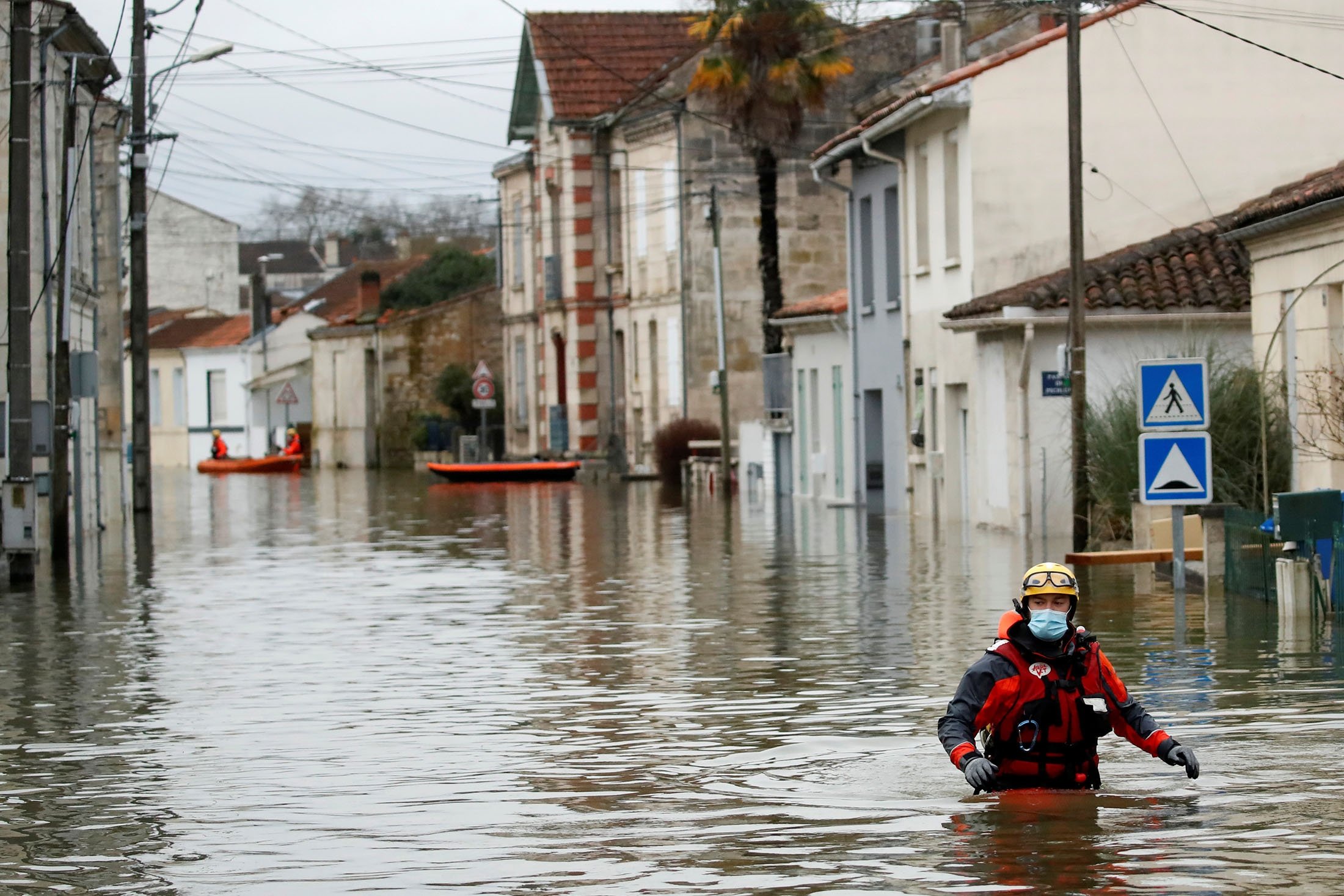
By 7 a.m, rescue crews were navigating what used to be intersections by boat.
Emergency services moved quickly once the scale became undeniable.
Firefighters went door to door where possible.
Inflatable crafts slid over submerged sidewalks.
Elderly residents were lifted from upper-story windows, wrapped in blankets against a cold that felt sharper than the season allowed.
Officials confirmed that thousands of homes had been affected, with power outages cascading block by block as substations were shut down to prevent further risk.
Yet even as sirens echoed through the flooded quarters, a quiet question began to surface: how did the river climb so high, so fast?
Meteorological data shows significant rainfall in the days leading up to the surge.
The soil was already waterlogged.
Reservoir levels upstream were elevated.
None of this is secret.
Still, longtime residents point out that Saintes has endured heavy rains before.
Flood markers etched into old stone walls tell a long history of seasonal swelling.
This time, the speed appears to have been the difference.
A six-meter jump in water level compresses what might have been a gradual emergency into a sudden shock.
Authorities insist there was no structural failure in dams or levees.
No breach, no collapse.
The systems, they say, performed within expected limits.

Yet the phrase “within expected limits” does little to calm those who watched refrigerators float past their front doors.
Some homeowners claim they received alerts too late to meaningfully act.
Others argue that forecasts underestimated the intensity of upstream accumulation.
Officials counter that warnings were issued in accordance with national protocols.
The truth, as often happens in disasters, sits somewhere in the narrow space between data and lived experience.
The visual landscape of Saintes now carries an unsettling stillness.
Street signs protrude from water like markers in an improvised graveyard.
Parked cars rest at odd angles beneath the surface, their roofs barely visible.
Shop windows, once displaying seasonal promotions, now frame distorted underwater silhouettes.
In certain quarters, the river has merged seamlessly with what used to be pedestrian plazas, making it difficult to tell where nature ends and infrastructure begins.
Local business owners stand outside barricaded zones, staring at what remains.
One café operator described watching the water rise against his establishment’s glᴀss facade in increments so precise it felt deliberate.
“It was like something measuring itself,” he said, stopping short of elaboration.
His words may reflect exhaustion more than implication, yet they echo a broader unease spreading through the town.
Climate scientists have long warned that extreme weather patterns in Europe are intensifying.
Warmer air holds more moisture.
Storm systems stall longer.
Rivers that once followed predictable rhythms now respond with volatility.
France has experienced notable flooding events in recent years, and national adaptation strategies have been widely discussed.
Saintes may be the latest illustration of those projections becoming reality.
Or it may be a reminder that predictive models, while advanced, cannot fully capture the compound effects of terrain, timing, and human settlement.
Social media, meanwhile, has filled the interpretive vacuum.
Videos circulating online show water advancing down narrow lanes with unnerving steadiness.
Some posts suggest that upstream water management decisions exacerbated the surge.
Others hint at infrastructure strain not publicly acknowledged.
Authorities have dismissed speculation, urging residents to rely on official channels.
Yet once uncertainty enters the narrative, it rarely leaves quietly.
Insurance ᴀssessors are only beginning to quantify the damage.
Early estimates point to significant financial losses, with restoration likely to take months, perhaps longer.
The more immediate concern remains safety.
Structural inspections are underway.
Contaminated water poses health risks.
Electrical systems must be thoroughly evaluated before neighborhoods can be deemed secure.
For displaced families, temporary shelters offer basic relief, but little in the way of certainty.
As the water stabilizes, investigators will analyze hydrological data minute by minute.
They will map rainfall intensity, river discharge rates, soil absorption thresholds.
Graphs will be generated.
Reports will be filed.
Findings will likely attribute the surge to a convergence of measurable factors.
Yet numbers cannot entirely capture the sensation described by residents who woke to a town transformed before daylight.
There is also the question of memory.
Saintes is a place layered with centuries of history, from Roman ruins to medieval churches.
Floods have visited before, leaving stains on stone and stories pᴀssed down across generations.
But this event, many say, feels different not only in scale but in tempo.
It arrived with a kind of quiet acceleration that defied instinct.
The absence of a singular dramatic trigger — no visible wall collapsing, no siren announcing a breach — has made it harder to narrate.
National officials have pledged support.
Emergency funds are being mobilized.
Engineers will reᴀssess flood defenses.
Conversations about resilience and preparedness will intensify.
These are predictable responses.

What remains less predictable is how a community metabolizes the shock of seeing familiar ground vanish beneath water in a single night.
Standing on higher terrain overlooking the flooded districts, one can see rooftops punctuating the surface like islands.
The river appears almost calm now, its earlier urgency replaced by a deceptive composure.
It is difficult to reconcile that serenity with the force required to displace thousands of lives within hours.
Some residents speak openly about rebuilding.
Others speak in fragments, as though the right vocabulary has not yet formed.
In disasters shaped by natural forces, blame often diffuses into abstraction.
Yet when warning systems, infrastructure, and human decisions intersect with weather, the line between inevitability and oversight can blur.
For now, Saintes waits.
Pumps hum steadily.
Boats continue to traverse what were once bus routes.
The six-meter surge has receded from its peak, but its imprint remains etched across walls and memory alike.
Whether this flood will ultimately be classified as a statistical anomaly, a symptom of broader climatic shifts, or a preventable escalation is a matter that analysts will debate.
What cannot be debated is the image of a town waking up to find itself partially erased.
In the dim light of that morning, before explanations solidified, the river simply rose.
And in doing so, it forced Saintes — and perhaps others watching from afar — to confront an unsettling possibility: that the boundaries long ᴀssumed stable may not be as fixed as believed.


