HIDDEN WARNING BURIED FOR 3,000 YEARS? SHOCKING NEW INTERPRETATION OF THE COLOSSAL OLMEC HEADS SPARKS FEARS OF A SUPPRESSED TRUTH!
The colossal stone heads created by the Olmec civilization have long stood as some of the most striking and enigmatic monuments of the ancient Americas.
Carved between approximately 1200 BCE and 400 BCE, these mᴀssive sculptures—some weighing up to 20 tons—were fashioned from basalt and transported across considerable distances before being erected at major Olmec centers in what is now southern Mexico.
For decades, scholars debated their purpose and meaning.
Recent interpretations, based on accumulated archaeological evidence and comparative analysis, have strengthened the view that these heads represent specific rulers and functioned as powerful symbols of political authority.
While the idea of a newly “decoded hidden message” may sound dramatic, the reality is more measured: ongoing research continues to clarify that the heads were expressions of leadership, idenтιтy, and social organization in one of Mesoamerica’s earliest complex societies.
The Olmecs are often referred to as the “mother culture” of Mesoamerica because of their early influence on later civilizations such as the Maya and the Aztecs.
Flourishing along the Gulf Coast of present-day Mexico, particularly in the states of Veracruz and Tabasco, the Olmecs established major ceremonial centers including San Lorenzo, La Venta, and Tres Zapotes.

These sites reveal sophisticated planning, monumental architecture, and elaborate artistic traditions.
Among the most remarkable of their artistic achievements are the colossal heads, seventeen of which have been discovered to date.
Each head is carved from a single block of basalt, likely quarried from the Tuxtla Mountains.
Transporting these stones—some from distances exceeding 60 kilometers—would have required extensive coordination and labor.
Scholars believe that the Olmecs likely used river systems for part of the journey, along with wooden rollers or sledges and large groups of workers to move the stones over land.
The scale of this effort suggests a highly organized society with the capacity to mobilize significant human resources.
One of the most notable features of the colossal heads is their individuality.
Although similar in overall form, each head displays distinct facial characteristics.
Differences in facial proportions, expressions, and headgear strongly suggest that these sculptures were portraits of specific individuals rather than generic representations.
This observation has become central to the prevailing interpretation that the heads depict rulers.
The helmet-like headgear worn by the figures has been a topic of considerable discussion.
Some researchers propose that it represents protective gear ᴀssociated with the Mesoamerican ballgame, a ritualized sport that held religious and political significance in later cultures.
Others suggest the headgear may symbolize status, lineage, or sacred authority.
Regardless of its exact function, the headgear reinforces the idea that these figures were elite members of society.
The interpretation of the heads as ruler portraits is supported by their archaeological context.
Many of the colossal heads were found in prominent positions within ceremonial centers.
At San Lorenzo, for example, several heads were arranged in ways that suggest intentional display.
Their placement would have made them highly visible to members of the community and to visitors, reinforcing the authority of the individuals they represented.

In addition to their size and placement, the craftsmanship of the heads indicates a society with specialized artisans.
Carving basalt with stone tools would have been a time-consuming and technically demanding process.
The smooth surfaces and detailed features demonstrate a high level of skill and artistic tradition.
Such specialization implies a social structure capable of supporting full-time craftsmen, which in turn suggests economic stability and centralized leadership.
Some heads show evidence of modification or reworking.
In certain cases, archaeologists have observed that older monuments were reshaped into new sculptures.
There are also indications that some heads were buried or repositioned in antiquity.
These actions may reflect political transitions, such as the rise of new rulers or the decline of previous regimes.
The reworking of monuments could have served to ᴀssert new authority while symbolically transforming the legacy of earlier leaders.
The idea that the heads convey a “hidden message” can be understood as a metaphor rather than a literal decoding of text.
The Olmecs left behind few written records, and there is limited evidence of a fully developed writing system during their early period.
Instead, their messages were communicated visually through monumental art and spatial organization.
The colossal heads can be seen as statements of power and permanence.
By carving their likenesses into mᴀssive stone monuments, rulers projected their presence across time and space.
This interpretation aligns with broader patterns observed in ancient civilizations worldwide.
Monumental portraiture has often been used as a tool of political expression.
From the statues of Egyptian pharaohs to the busts of Roman emperors, leaders have sought to legitimize and memorialize their authority through large-scale artistic representations.
The Olmec heads fit within this global tradition of monumental propaganda.
At the same time, the Olmec civilization retains many mysteries.
While the heads are among the most iconic artifacts, they represent only one aspect of a complex culture.
Olmec art includes intricate jade carvings, altars, figurines, and motifs that may depict mythological beings or cosmological themes.
The so-called “were-jaguar” imagery, for example, appears frequently in Olmec iconography and may relate to religious beliefs or mythic narratives.
The lack of extensive written records limits our ability to reconstruct the full context of Olmec political and religious systems.
Archaeologists rely on material evidence, comparative studies, and careful excavation to build interpretations.
As new discoveries are made, existing theories are refined or revised.
The process of understanding the Olmecs is ongoing and incremental rather than sudden or dramatic.
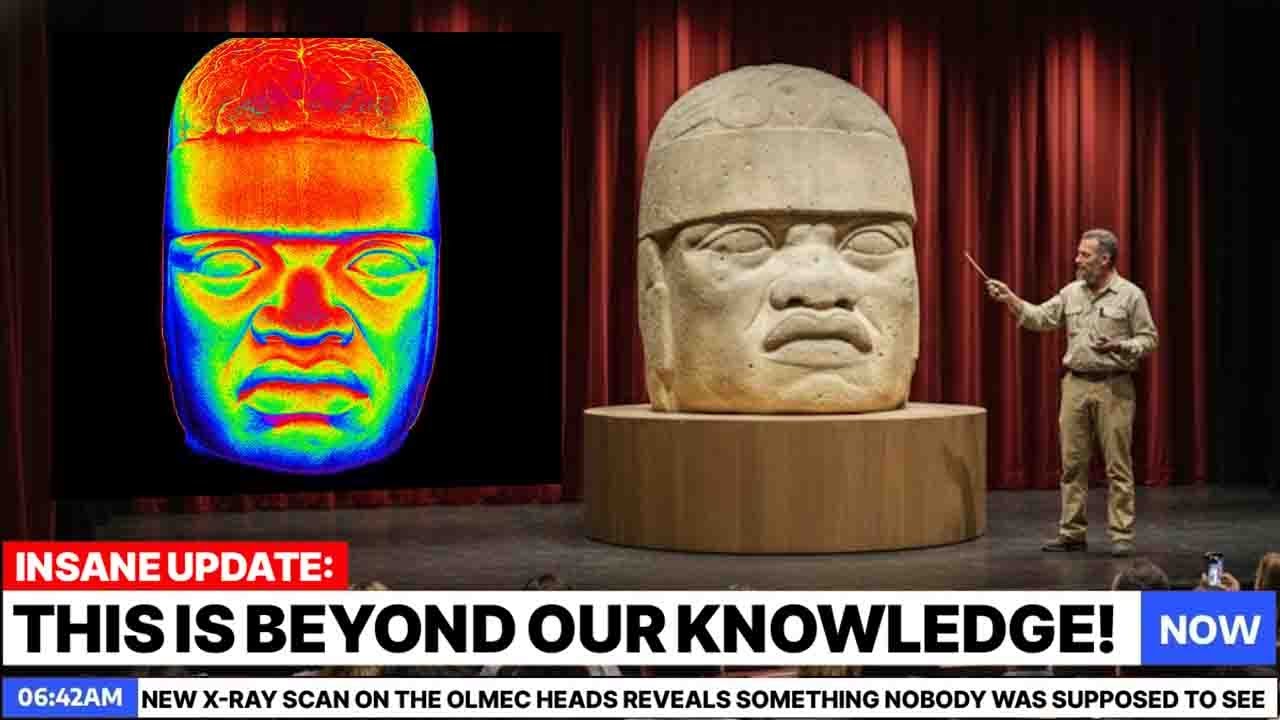
One factor that has contributed to sensational interpretations in the past is the sheer visual impact of the heads.
Their size and distinctive features have sparked numerous speculative theories, including claims of transoceanic contact or extraterrestrial influence.
However, mainstream scholarship finds no credible evidence supporting such ideas.
The physical characteristics of the heads are consistent with indigenous Mesoamerican populations, and there is no archaeological basis for attributing them to outside civilizations.
Modern research emphasizes the importance of contextual analysis.
By examining the geological sources of the basalt, archaeologists have traced the origins of the stone to specific mountain ranges.
This evidence confirms local sourcing rather than foreign intervention.
Similarly, stylistic comparisons with other Olmec artifacts demonstrate continuity within the region’s artistic traditions.
The transportation and carving of the heads required not only labor but also leadership.
Organizing large workforces implies social hierarchy and centralized control.
The ability to mobilize people for large-scale projects suggests that Olmec rulers exercised considerable authority over their communities.
In this sense, the heads are physical manifestations of political organization.
The ceremonial centers where the heads were discovered also reveal complex urban planning.
Platforms, plazas, and mounds were carefully arranged, often aligned with cardinal directions or astronomical events.
Such planning reflects an advanced understanding of space and ritual.
The heads would have been integrated into these ceremonial landscapes, reinforcing the connection between political power and sacred authority.
Over time, environmental changes and shifting political dynamics contributed to the decline of major Olmec centers.
By around 400 BCE, the prominence of sites like San Lorenzo and La Venta had diminished.
The reasons for this decline are still debated, with possibilities including ecological stress, social upheaval, or changing trade networks.
Nevertheless, elements of Olmec culture persisted and influenced subsequent Mesoamerican societies.
The reinterpretation of the colossal heads as ruler portraits does not diminish their significance.
On the contrary, it enhances our understanding of the Olmecs as a sophisticated civilization capable of monumental expression.
Rather than mysterious relics of unknown origin, the heads become tangible evidence of human ambition, artistry, and governance.
It is important to approach claims of newly “decoded” messages with caution.
Archaeology rarely produces sudden revelations that overturn established knowledge overnight.
Instead, insights accumulate through careful study.
The growing consensus about the political function of the heads reflects decades of research rather than a single breakthrough.
Public fascination with the Olmec heads speaks to a broader interest in ancient mysteries.
Monumental art captures the imagination because it bridges vast spans of time.
Standing before a colossal head, one confronts the physical presence of a civilization that flourished thousands of years ago.
The durability of stone allows these faces to endure long after the societies that created them have changed or disappeared.
In examining the Olmec heads, we gain insight not only into a specific culture but also into universal aspects of human society.
The desire to commemorate leaders, to ᴀssert idenтιтy, and to project power across generations is not unique to the Olmecs.
It is a recurring theme throughout history.
By situating the heads within this broader context, archaeologists can better appreciate their role in the development of early complex societies.
Future research may continue to refine our understanding of the Olmecs.
Advances in technology, such as ground-penetrating radar and improved dating techniques, could reveal new information about site organization and chronology.
Ongoing excavations may uncover additional monuments or artifacts that shed further light on the political and religious landscape of the time.
For now, the colossal heads remain enduring symbols of the Olmec civilization.
Their imposing forms remind us of the scale of human creativity and organization in the ancient world.
Far from being inscrutable enigmas, they represent the achievements of a society that laid important foundations for later cultures in Mesoamerica.
The idea that archaeologists have “decoded” a hidden message may oversimplify a complex process of interpretation.
Yet it reflects a genuine progress in understanding: the recognition that these monumental faces were not abstract or anonymous.
They were portraits of leaders, expressions of authority carved in stone.
In that sense, the message they convey is both specific to their time and universal in its themes.
Through continued research and respectful engagement with the archaeological record, scholars aim to deepen our appreciation of the Olmecs and their legacy.
The colossal heads, silent yet expressive, continue to inspire curiosity and inquiry.
As new evidence emerges, our interpretations may evolve, but the significance of these monumental works endures.


