In the middle of the Mojave Desert, a city that should never have existed continues to defy nature.
Las Vegas is home to more than 2.3 million residents and welcomes tens of millions of visitors each year.
Yet it survives almost entirely on a single water source—Lake Mead.
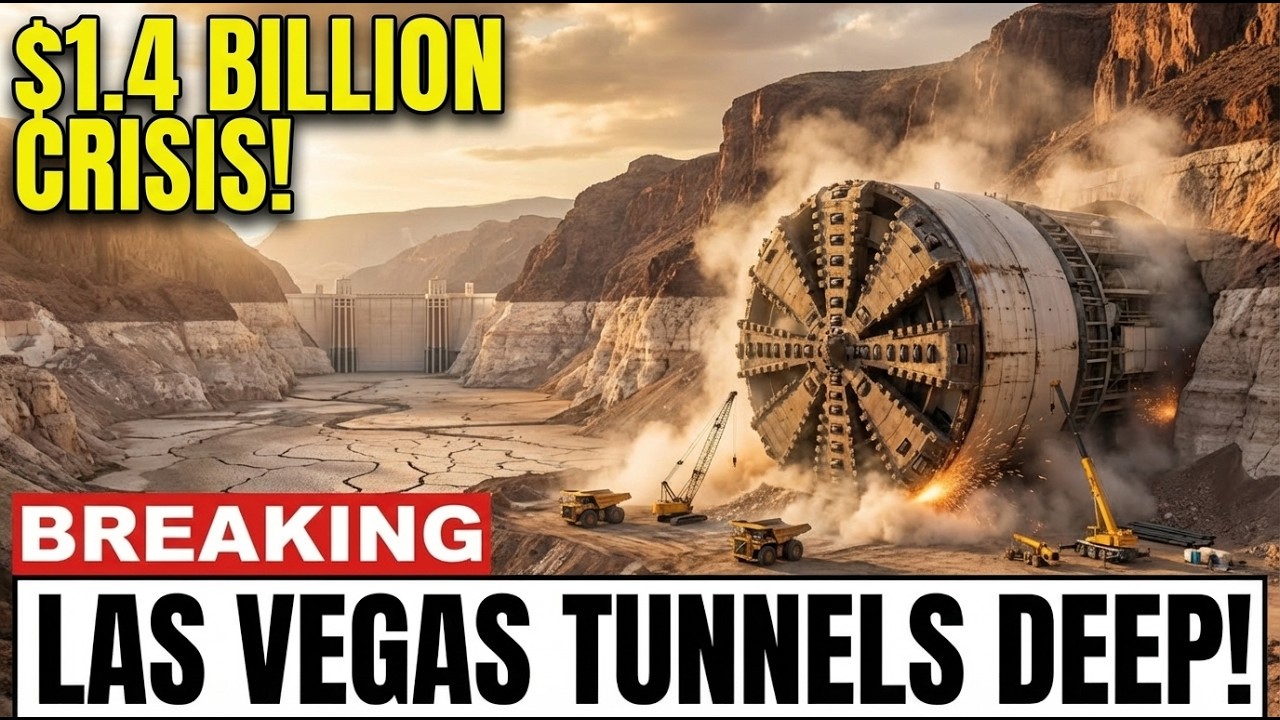
For decades, that system worked.
Then the water began to disappear.
Over the past 20 years, Lake Mead has been steadily shrinking, reaching historic lows that shocked even seasoned water experts.
By 2022, the situation had become so severe that the city was approaching a scenario few had seriously imagined.
Not restrictions.
Not shortages.
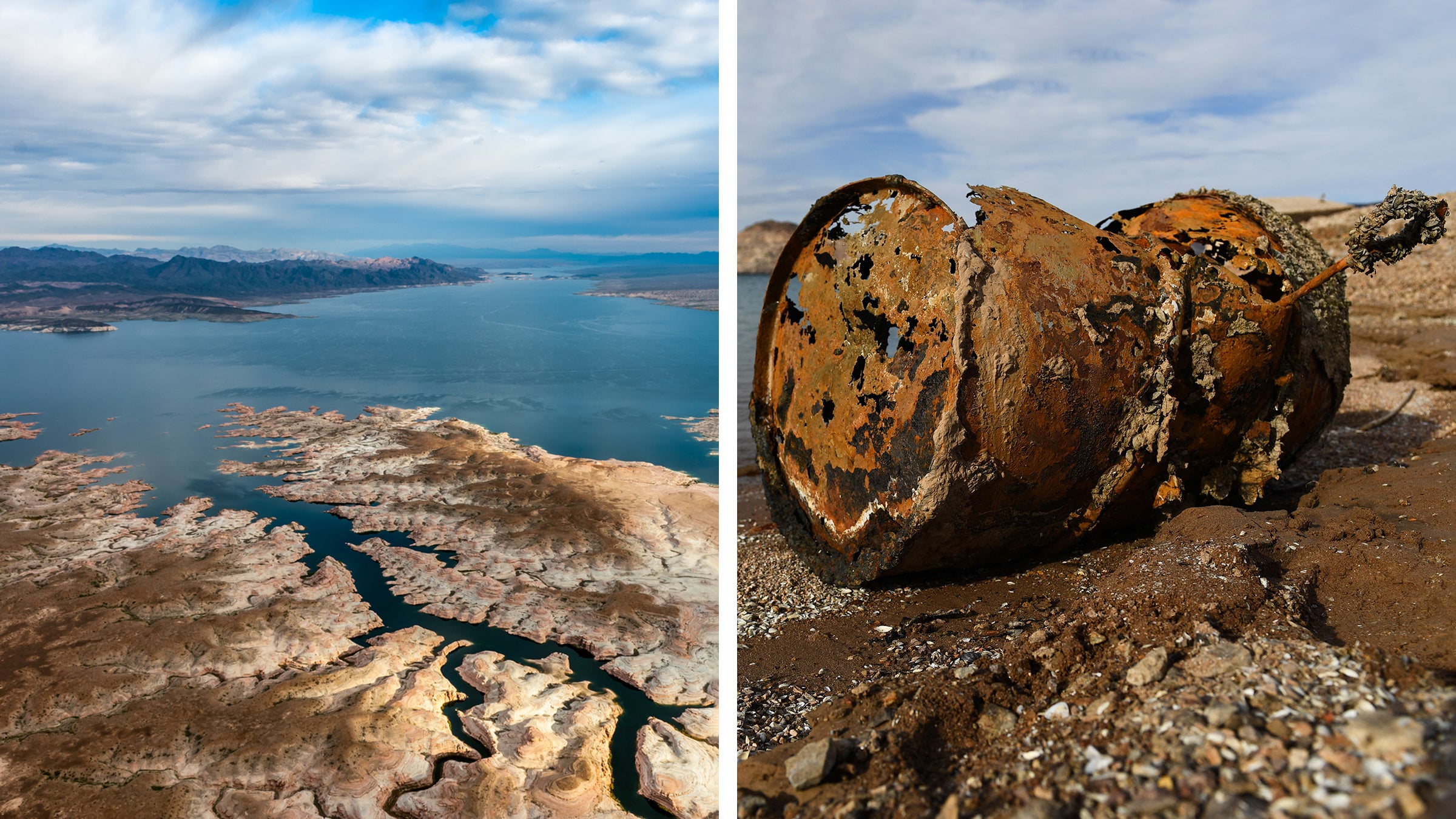
But the real possibility of running out of accessible water entirely.
Faced with that threat, officials took an extraordinary step.
They launched a $1.4 billion project to drill a tunnel deep beneath the lake itself.
This project, known as the “third straw,” was unlike anything attempted before.
It stretches roughly three miles through solid rock, reaching water at depths far below existing intake systems.
The goal was simple but urgent.
Access water that would remain available even if the lake dropped to critically low levels.
The execution, however, was anything but simple.
Engineers had to drill through dense volcanic rock hundreds of feet below the lakebed.
They worked under immense pressure, knowing that even a small miscalculation could lead to catastrophic flooding.
The environment was harsh, the risks constant, and the margin for error almost nonexistent.
After seven years of effort, the tunnel was completed in 2015.
It was hailed as a technological triumph.
A solution designed to secure the city’s future against drought.
But the deeper story is far more complicated.
Lake Mead is not just a reservoir.
It is part of a much larger system fed by the Colorado River, which supplies water to roughly 40 million people across the American Southwest.
And that system has been under strain for decades.
The root of the problem dates back to the Colorado River Compact.
This agreement divided water among several states based on unusually wet years.
In reality, the river has rarely produced that much water consistently.
For over a century, more water has been allocated than the river can reliably deliver.
As populations grew and demand increased, the imbalance became impossible to ignore.
Lake Mead, once a symbol of abundance, became a warning sign.
There is a critical threshold that engineers fear most.
It is known as “ᴅᴇᴀᴅ pool.”
At this level, water can no longer flow through Hoover Dam, effectively rendering the reservoir useless for downstream supply.
The third straw was designed to operate even below this level, reaching deeper than any previous intake.
But even this system has limits.
If water levels fall too far, there simply won’t be enough water left to draw from—no matter how deep the tunnel goes.
In that scenario, the $1.4 billion solution becomes irrelevant.
Recognizing that engineering alone could not solve the problem, Las Vegas also turned to conservation.
The results have been remarkable.
Over the past two decades, the city has reduced per capita water use by more than 40%.
It now recycles nearly all indoor water, returning treated supplies back to Lake Mead for reuse.
Outdoor water use, once a major source of waste, has been aggressively reduced.
Decorative grᴀss has been removed, irrigation restricted, and consumption limits proposed.
These efforts have allowed the city to grow while using less water overall.
Yet even with these achievements, the underlying challenge remains.
The region is getting H๏τter and drier.
Climate models suggest that drought conditions may become more frequent and more severe.
The Colorado River, already stretched thin, may not recover to past levels.
And historical data reveals an even more unsettling possibility.
The current drought may not be unusual.
It could be a preview of longer, more intense “megadroughts” that have occurred in the past.
If that is the case, the system is not just under stress.
It is fundamentally unsustainable in its current form.
There is also another hidden risk.
As water levels fluctuate, sediments at the bottom of Lake Mead can be disturbed.
These sediments may contain contaminants from decades of industrial activity.
The deeper the intake reaches, the greater the concern about water quality.
This adds another layer of complexity to an already fragile system.
What makes this situation even more significant is that Las Vegas is not alone.
Cities like Phoenix and Los Angeles, along with vast agricultural regions, depend on the same river.
The decisions made about how to share this shrinking resource will affect millions of lives.
The third straw is not a permanent solution.
It is a temporary advantage.
A way to buy time in a system that is running out of it.
Time for policies to change.
Time for conservation to expand.
Time for difficult decisions that have been delayed for decades.
Beneath Lake Mead, the tunnel stands as a symbol of human ingenuity.
But above it, the desert continues to remind everyone of a harsher truth.
You can engineer access to water.
You cannot create it where it no longer exists.


