The $400 Million Mistake That Left a Skyscraper Empty Forever
In the bustling skyline of New York City, where ambition rises as high as steel and glᴀss can stretch, one building stands as a haunting anomaly.
At 161 Maiden Lane, a 670-foot skyscraper looms over Manhattan’s financial district, not as a symbol of success, but as a monument to failure.
Despite costing approximately $400 million to construct, the building has remained completely empty for years.
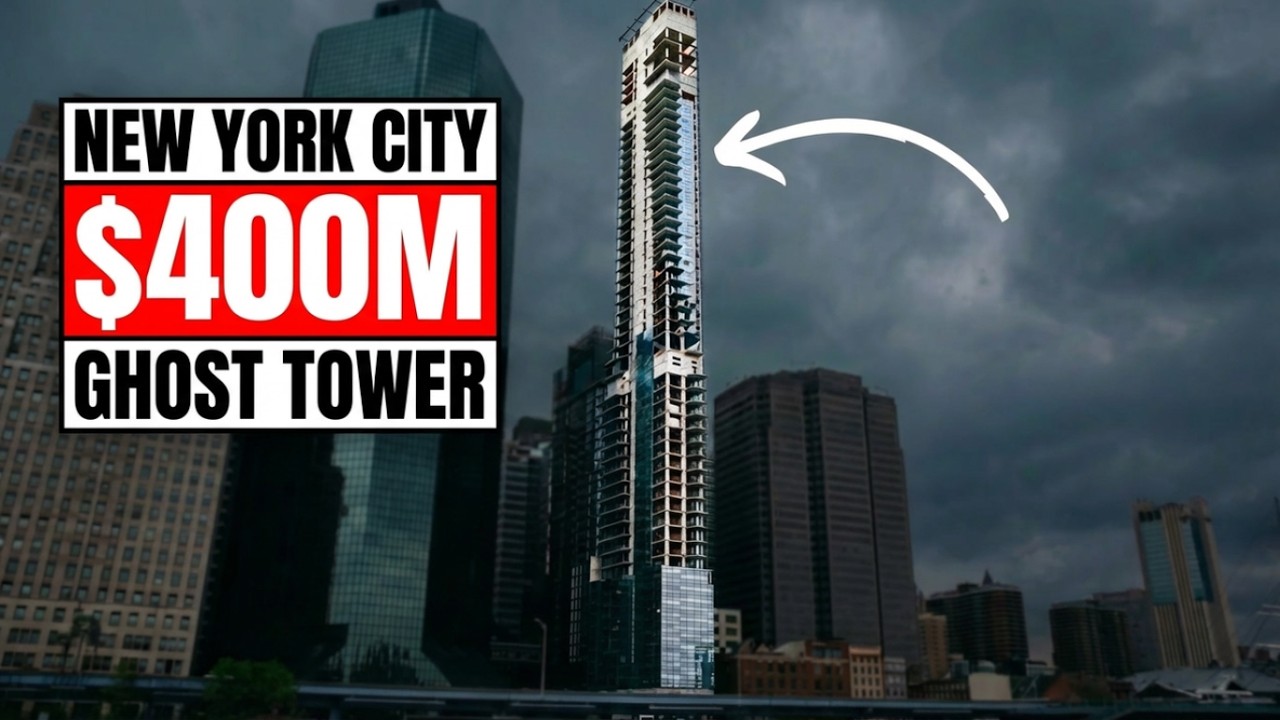
No residents have ever lived inside its luxury condominiums.
The reason is both simple and shocking.
The building is leaning.
While a slight tilt might seem trivial, in the world of skyscrapers, even a deviation of a few inches can signal catastrophic structural instability.
In this case, the tower reportedly tilted about three inches, a seemingly small number with enormous consequences.
Engineers described the structure not just as leaning, but bending—earning comparisons to the shape of a banana.
This revelation triggered immediate panic behind the scenes.
Buyers canceled contracts, investors pulled back, and lawsuits quickly followed.
What was meant to be a crown jewel of luxury living became an abandoned shell trapped in legal and financial chaos.
To understand how such a disaster could occur, one must look beneath the surface—literally.
Lower Manhattan is not entirely natural land.
Much of it is built on centuries-old landfill, a mix of soil, debris, and even remnants of old ships.
Far below this unstable layer lies Manhattan schist, a solid bedrock capable of supporting mᴀssive structures.
Traditionally, skyscrapers are anchored deep into this bedrock using strong foundational piles.
This method is expensive but reliable.
However, the developers of 161 Maiden Lane chose a different path.
Instead of drilling down to bedrock, they opted for a faster and cheaper technique known as soil improvement.
This method involves injecting concrete and chemicals into the ground to strengthen the existing soil.
While it can work in certain conditions, it is inherently riskier—especially in unpredictable landfill terrain.
The decision saved approximately $6 million, a relatively small amount in a project of this scale.
Yet this cost-cutting measure would become the root of a far greater loss.
As construction progressed and the building’s weight increased, the ground beneath it began to compress unevenly.
The north side sank faster than the south, causing the structure to tilt.
This phenomenon, known as differential settlement, is one of the most feared issues in structural engineering.
What makes this situation even more striking is that warnings had been issued in advance.
Engineering consultants reportedly advised against using soil improvement for this site.
They highlighted the unpredictable nature of the landfill and the high risk of uneven settling.
Despite these warnings, the decision was made to proceed.
Once the tilt became evident, the project descended into a legal battle.
The contractor and developer blamed each other, each claiming the other was responsible for the failure.
As lawsuits dragged on, construction halted completely.
The building was left unfinished, exposed to environmental damage and unable to meet safety requirements.
Critical systems, including fire protection, were never completed.
Elevator shafts became misaligned, making installation impossible.
The structure itself grew increasingly compromised over time.
Ironically, the engineering solution to fix the building is well known.
It would involve installing deep foundation piles to anchor the structure into bedrock, effectively correcting the original mistake.
However, this solution comes with a staggering price tag—estimated between $80 million and $150 million.
And this is where the real problem emerges.
Even if the building were successfully repaired, its reputation would remain permanently damaged.
Potential buyers would hesitate to invest in a property known for structural failure.
Banks might refuse financing, and insurers could deem it too risky.
In essence, the building’s market value would never justify the cost of repair.
What began as a $6 million saving has resulted in a half-billion-dollar disaster.
From a financial perspective, fixing the tower simply does not make sense.
And so, it remains frozen in time.
Unlike other troubled skyscrapers that have been repaired and reoccupied, 161 Maiden Lane stands as a rare case where economics outweigh engineering feasibility.
It is not that the building cannot be fixed.
It is that no one is willing to pay the price to do so.
This story is not just about a single building.
It is a cautionary tale about the dangers of prioritizing short-term savings over long-term stability.
It highlights the consequences of ignoring expert advice and underestimating the complexity of natural forces.
In the race to build higher, faster, and cheaper, even the smallest compromise can lead to catastrophic outcomes.
Today, the silent tower at 161 Maiden Lane serves as a stark reminder.
In engineering, as in life, the cheapest option can sometimes become the most expensive mistake of all.


