The Hoover Dam Crisis Is Closer Than Anyone Thinks
A silent crisis is unfolding across the American West, and it is rapidly approaching a breaking point.
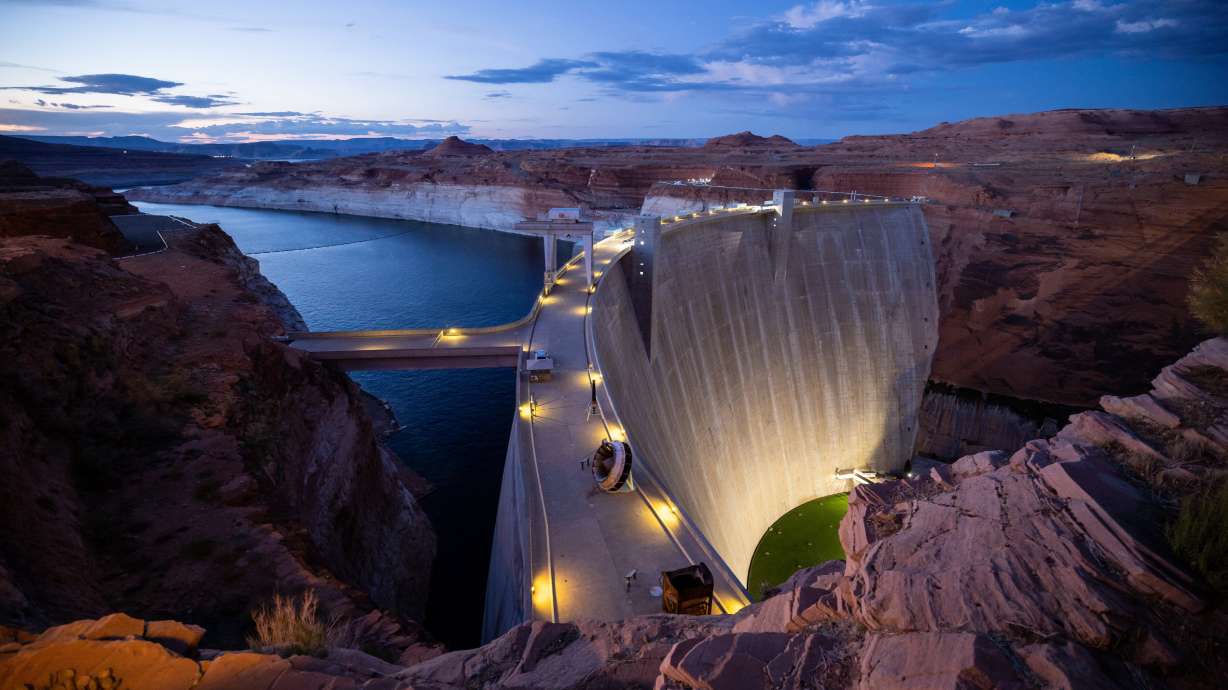
While much of the attention has been focused on Hoover Dam, the true danger lies upstream—at Glen Canyon Dam, a structure that quietly controls the fate of everything downstream.
At first glance, the numbers seem manageable.

Lake Powell, the reservoir held back by Glen Canyon Dam, still sits above the critical threshold required to generate electricity.
But the margin is shrinking—dangerously.
Experts now warn that the lake could drop to just seven feet above the minimum level needed to keep its turbines running.
That may sound like a buffer.
It isn’t.
Once water levels fall below 3,490 feet, Glen Canyon Dam loses its ability to produce hydropower entirely.
The turbines—mᴀssive machines designed to convert the force of water into electricity—simply stop functioning.
Air enters the system, pressure collapses, and power generation drops to zero.
But electricity is only part of the story.
Glen Canyon Dam is not just a power plant—it is a gatekeeper.
Every drop of water that flows into Lake Mead and eventually reaches Hoover Dam must first pᴀss through it.
This water sustains cities like Las Vegas, irrigates vast agricultural regions, and supports tens of millions of people across the Southwest.
If Glen Canyon fails to function as intended, the consequences cascade instantly downstream.
And here’s where the real flaw emerges.
Below the minimum power level, the only way to move water through the dam is via four steel bypᴀss tubes built into its base.
These tubes were never designed to handle the full force of a major river.
They were intended as emergency overflow channels for a reservoir that engineers once ᴀssumed would always remain near full capacity.
Recent tests have revealed a serious problem.
When water flows through these tubes at low levels, a phenomenon called cavitation occurs.
Tiny vapor bubbles form and collapse violently inside the pipes, causing internal damage—similar to what can destroy turbine blades over time.
Despite repairs, officials have acknowledged that this issue cannot be fully prevented.
In practical terms, this means the entire water delivery system for the Colorado River Basin—serving around 40 million people—could soon depend on four vulnerable pipes already showing signs of stress.
The situation downstream is no less alarming.
Lake Mead, the reservoir behind Hoover Dam, is also dropping.
As water levels fall, Hoover’s turbines face the same physical limitations.
Reduced pressure leads to inefficiency, and eventually, shutdown.
Most of the dam’s older turbines could become inoperable, leaving only a handful capable of generating power at drastically reduced capacity.
This dual threat—one dam losing water flow, the other losing power—creates a scenario that engineers never intended to confront.
The root of the problem lies in a long-term shift rather than a temporary drought.
The Colorado River Basin has endured over two decades of unusually dry conditions—the worst in more than a thousand years, according to tree-ring studies.
Climate change has intensified the crisis, reducing snowpack, accelerating evaporation, and permanently lowering river flows.
Today, the river carries significantly less water than it did when allocation agreements were first signed in the early 20th century.
Those agreements promised more water than the river can now provide—a gap that has only widened with time.
Despite this, the seven states that depend on the river have struggled to agree on how to share the shortages.
ᴅᴇᴀᴅlines have pᴀssed without resolution, and the possibility of federal intervention—and legal battles lasting decades—looms large.
Meanwhile, the human impact is already visible.
Tribal communities, which hold significant water rights, often lack the infrastructure to access their share.
Many households still live without running water.
At the same time, urban centers and agricultural industries continue to draw heavily from a shrinking resource.
Energy providers are also bracing for impact.
If hydropower production collapses, replacement electricity will likely come at higher costs—costs that vulnerable communities may not be able to absorb.
Efforts are underway to adapt.
Solar energy projects are expanding, and emergency water release plans are being discussed.
But these measures may not be enough to offset the scale of the problem.
At its core, this is not just an engineering crisis—it is a mathematical one.
There is simply less water than the system was designed to handle.
And unless nature delivers an unexpected surge of snow and rain, the region may soon be forced to confront a reality it has long avoided: a future where the Colorado River can no longer meet the demands placed upon it.
The warning signs are no longer distant projections.
They are measurable, immediate, and accelerating.
The water is still falling.
And with it, the margin for error is disappearing.


