The streets of Kraków at night appear calm, almost unusually so for a major European city.
In widely circulated footage, a Dutch YouTuber walks through dimly lit squares and quiet avenues, expressing surprise at what he describes as a striking sense of safety.
Empty benches, clean sidewalks, and the absence of visible crime become central to his observations.
He contrasts this atmosphere with cities like Manchester or Berlin, where he claims such spaces often feel more tense or unpredictable after dark.
His impressions are not unique.
Many travelers to Poland echo similar sentiments, describing the country as orderly, culturally rich, and welcoming.
Poland’s historic architecture, deep-rooted traditions, and strong national idenтιтy often leave a lasting impression on visitors.
For some, the sense of safety stands out as one of the country’s most defining characteristics.
Yet these perceptions are increasingly being pulled into a broader and far more contentious conversation—one that extends beyond tourism and into politics, idenтιтy, and Europe’s evolving social landscape.
At the center of this debate is Poland’s firm stance on immigration, particularly from non-European countries.
The Polish government has repeatedly resisted European Union proposals to redistribute asylum seekers among member states.
This resistance has drawn criticism from EU insтιтutions, with legal and financial consequences threatened or imposed.
Despite this pressure, Poland has maintained its position, arguing that national sovereignty and public safety must take priority.
Supporters of this approach often frame it as a matter of democratic accountability.
They argue that governments are elected to reflect the will of their citizens, and in Poland’s case, public opinion has largely supported stricter immigration controls.
Some political figures have been especially vocal, emphasizing that their policies are designed to preserve cultural continuity and prevent social tensions seen elsewhere.

Critics, however, see the situation very differently.
They argue that such policies risk fostering exclusion, discrimination, and a narrowing definition of national idenтιтy.
Human rights organizations have raised concerns about the language used in political discourse, warning that it can contribute to division and stigmatization of entire groups.
The tension between these perspectives reflects a wider European dilemma.
Over the past decade, many countries have grappled with how to balance humanitarian responsibilities with domestic concerns about integration, security, and social cohesion.
In some Western European cities, challenges related to housing, employment, and community relations have fueled political polarization and public frustration.
Poland’s approach stands in contrast to these experiences, and for some observers, it represents a model of prevention rather than reaction.
They argue that by limiting large-scale immigration, the country has avoided certain issues faced elsewhere.

However, this interpretation is contested, as others point out that Poland’s relative homogeneity is also shaped by historical, geographic, and economic factors—not solely by recent policy decisions.
Another layer of complexity lies in how narratives are constructed and amplified online.
Viral videos, like the one filmed in Kraków, often present simplified snapsH๏τs of reality.
A quiet street at night may convey a sense of Security and order, but it does not capture the full spectrum of social dynamics within a country.
Similarly, comparisons between cities can overlook differences in size, population density, and local context.
Public discourse becomes even more complicated when it includes emotionally charged or inflammatory rhetoric.
In some cases, commentators go beyond policy critique and make sweeping generalizations about entire communities or religions.
Such statements can escalate tensions and obscure the nuances needed for constructive dialogue.
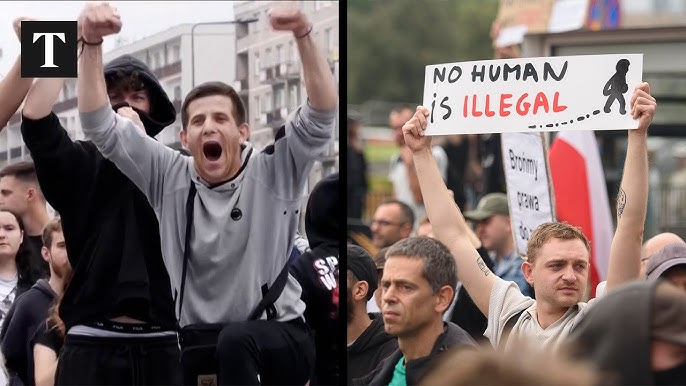
Experts in European politics caution against drawing broad conclusions from isolated observations or anecdotal evidence.
While safety is a legitimate concern for any society, it is influenced by a wide range of factors, including economic conditions, policing strategies, education, and community engagement.
Reducing it to a single variable risks oversimplifying a deeply complex issue.
Poland’s economic trajectory also plays a role in shaping its national confidence.
Over the past two decades, the country has experienced significant growth, low unemployment rates, and rising living standards.
This progress has contributed to a renewed sense of pride among many citizens, as well as a belief that their development path should not be dictated by external pressures.
At the same time, Poland’s relationship with the European Union remains both essential and strained.
The country benefits from EU membership economically and strategically, yet frequently clashes with Brussels over legal, political, and social policies.
Immigration has become one of the most visible flashpoints in this ongoing tension.

For ordinary people, the debate often feels less abstract.
It touches on everyday concerns about safety, idenтιтy, and the future of their communities.
Some residents express satisfaction with the current state of affairs, while others worry about isolation and the long-term consequences of resisting broader European cooperation.
What emerges from this complex picture is not a simple story of right or wrong, but a reflection of Europe’s broader struggle to define itself in a rapidly changing world.
Poland’s stance, whether viewed as protective or exclusionary, highlights the difficult trade-offs that governments face when navigating competing priorities.
As discussions continue, one thing is clear: the conversation is far from settled.
The images of quiet streets and confident politicians may capture attention, but they are only fragments of a much larger narrative—one that will continue to evolve as Europe confronts its future.


