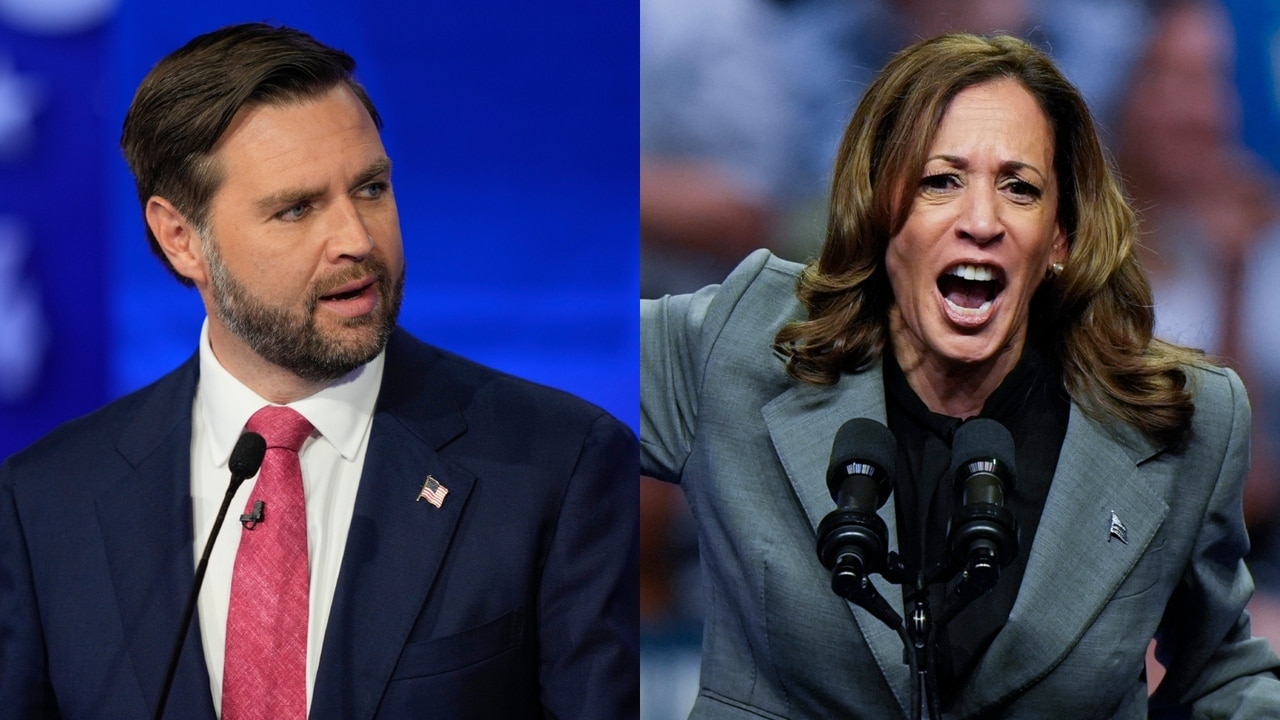
The dramatic narrative describing a Senate hearing confrontation between Vice President J.D. Vance and former Secretary of State Hillary Clinton has rapidly circulated online, captivating audiences with its cinematic intensity and emotional weight.
But beneath the gripping storytelling lies a far more complicated reality—one that raises critical questions about authenticity, political narratives, and how modern audiences consume information.
At first glance, the story reads like a defining moment in American political history. A powerful hearing, a seasoned political figure under scrutiny, and a rising political force delivering a meticulously constructed argument filled with documents, testimony, and personal conviction.
It has all the elements of a historic reckoning. Yet, when examined closely, there is no verified record that such a Senate hearing ever took place in the form described.
No official congressional transcripts, no credible mainstream reporting, and no verified public records confirm that Vice President J.D. Vance presided over a Senate hearing interrogating Hillary Clinton in this manner.
The detailed exchanges, the dramatic monologues, and even the specific testimonies appear to originate from a highly stylized narrative rather than a documented event.

This does not mean the story is meaningless. On the contrary, its viral spread reveals something important about the current political climate.
The narrative taps into long-standing controversies that have followed Clinton for years—her use of a private email server, the Benghazi attack, and the Clinton Foundation’s fundraising practices.
These are real issues that have been investigated, debated, and politicized extensively.
Similarly, the portrayal of J.D. Vance draws heavily from his real-life biography.
His upbringing in Middletown, Ohio, his service in the Marine Corps, and his rise through education and politics are well-documented. His memoir, “Hillbilly Elegy,” resonated with many Americans who felt overlooked by traditional political narratives.
The story leverages this background to frame him as a representative of working-class America confronting elite power structures.

What makes the narrative particularly compelling is how it blends verified facts with fictionalized dialogue and imagined scenarios.
The references to Clinton’s “basket of deplorables” comment from 2016 are accurate. Her remarks did generate significant backlash and became a defining moment in that election cycle. The story uses that real event as a foundation, then builds an extended fictional confrontation around it.
The inclusion of emotional testimonies—such as grieving families, working-class citizens, and veterans—adds another layer of persuasive power.
These elements are designed to evoke empathy and reinforce a broader Political message about division, accountability, and representation. However, there is no evidence that such testimonies occurred in the specific hearing described.
This blending of fact and fiction is not accidental. It reflects a broader trend in modern media where storytelling techniques traditionally ᴀssociated with entertainment are increasingly applied to political content. The result is narratives that feel true, even when they are not factually accurate in their entirety.
Social media plays a significant role in amplifying these stories. Short video clips, emotionally charged quotes, and simplified narratives spread rapidly, often detached from their original context. In this case, phrases like “I had Mama” or references to “deplorables” become symbolic, representing larger cultural and political divides.

The reaction to the story also highlights a deeper polarization. For some audiences, the narrative feels like long-overdue accountability. For others, it appears as a constructed attack designed to reinforce existing biases. The same story is interpreted in completely different ways depending on the viewer’s perspective.
This phenomenon raises an important question: why do stories like this gain so much traction? Part of the answer lies in their structure. The narrative follows a classic arc—conflict, buildup, climax, and resolution. It presents clear heroes and villains, emotional stakes, and a sense of closure. In reality, politics is rarely this clean or definitive.
Another factor is trust. In an environment where trust in insтιтutions and media is often low, audiences may be more willing to accept narratives that align with their existing beliefs, even if those narratives are not fully verified. The line between reporting and storytelling becomes increasingly blurred.
It is also worth noting that the issues referenced in the narrative remain relevant. Questions about government transparency, accountability, and the influence of money in politics continue to be debated across the political spectrum. While the specific hearing may not have occurred, the themes it explores are very real.
At the same time, the spread of such narratives underscores the importance of media literacy. Being able to distinguish between documented events and dramatized accounts is essential in an age where information moves quickly and is often presented without clear sourcing.
The story’s impact ultimately lies not in whether the event happened exactly as described, but in what it reveals about the current state of political discourse. It shows how easily compelling narratives can shape perception, influence opinion, and drive engagement—even in the absence of verifiable evidence.
As audiences continue to encounter similar content, the challenge will be to engage critically, question sources, and seek out confirmed information. Emotional resonance does not equal factual accuracy, and dramatic storytelling should not replace careful analysis.
In the end, the viral “hearing” serves as a case study in modern information dynamics. It demonstrates how narratives are constructed, how they spread, and how they resonate with audiences navigating an increasingly complex media landscape.


