Hoover Dam at Risk: The Water Crisis Reshaping the American West
For decades, Hoover Dam has stood as one of America’s greatest engineering achievements—transforming the Colorado River into a lifeline for millions.
But today, that system is under unprecedented pressure.
At the center of the crisis is Lake Mead, the largest reservoir in the United States.
As of early 2026, it has dropped to roughly 34% of its full capacity—a level that is no longer just concerning, but critical.
And the decline is accelerating.

In just a few weeks, water levels have fallen noticeably, despite this being a period when snowmelt should stabilize the system.
Forecasts suggest that within the next two years, the lake could drop to levels even lower than the historic lows recorded in 2022.
This is not just about water.
It’s about energy, infrastructure, and survival.
Hoover Dam was built with 17 turbines designed to generate electricity from falling water.
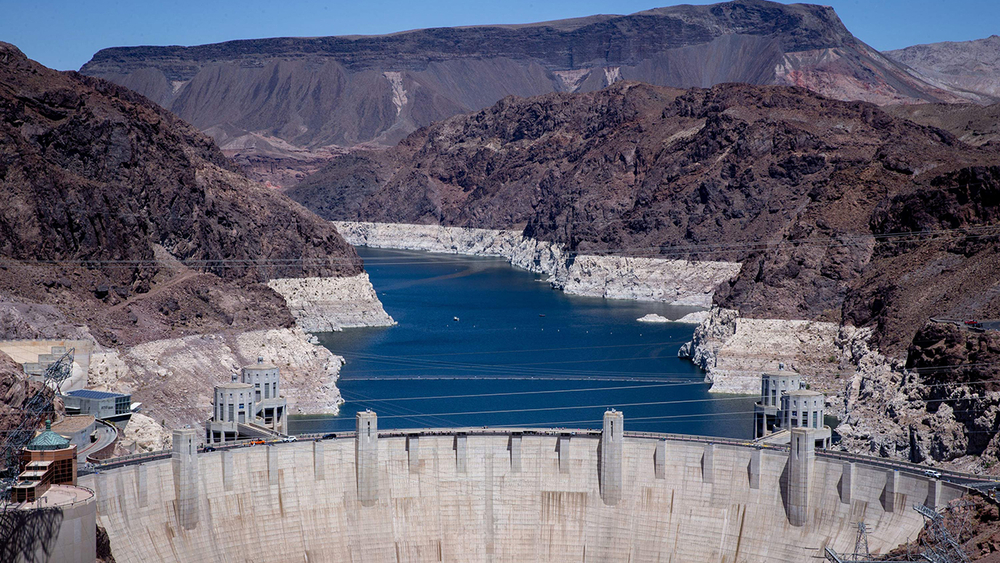
At full capacity, it can produce over 2,000 megawatts of power—enough for nearly 2 million homes.
But as water levels drop, so does that output.
Currently, the dam is operating at a fraction of its intended capacity.
And if Lake Mead falls below a critical threshold—around 1,035 feet—12 of those turbines may have to shut down completely due to a phenomenon called cavitation, where low pressure damages the machinery.
That would leave just five turbines running.
The result? An estimated 80% drop in power generation.
Communities across Nevada, Arizona, and California would feel the impact.
Rural and tribal areas, in particular, could face higher energy costs as they are forced to replace lost hydroelectric power with more expensive alternatives like natural gas.
About 30 miles downstream, Las Vegas has already prepared for this scenario.
Facing the possibility of losing access to traditional water intakes, the city invested over $1.5 billion in a mᴀssive underground system known as the “third straw.”
This tunnel, drilled deep beneath Lake Mead, can draw water even when levels fall below the point where Hoover Dam can function.
Originally designed as a backup, it is now the city’s primary water source.
This system allows Las Vegas to continue operating—even if the lake reaches so-called “ᴅᴇᴀᴅ pool” levels, where water can no longer flow through the dam.
But even this remarkable engineering solution has limits.
Las Vegas relies on the Colorado River for about 90% of its water.
While the city has reduced per-person water use by more than half and recycles most indoor water, it cannot escape the broader reality: the source itself is shrinking.
The Colorado River supplies water to around 40 million people across seven U.S. states and parts of Mexico.
But the system governing its use was built on outdated ᴀssumptions.
When the Colorado River Compact was signed, it overestimated how much water the river could provide.
Today, the river carries significantly less water than originally promised.
That gap—between supply and demand—has been growing for decades.
Add to that a megadrought that has lasted more than 20 years, and the situation becomes even more severe.
Scientific studies suggest this may be the driest period in over a thousand years, with climate change playing a major role in intensifying the conditions.
Less snowpack, higher temperatures, and increased evaporation are all contributing to declining water levels.
And the trend is not reversing.
As the crisis deepens, the seven states that depend on the Colorado River must renegotiate how the water is shared.
But progress has been slow.
Upper basin states—like Colorado and Utah—want to protect their allocations, while lower basin states—such as Arizona, California, and Nevada—are pushing for significant cuts.
ᴅᴇᴀᴅlines have come and gone without agreement.
And time is running out.
Without a new plan, the region risks entering a phase of unmanaged decline, where shortages are no longer negotiated—but forced.
Despite the alarming headlines, Hoover Dam is not “shutting down” entirely—at least not yet.
It will continue to operate, but at reduced capacity.
Similarly, cities like Las Vegas are not running out of water tomorrow.
But the direction is clear.
This is not a short-term crisis caused by a single bad year.
It is a long-term shift in the water system of the American West—one that challenges ᴀssumptions made nearly a century ago.
The infrastructure is adapting.
The policies are struggling to keep up.
And the environment is changing faster than both.
What’s happening at Lake Mead is more than a regional issue—it’s a warning.
It shows what happens when demand exceeds supply for too long.
When climate patterns shift beyond historical norms.
And when systems built for one reality must operate in another.
Hoover Dam still stands.
Las Vegas still has water.
But the margin for error is shrinking.
And the next chapter will depend not just on engineering—but on decisions made now about how to share, conserve, and adapt to a river that no longer behaves the way it once did.


