Japan’s $72 Billion Flying Train: The Engineering Marvel That Defied Mountains
Japan is building what may be the most advanced railway ever conceived—a $72 billion high-speed maglev line capable of reaching speeds over 600 km/h.
Unlike traditional trains, this one doesn’t rely on wheels.
At high speeds, it levitates, floating above the track using powerful magnetic forces.
It is not just fast—it is fundamentally redefining how rail transport works.
The project, known as the Chuo Shinkansen, aims to connect Tokyo and Nagoya in just 40 minutes, a journey that currently takes nearly twice as long.
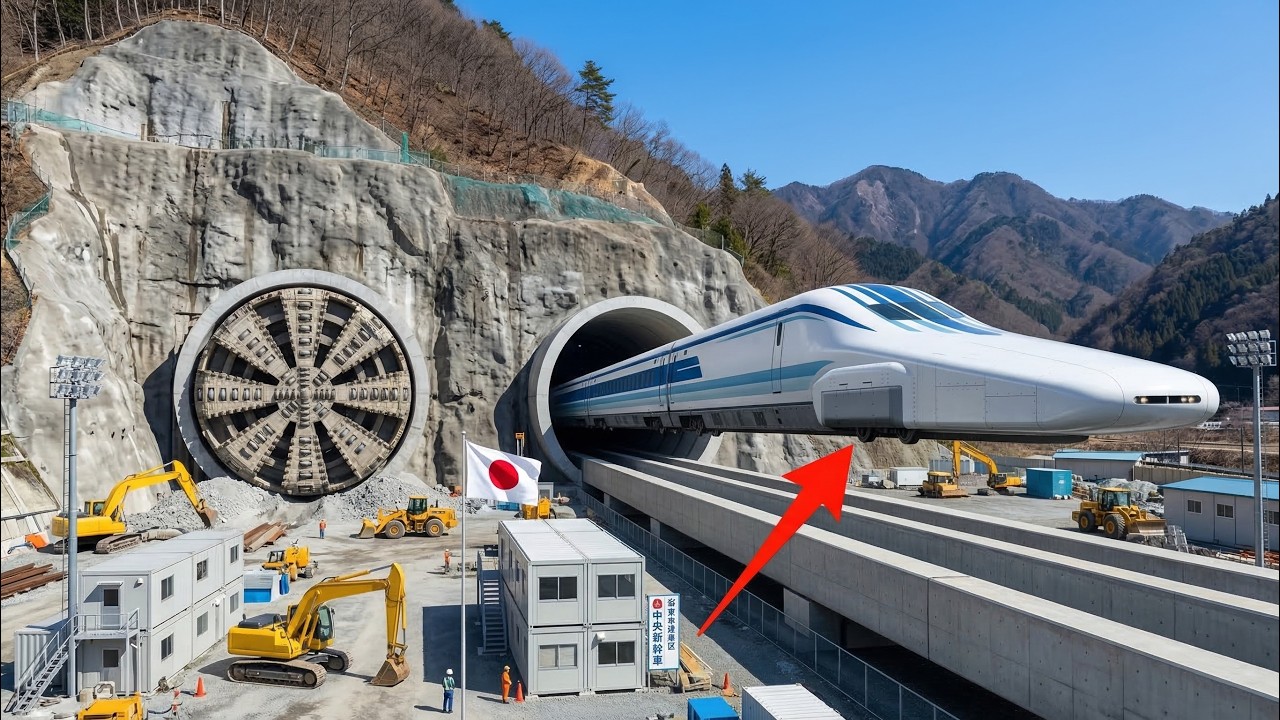
But the real story is not just the speed—it is the extraordinary effort required to make it possible.
To achieve a direct route between major cities, engineers made a bold decision: instead of following the terrain, they would cut straight through it.
As a result, approximately 86% of the railway runs through tunnels, including 246 kilometers carved through some of the most challenging geological formations in Japan.
This decision turned the project into a decades-long engineering battle.
Japan began researching magnetic levitation technology as early as 1962, just before launching the world’s first bullet train in 1964.

Early experiments in the 1970s proved that levitation was possible, and by the 1990s, test tracks demonstrated that trains could reach unprecedented speeds.
The technology itself is revolutionary.
Instead of engines on the train, propulsion comes from the track.
Thousands of electromagnetic coils embedded in the guideway generate forces that both lift and propel the train forward.
Once the train exceeds about 160 km/h, its wheels retract, and it begins to float—eliminating friction and enabling extreme speeds.
Inside the train, the experience is surprisingly calm.
Despite traveling faster than any ground-based vehicle in history, pᴀssengers feel minimal vibration.
The engineering that makes this possible—superconducting magnets cooled to temperatures near absolute zero, precision-aligned guideways, and advanced control systems—remains largely invisible.
But building the system has been anything but smooth.
The Southern Alps presented some of the most difficult tunneling conditions engineers have ever faced.
Rock formations dating back 300 million years proved unstable and unpredictable.
In some areas, immense pressure from overlying rock threatened to crush tunnels.
Underground rivers flooded construction zones, requiring constant pumping and drainage.
To overcome these challenges, engineers used multiple tunneling methods, including tunnel boring machines (TBMs), drill-and-blast techniques, and the New Austrian Tunneling Method (NATM).
Each section of the route demanded a different approach, slowing progress and driving up costs.
Construction also required extreme precision.
The guideway must be aligned within millimeter tolerances over hundreds of kilometers.
More than half a million electromagnetic coils have to be installed by hand, each positioned with exact accuracy.
Even minor deviations could affect performance at high speeds.
The scale of the project is staggering.
Around 30,000 workers are involved across 60 construction sites.
Mᴀssive underground stations are being carved directly into rock, some located 40 meters below the surface.
Ventilation shafts, access tunnels, and support infrastructure add further complexity.
Yet technical challenges were only part of the story.
At one point, construction was halted for four years due to environmental concerns.
A regional governor blocked progress over fears that tunneling would disrupt water supplies for hundreds of thousands of residents.
Engineers were forced to redesign systems to ensure groundwater would be preserved and returned to natural flows.
This delay alone added billions of dollars to the project’s cost, pushing the total from an initial estimate of $9 billion to over $72 billion.
Each year of delay compounded expenses, highlighting the financial risks of such ambitious infrastructure.
Despite these setbacks, testing has continued to deliver remarkable results.
The maglev train has already achieved a world-record speed of 603 km/h.
In trials, it has demonstrated not only speed but also safety, including the ability to stop automatically during earthquakes—an essential feature in a country as seismically active as Japan.
The system is also surprisingly energy-efficient.
At high speeds, it consumes roughly half the energy per pᴀssenger of an equivalent airplane journey, offering both environmental and economic advantages over time.
Globally, the race for high-speed rail dominance is intensifying.
China has developed its own maglev systems and is pushing toward similar speeds.
While Japan pioneered the technology, delays have raised concerns that it could lose its lead in bringing the first fully operational ultra-high-speed maglev line to market.
Still, Japan continues to refine and improve the system even as construction progresses.
New train designs are lighter, more efficient, and more cost-effective.
Every test run generates vast amounts of data, ensuring that no detail is left unexamined.
The target for commercial operation is now set for the mid-2030s.
When completed, the Chuo Shinkansen will fundamentally reshape travel between Japan’s largest cities, compressing distance and time in ways once thought impossible.
But perhaps the most remarkable aspect of the project is not its speed or technology—it is its persistence.
For over 60 years, engineers, workers, and planners have pushed forward through geological obstacles, political resistance, and financial challenges.
The result is more than just a train.
It is a statement about what long-term vision and engineering ambition can achieve—even when the path runs straight through a mountain.


