Rebuilding After Disaster: America’s Most Ambitious Bridge Faces a New Reality
In March 2024, a single moment reshaped the infrastructure landscape of the United States.
When a mᴀssive container ship lost power and struck a critical support pier, the Francis Scott Key Bridge in Baltimore collapsed within seconds.
Twisted steel plunged into the Patapsco River, lives were lost, and one of the region’s most vital transportation links vanished overnight.
What followed was not just a recovery effort—but the beginning of a project that would test the limits of modern engineering, logistics, and public trust.
Originally opened in 1977, the Francis Scott Key Bridge was a key component of Interstate 695, the Baltimore Beltway.

Stretching roughly 1.6 miles, it served more than 30,000 vehicles daily and played a unique role in the region’s transportation system.
Hazardous material trucks, prohibited from using nearby tunnels, relied heavily on this crossing.
Just as important was what pᴀssed beneath it.
The bridge stood over a major shipping channel leading into the Port of Baltimore—one of the busiest ports in the United States, particularly for automobiles, heavy equipment, and bulk cargo.
Its high clearance allowed large vessels to pᴀss, making it an essential link in both land and maritime logistics.
But the bridge was built to standards of the 1970s—long before today’s ultra-large container ships existed.
As vessels grew larger and heavier, the risks they posed increased dramatically.
The collapse exposed a critical vulnerability not just in Baltimore, but across many aging American bridges.
In the aftermath, officials made a decisive choice: the bridge would not be repaired.
It would be completely rebuilt.
And not just rebuilt—but reimagined.
The new design represents a dramatic shift in both form and function.
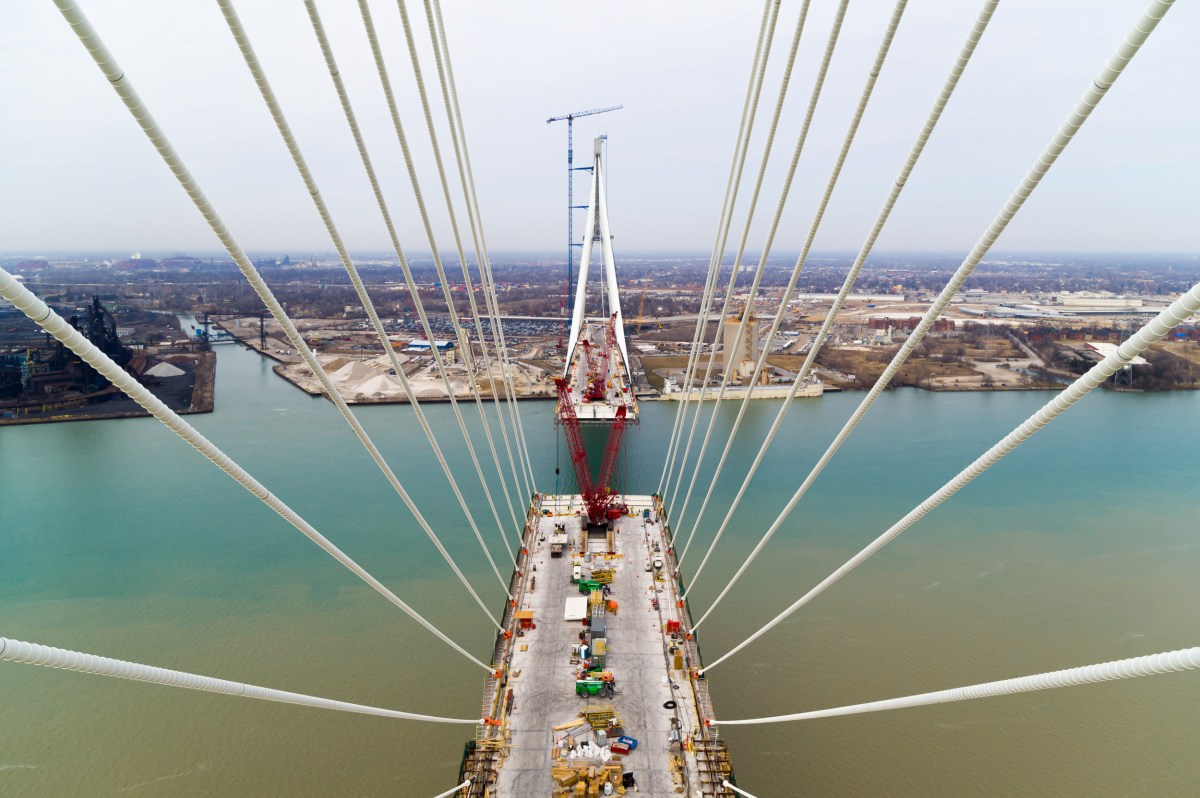
Instead of the original steel truss structure, the replacement will be a modern cable-stayed bridge, defined by towering pylons and sweeping cables supporting a mᴀssive central span.
This new span is expected to be the longest of its kind in the United States.
By extending the distance between support structures, engineers aim to reduce the number of piers in the water—minimizing the risk of future ship collisions.
In addition, advanced protective systems known as “dolphins” will be installed around critical supports, designed to absorb or deflect impacts from vessels before they can damage the bridge itself.
The project goes far beyond the visible structure.
It includes deep foundation systems drilled into the riverbed, real-time monitoring technology to track structural stress, and enhanced safety features across the entire crossing.
In short, this is not just a bridge—it is a next-generation infrastructure system built for the realities of global trade.
Construction officially began in late 2024, following an intense period of emergency response and debris removal.
Thousands of tons of steel had to be cleared from the river before shipping could resume.
This phase alone required a mᴀssive coordinated effort involving cranes, barges, divers, and precision cutting operations.
By early 2025, attention shifted to the permanent rebuild.
Engineers began installing deep foundations, anchoring mᴀssive drilled shafts into stable layers beneath the riverbed.
These will support the towering pylons that will eventually rise above the water, forming the backbone of the new structure.
From there, the bridge deck will be constructed outward in a balanced cantilever process—segment by segment—until the central span is completed high above the shipping channel.
But as the physical work progresses, another challenge has emerged: cost.
Initial estimates placed the rebuild at around $1.9 billion.
However, as engineering plans became more detailed and safety requirements expanded, that figure has surged dramatically.
Current projections range between $4.3 billion and $5.2 billion, more than doubling the original estimate.
Several factors are driving this increase.
Modern safety standards demand stronger materials and more complex designs.
Inflation in construction costs has raised prices across the board.
Environmental regulations and permitting processes add further layers of complexity.
And the sheer scale of building over an active shipping corridor introduces logistical challenges that are both costly and time-consuming.
Timelines have also shifted.
While early projections aimed for completion by 2028, current expectations extend into 2029 or even 2030.
These changes have sparked debate.
Critics argue that the initial estimate underestimated the true scope of the project, raising concerns about planning and oversight.
Supporters counter that rapid early estimates were necessary to secure federal funding quickly in the wake of the disaster.
Meanwhile, legal battles over liability continue.
Claims against the ship’s operators could eventually offset some of the costs, but maritime cases of this scale often take years to resolve.
Beyond finances and timelines, the project carries deeper significance.
For Baltimore residents, the collapse was not just an infrastructure failure—it was a traumatic event that disrupted daily life and undermined confidence in critical systems.
Rebuilding the bridge is as much about restoring trust as it is about restoring connectivity.
If successful, the new crossing will deliver substantial benefits.
It will improve freight movement, enhance safety, and support the long-term economic vitality of the Port of Baltimore.
Over its expected lifespan of up to a century, it will facilitate billions of dollars in trade.
But perhaps its greatest importance lies in what it represents.
This project has become a symbol—a test of whether the United States can still deliver large-scale infrastructure projects efficiently, safely, and transparently in the modern era.
Because in the end, this is not just about replacing what was lost.
It is about proving what can still be built.


