Inferno on the Plains: Inside Nebraska’s Most Devastating Wildfire
The largest wildfire in Nebraska’s history is no longer a distant threat—it is a fast-moving catastrophe reshaping the Great Plains in real time.
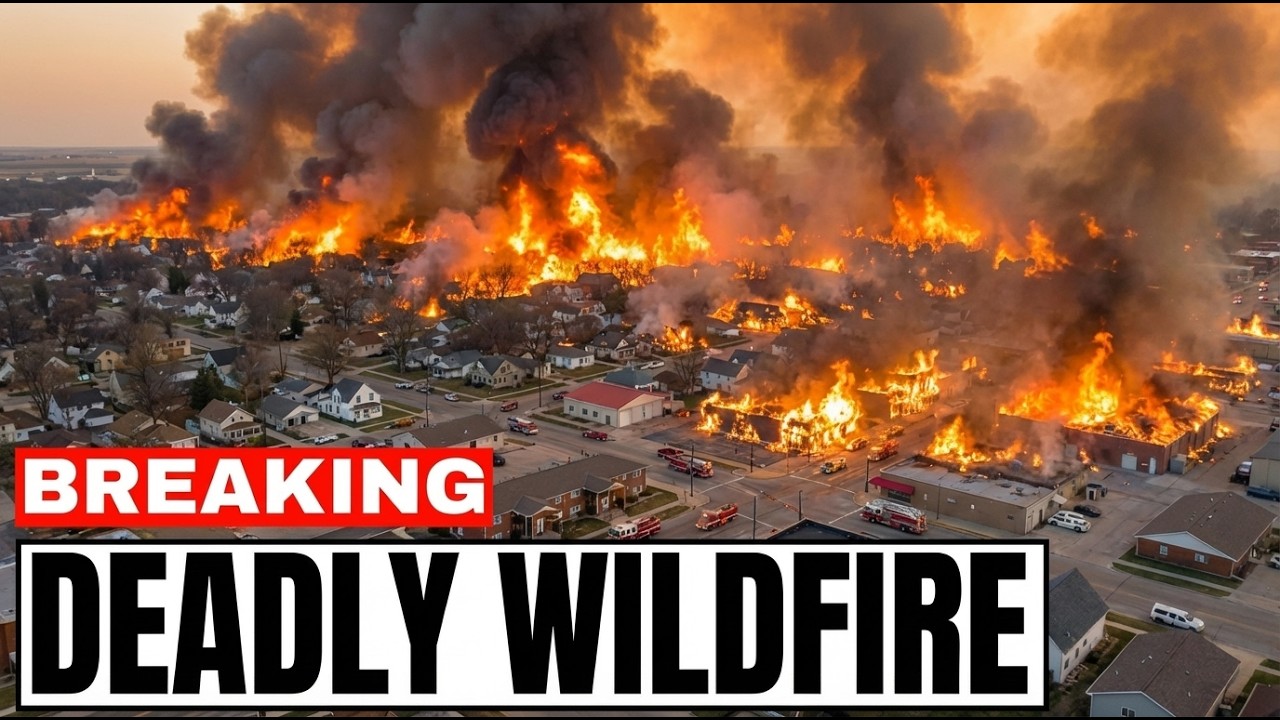
In a matter of hours, flames devoured land at a pace few had ever witnessed, racing 65 miles in just six hours and consuming more than 600,000 acres.
With zero containment reported in the early stages, entire communities were left exposed, forced to evacuate or stand their ground against an unstoppable wall of fire.
The human toll has already begun to emerge.
Rose White, a grandmother in Arthur County, lost her life while attempting to flee.
Her death stands as a stark reminder that behind the staggering statistics are real people, families, and livelihoods shattered in moments.
Across seven counties, a state of emergency has been declared, prompting the deployment of the National Guard, including Blackhawk helicopters, in a desperate effort to contain the chaos.
But the destruction extends far beyond homes.

Nebraska’s agricultural backbone has taken a devastating hit.
Nearly 30,000 cattle have been displaced during calving season, while vast stretches of rangeland and fencing have been reduced to ash.
Ranchers now face not only immediate losses but long-term uncertainty about recovery.
In an unprecedented move, even firefighting crews from Omaha—located 350 miles away—were dispatched westward, underscoring the severity of the crisis.
The wildfire outbreak is not isolated.
Across state lines, the situation mirrors Nebraska’s struggle.
Oklahoma has evacuated thousands, Colorado has cut power to tens of thousands to prevent further ignitions, and red flag warnings stretch across six states.
The Great Plains, it seems, are collectively under siege.
Yet amid the chaos, a troubling revelation has surfaced—one that could redefine how this disaster is understood.
One of the four major fires, known as the Road 203 Fire, did not begin naturally.
Instead, it originated from a prescribed burn conducted by the United States Forest Service.
Initially declared complete and placed under monitoring, the burn escaped control just 36 hours later when powerful winds—reaching up to 74 miles per hour—swept across the region.
The consequences have been severe.
The Road 203 Fire alone has already consumed more than 36,000 acres, including parts of the very forest it was intended to protect.
Despite this, no formal investigation or public apology has been announced.
The situation draws uneasy comparisons to a similar incident in New Mexico in 2022, where a controlled burn spiraled into the state’s largest wildfire, ultimately costing billions in damages.
Weather conditions played a critical role in accelerating the disaster.
Nebraska has been locked in extreme drought, with some areas receiving as little as 11–14% of their normal moisture over the past six months.
The grᴀsses covering the plains—classified as “one-hour fuels”—can dry out and become highly flammable in just 60 minutes.
Combined with low humidity levels and relentless winds, the environment became a perfect storm for wildfire ignition and spread.
By the time night fell on March 12, multiple fires were already raging across the state.
The largest, the Morrill Fire, had surged across counties with terrifying سرعت, while the Cottonwood Fire forced evacuations in Dawson County.
Firefighters, overwhelmed by the speed and scale, could do little more than watch as flames advanced unchecked.
Unlike typical wildfires, which tend to slow after sunset, these fires continued to intensify through the night.
Amid the devastation, stories of resilience have emerged.
Volunteers have mobilized quickly, setting up shelters, distributing supplies, and supporting exhausted firefighters who have worked for more than 30 hours without rest.
Ranchers and farmers, facing the loss of everything they own, have taken matters into their own hands—using tractors in the middle of the night to carve firebreaks and save their homes.
In some cases, their efforts succeeded where formal systems could not.
Still, the outlook remains grim.
While a brief cold front brought cooler temperatures and even light snow to parts of the region, experts warn this is only temporary relief.
Forecasts predict a rapid return to high temperatures, strong winds, and low humidity—conditions that could reignite and expand the fires in the coming days.
Complicating matters further is the strain on firefighting resources.
Multiple states are battling similar conditions, forcing them to compete for federal ᴀssistance.
Ironically, the same federal agency responsible for providing support is also under scrutiny for its role in starting one of the fires.
This raises a critical and uncomfortable question: if the conditions that allowed the prescribed burn were deemed acceptable, what conditions would be considered too dangerous? The answer could have far-reaching implications, not only for Nebraska but for wildfire management policies nationwide.
As night falls over the scorched plains, uncertainty hangs heavy in the air.
Firefighters, ranchers, and families alike know that the worst may not yet be over.
The wind is shifting, temperatures are fluctuating, and the land—still dry and vulnerable—waits.
In Nebraska, the fire is not just a natural disaster.
It is a test of preparedness, accountability, and resilience.
And for many, tomorrow does not bring relief—it brings fear that the inferno will only grow.


