Kubrick’s Final Mystery: The Legend of the “Forbidden Cut” of Eyes Wide Shut
When Stanley Kubrick died in March 1999, the legendary director left behind a film that would quickly become one of the most debated movies in modern cinema.
Eyes Wide Shut, starring Tom Cruise and Nicole Kidman, was released later that same year.
On the surface, it appeared to be a psychological drama about jealousy, temptation, and secrecy within the lives of wealthy elites.
Yet almost immediately after its release, the film became surrounded by rumors.
Some viewers believed the mysterious masked ritual depicted in the film hinted at hidden societies among the world’s most powerful people.

Others focused on an even stranger claim: that Kubrick had originally completed a much longer version of the film—one that was never shown to the public.
According to these stories, Kubrick screened a nearly four-hour cut of Eyes Wide Shut shortly before his death.
This version allegedly contained extended scenes, especially during the famous masked ceremony sequence at the mansion.
In the theatrical version, the ceremony is disturbing but ambiguous.
Masked figures stand in silence while a ritual unfolds under candlelight.
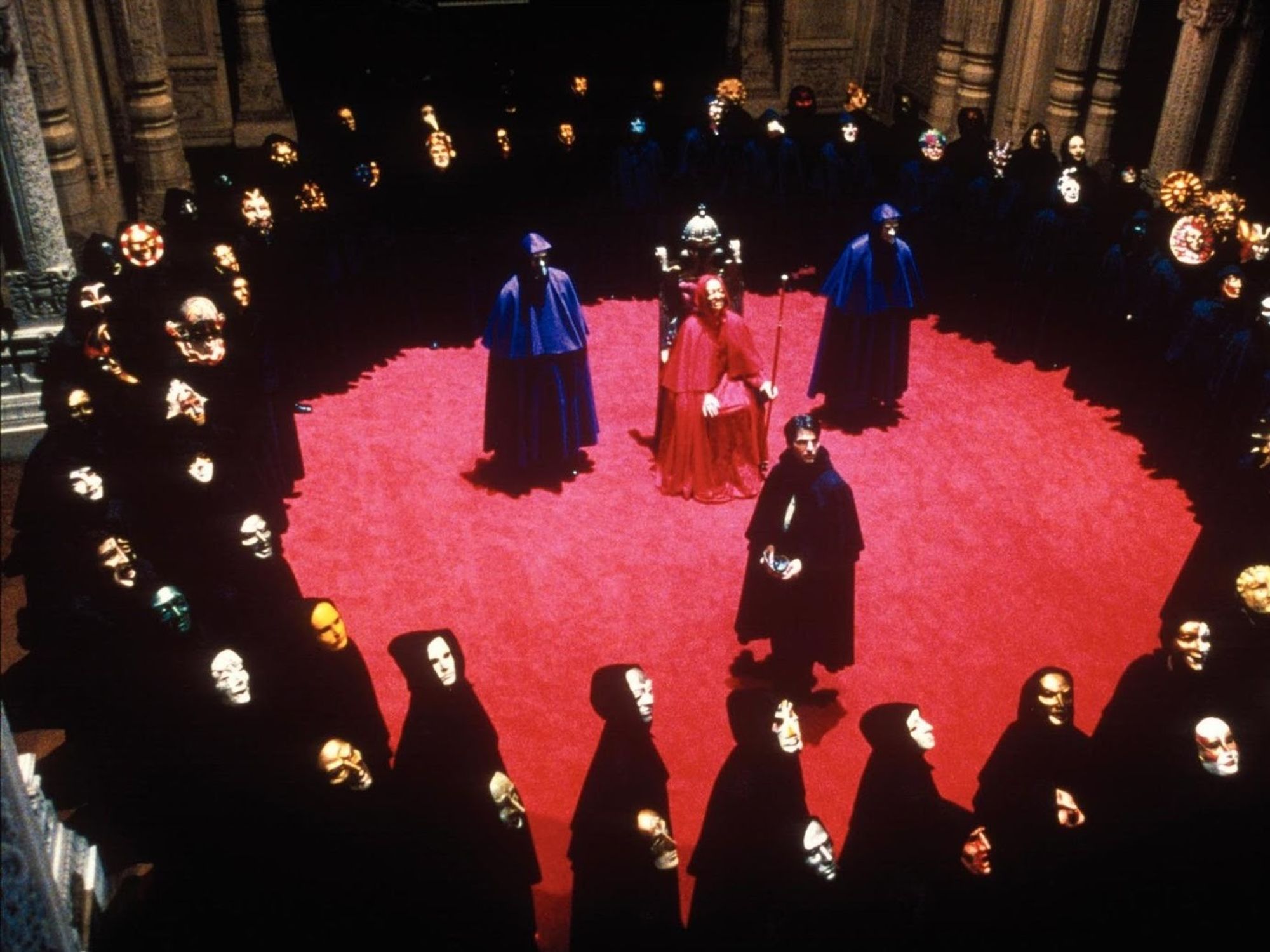
The camera lingers on rows of cloaked participants before abruptly cutting away.
But conspiracy-minded interpretations claim Kubrick’s original edit went further.
The rumor suggests that, in the longer version, the ritual ended differently.
Instead of cutting away, the masks were supposedly removed, revealing the faces of the people participating in the ceremony.
In the story’s most dramatic version, these faces belonged to recognizable elites—individuals Kubrick allegedly intended audiences to notice.
However, there is no confirmed evidence that such a version of the film ever existed.
What is known is that Kubrick completed a final cut of the film and screened it privately for Warner Bros.
executives on March 1, 1999.
Just six days later, he died in his sleep from a heart attack at the age of 70.
Because of this timing, many fans believe Kubrick never fully supervised the final release of the movie.
This belief intensified when viewers noticed that the theatrical version of Eyes Wide Shut contained digital figures inserted into the ritual scene.
These computer-generated silhouettes stand in the foreground and partially block the view of the ceremony.
Warner Bros.
explained that these additions were necessary to avoid an “NC-17” rating in the United States.
By obscuring certain explicit elements of the scene, the film could receive the more commercially viable “R” rating.
Technically, this explanation makes sense.
Studios frequently alter films to meet rating guidelines.
Still, the unusual editing choice fueled speculation.
To some viewers, the silhouettes looked oddly placed—as if they were hiding something beyond simple nudity.
The rumor grew even larger online during the early 2000s, when internet forums began dissecting the film frame by frame.
Amateur analysts searched for hidden symbols, secret messages, and clues about Kubrick’s intentions.
Part of the fascination comes from Kubrick’s reputation itself.
Throughout his career, he was known for meticulous research and obsessive attention to detail.
Whether directing 2001: A Space Odyssey, A Clockwork Orange, or The Shining, Kubrick often spent years studying subjects before filming them.
For Eyes Wide Shut, he adapted Arthur Schnitzler’s 1926 novella Traumnovelle (“Dream Story”), which tells the tale of a man who infiltrates a secret gathering of masked elites.
Kubrick had reportedly been interested in adapting the story for decades.
During production, the shoot became famously long and complicated.
Filming lasted roughly 15 months, making it one of the longest continuous shoots in Hollywood history.
Kubrick demanded numerous retakes and maintained strict control over the set.
That secrecy, combined with the film’s themes, helped feed the myth that the director was exploring real-world secret societies.
But historians and film scholars point out that there is no credible documentation showing Kubrick was exposing hidden rituals among powerful groups.
Instead, they argue that the film is a psychological exploration of desire, power, and illusion within elite social circles.
The mysterious atmosphere was intentional—but symbolic rather than documentary.
Even so, the legend of the “lost cut” continues to fascinate movie fans.
Part of that fascination lies in the unanswered questions surrounding Kubrick’s final days.
He died just after delivering his completed film.
The studio made minor edits afterward.
And the movie itself deals with secrecy, power, and hidden worlds.
Those elements combine into a story that almost feels like one of Kubrick’s own plots.
More than two decades later, Eyes Wide Shut remains one of the most debated films in cinema history.
Some viewers see it as a haunting psychological drama.
Others view it as a coded warning about elite power structures.
The truth is likely far less mysterious.
But the combination of Kubrick’s perfectionism, his sudden death, and the film’s unsettling imagery ensured that the legend of the “forbidden cut” would never completely disappear.
And perhaps that lingering uncertainty is exactly what keeps audiences watching—and questioning—every frame.


