Beyond the Culture War: Bishop Barron’s Brilliant Take on the Halftime Divide
The recent Super Bowl halftime show became more than entertainment.
It became a symbol of America’s deep cultural divisions.
On one side were critics framing the event as politically charged or ideologically skewed.

On the other were supporters celebrating the performance and dismissing the backlash.
Viewership numbers were cited, online arguments multiplied, and familiar tribal lines hardened.
But beneath the spectacle lies a deeper concern: what constant exposure to cultural conflict is doing to the human soul.
According to Bishop Barron’s theological reflection, the problem is not merely political disagreement.
It is spiritual formation.

What we habitually behold, he argues, we eventually become.
To make his point, Barron turns not to modern punditry but to Scripture—specifically the Gospel of Matthew and the prophecy of Isaiah.
He notes that many readers rush past a crucial detail: Jesus begins His ministry in the region of Zebulun and Naphtali.
For first-century Jews, these names were loaded with meaning.
This northern territory had been devastated by ᴀssyrian invasion, ᴀssociated with compromise, exile, and darkness.

Isaiah had prophesied that from this very “land of darkness” would come a great light.
When Matthew’s Gospel identifies Jesus beginning His public mission there, attentive Jewish listeners would immediately recognize the fulfillment.
Out of division and exile, God would bring unity and restoration.
This is not accidental geography.
It is theological geography.

Jesus’ first proclamation—“Repent, for the kingdom of heaven is at hand”—is often spiritualized in modern ears.
But in its original context, it signaled something concrete: the long-awaited reunification of Israel under God’s reign.
A divided people would be gathered again.
And how does Jesus begin that gathering? By calling twelve disciples—symbolic of the twelve tribes of Israel.
The fractured family of God is being reᴀssembled.

Barron emphasizes that Christ’s mission is fundamentally one of ingathering.
He does not intensify division; He overcomes it.
This stands in stark contrast to today’s cultural climate, where idenтιтy is often forged through opposition—us versus them, ally versus enemy.
Barron’s most striking insight is the distinction between horizontal and vertical focus.
When we gaze horizontally—at outrage cycles, political rivalries, constant commentary—we are formed by rivalry.
Over time, suspicion becomes instinctive.

We interpret events through lenses of fear, compeтιтion, and tribal loyalty.
But when we lift our gaze vertically—toward God—we encounter something radically different: communion.
At the heart of Christian faith is the Trinity: Father, Son, and Holy Spirit in perfect unity.
No compeтιтion.
No insecurity.
No grasping for dominance.

Only self-giving love.
If that communion becomes our “ultimate concern,” to borrow theologian Paul Tillich’s phrase, it reshapes us.
A culture formed by rivalry produces rivals.
A people formed by communion become peacemakers.
In a world that constantly demands we pick sides, Barron proposes a countercultural move: refuse the game altogether.

This does not mean disengagement from society.
It means refusing to let partisan idenтιтy become ultimate idenтιтy.
If politics becomes ultimate, hatred of opponents follows naturally.
If wealth becomes ultimate, anxiety and protectionism dominate.
But if Christ is ultimate, everything else is relativized.

The “main thing,” Barron insists, must remain the main thing.
When Christ becomes the reference point, division no longer defines us.
We are free from the compulsion to dominate or defeat.
Instead, we are drawn into participation in divine communion.
The halftime controversy will fade.

Another spectacle will take its place.
Another cultural skirmish will erupt.
The deeper question remains: what is shaping us?
Are we being formed by outrage, commentary, and endless rivalry? Or are we being reoriented toward the vertical—toward the God whose life is unity itself?
Bishop Barron’s reflection is not really about a halftime show.
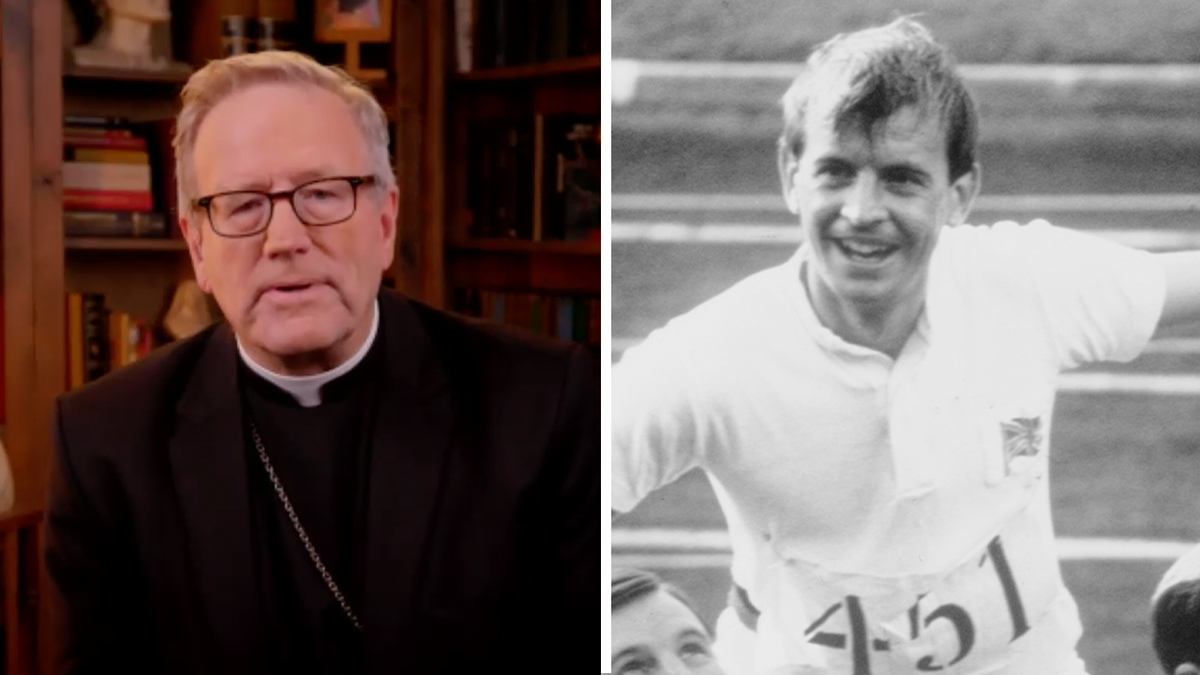
It is about the condition of the human heart in a fractured age.
In the end, the path beyond division is not found in winning the culture war.
It is found in rediscovering the kingdom—a kingdom that gathers, heals, and reconciles.
And that changes everything.


