ALL ABOARD! KING CHARLES ARRIVES IN LANCASHIRE FOR RURAL-FOCUSED VISIT
King Charles III arrived in Lancashire by train this week, beginning a visit that placed rural life, farming communities, and mental well-being at the forefront.
It was a deliberately low-key arrival—no grand procession, no sweeping speeches at first—just a monarch stepping onto a station platform in Clitheroe, greeted by local residents and community leaders.
This marked the King’s second visit to Lancashire since ascending the throne, and the choice of destination was no accident.
Long before becoming monarch, Charles built a reputation as one of the most outspoken advocates for rural Britain, sustainable farming, and community resilience.
In Lancashire, those priorities were on full display.
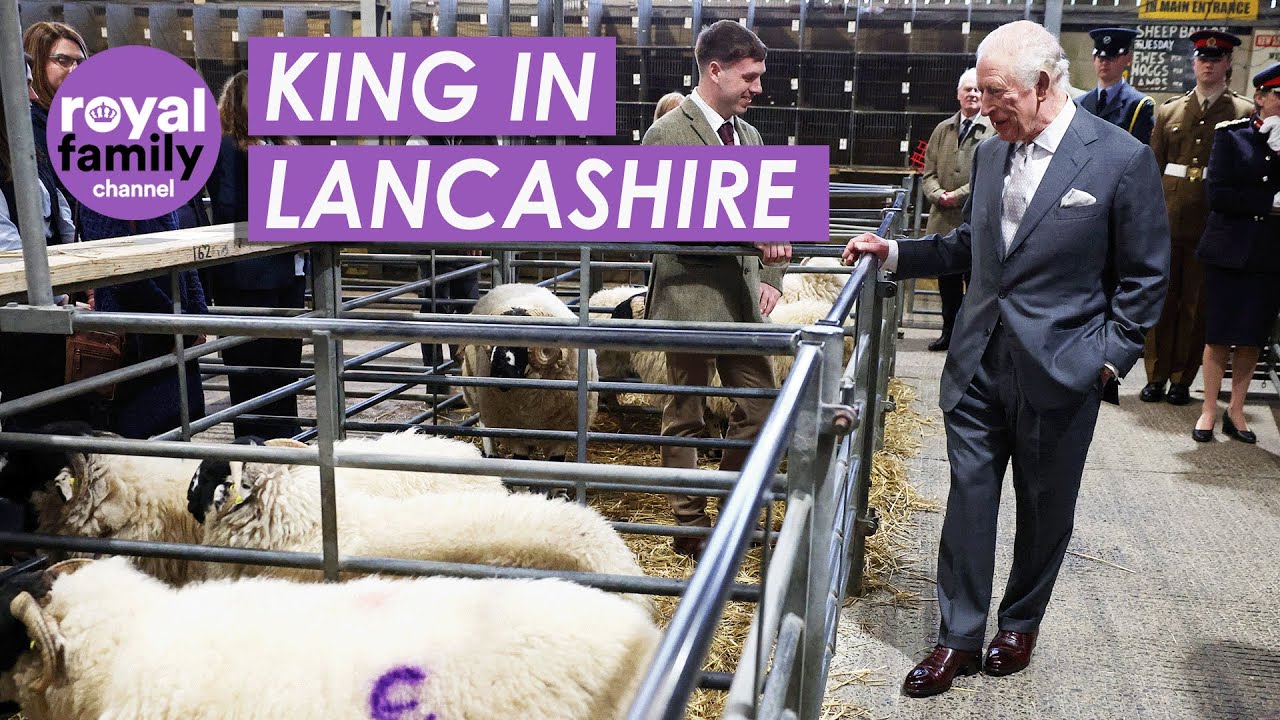
After arriving at Clitheroe Station, the King traveled onward to a local auction mart, a cornerstone of rural life that serves not only as a commercial hub for livestock trading, but also as a vital social space for farmers who often work in isolation.
For many in attendance, the visit was less about ceremony and more about being seen and heard.
Throughout the day, King Charles engaged in unguarded conversations with farmers, families, and agricultural workers.

He asked detailed questions about livestock, feed costs, herd sizes, and the realities of early mornings and long days.
Several farmers introduced their animals, including cattle prepared for shows, while others spoke about multigenerational family farms struggling to adapt to rising costs, climate pressures, and shifting regulations.
One recurring theme was resilience.
During discussions, farmers referenced the Farm Resilience Programme—supported by the King’s Countryside Fund—which offers training, financial planning, and mental health support to farming families.
Several participants credited the programme with helping them navigate periods of extreme stress, uncertainty, and isolation.
King Charles listened attentively, often recalling previous visits and conversations from years earlier.
His memory for people and places stood out, surprising some attendees who found he remembered details from past encounters.
For many, this personal engagement reinforced the sense that the visit was not symbolic, but genuinely informed.
The auction mart itself became a focal point of the visit.
Beyond its economic function, it was highlighted as a place where farmers can speak openly, seek advice, and access support services such as field nurses—professionals who provide confidential mental health ᴀssistance within agricultural communities.
In brief remarks, the King acknowledged how essential such spaces are, particularly in a sector where loneliness and stress remain persistent challenges.
He spoke candidly about the pressures farmers face, from volatile markets to unpredictable weather and the growing impact of climate change.
Rather than offering simplistic reᴀssurances, he emphasized adaptability, community networks, and the importance of insтιтutions that bring people together.
“I know only too well how vital the rural and farming sector is to this country,” the King said, noting that he has spent decades advocating for countryside issues.
He reflected on founding the Countryside Fund nearly 20 years ago, expressing hope that it continues to play a role in supporting farmers through ongoing and future challenges.
What struck many observers was the tone of the visit.
There was no attempt to gloss over hardship.
Instead, the King repeatedly acknowledged the complexity of modern farming—balancing tradition with innovation, heritage with survival.
At one point, he praised the sheer perseverance of farming families, remarking on their ability to endure constant pressure while continuing to supply food, care for land, and support rural economies.
His admiration appeared genuine and deeply rooted in his long-standing relationship with agricultural communities.
The visit also underscored a broader message about the monarchy under King Charles: a quieter, more grounded approach, centered on listening rather than spectacle.
Traveling by train, engaging directly with individuals, and focusing on practical initiatives rather than pageantry, the day reflected a style that aligns closely with his pre-kingly work.
For Lancashire’s farming community, the visit carried symbolic weight.
In a time when rural voices often feel overlooked in national debates, the presence of the monarch—engaged, informed, and attentive—served as a reminder that their work still matters at the highest level.
As the King concluded his visit, he expressed hope for a successful season ahead, “weather permitting, climate change permitting,” acknowledging with characteristic understatement the uncertainty farmers live with daily.
The visit may have lasted only hours, but for those who met him, it reinforced something deeper: that rural Britain, with all its challenges and quiet strength, remains close to the heart of the King.


