There are rare moments when history seems to pause, not because of spectacle or force, but because a truth long buried is suddenly spoken aloud.
Such a moment unfolded quietly in Brittany, France, when Cardinal Robert Sarah stood on sacred ground and spoke with a gravity that felt almost foreign to modern ears.
This was not a speech designed to comfort, persuade, or gather applause.
It was a warning, a reminder, and a call that echoed far beyond the small town where it was delivered.
Only a month earlier, Pope Leo XIV had made a decision that raised eyebrows across ecclesial and political circles.

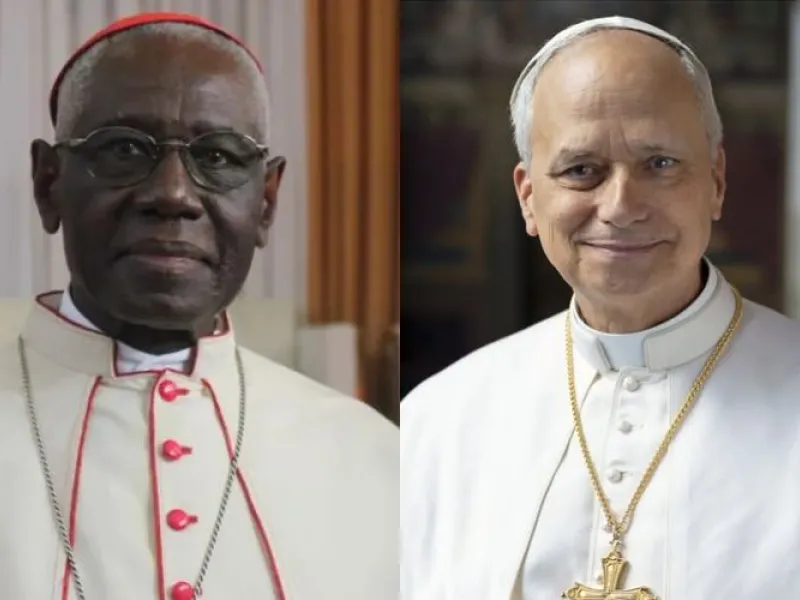
He appointed Cardinal Sarah as his special envoy to Brittany for the 400th anniversary of the apparitions of Saint Anne.
The choice was deliberate.
Sarah is not known for diplomacy softened by ambiguity.
He speaks with the blunt clarity of someone unconcerned with trends or approval.
By sending him, Pope Leo made it clear that this was not to be a ceremonial visit, but a spiritual intervention.
The location itself carried immense weight.
The sanctuary of Sainte-Anne-d’Auray is not merely a regional pilgrimage site.

According to tradition, it stands on land claimed by God himself in the 17th century through the apparitions of Saint Anne to a humble peasant.
The message was precise and uncompromising: this land was to be set apart, reserved for worship, not bent to human ambition or worldly utility.
It was to remain a physical reminder that some places belong to God alone.
Standing there, Cardinal Sarah did more than commemorate history.
He reactivated it.
He spoke as if the message of Saint Anne had never faded, only been ignored.

Brittany, he said, was meant to stand as a sign of what a Christian land looks like when it remembers who it belongs to.
Not a place ruled by noise or productivity, but by reverence, silence, and prayer.
His words carried the unsettling implication that much of the modern world has forgotten this distinction entirely.
He turned quickly to what he described as the central sickness of Western society: a fullness that is empty.
People have never been more connected, more entertained, or more materially comfortable, and yet spiritually they are starving.
Religion, he argued, has been hollowed out, reduced to vague moral sentiment and social utility.

The great themes that once defined faith—sin, salvation, eternity, sacrifice—are now avoided, replaced by language of comfort, inclusion, and emotional well-being.
In this shift, Cardinal Sarah saw a new form of idolatry.
No longer statues or false gods, but the worship of humanity itself.
God is quietly displaced, not through open rejection, but through neglect.
Faith becomes a tool for self-improvement, spirituality a kind of therapy, worship a performance.
Christianity is reshaped to be acceptable, manageable, and harmless.
In the process, it loses the very power that once changed civilizations.
He returned again and again to a single, piercing question: what truly satisfies the human soul? Bread from this world, or the bread that comes from heaven? Drawing from Christ’s temptation in the desert, he reminded listeners that Jesus explicitly rejected a faith centered on material satisfaction.
Even a world without hunger, Sarah insisted, would remain spiritually lost without God.
Service to the poor is essential, but it cannot replace worship.
When the Church confuses humanitarianism with salvation, it forgets its primary mission.
His words grew even more uncomfortable as he addressed the desecration of the sacred.

Churches, once built as houses of God, are increasingly treated as multipurpose spaces, cultural venues, or ideological platforms.
This is not a neutral change, he warned, but a spiritual amnesia.
When sacred spaces lose their idenтιтy, so do the people who worship in them.
The same erosion, he argued, has entered the liturgy itself, which is often reshaped to reflect social ideals rather than divine mystery.
Reverence, silence, and awe have been pushed aside.
In their place stand noise, spectacle, and endless commentary.
But worship, Cardinal Sarah insisted, is not entertainment.
It is not meant to reflect the world back to itself.
True worship humbles, unsettles, and draws the soul into silence before the mystery of God.
A faith that cannot be silent, he said, is a faith that can no longer hear.
Then came one of the most striking moments of his address.
On consecrated ground, he issued a direct warning to France itself.
Do not defile the nation, he said, with laws that choose death when God calls humanity to choose life.
This was not abstract theology.
It was a moral indictment of a society that once called itself the eldest daughter of the Church, now guided by ideologies rooted in human pride rather than divine order.
Yet the most powerful turn in his message came when he stopped speaking about nations, politics, and culture, and addressed the individual soul.
God did not only choose Brittany, he said.
He chose you.
Every human soul is sacred ground, a temple meant for God.
Neglected, damaged, even ruined perhaps, but never beyond restoration.
Time, however, is short.
He warned that a soul treated like a public space—filled with distractions, compromises, and constant noise—will never become what it was created to be.
The tragedy, he said softly, is that many will live their entire lives without ever becoming truly themselves.
Not because they lacked success, but because they lacked God.
Despite the severity of his words, Cardinal Sarah did not preach despair.
The door back remains open.
Silence is not emptiness; it is the place where God still waits.
In a world addicted to solutions, arguments, and activism, he offered something radically different.
In the face of evil, there are no political answers.
There is only adoration.
This was perhaps his most countercultural claim of all.
Real spiritual battles are not won in parliaments or protests, but in quiet hearts that kneel.
When the world fractures, worship remains.
When words fail, adoration still speaks.
Evil gains ground only where worship disappears.
As he closed, he echoed the words of Pope Leo XIV with the force of a declaration: evil will not prevail.
Not because of human brilliance or progress, but because God remains.
Where true worship endures, hope is born.
A hope not rooted in man, but in the living God, unshaken by the rise and fall of ages.


