SANTORINI SHAKES: Mediterranean Volcano Suddenly Awakens — Natural Activity or a Dangerous Warning?
The whitewashed cliffs of Santorini have always carried a quiet contradiction.
Postcards frame it as a sanctuary of light — cobalt domes, cascading bougainvillea, sunsets engineered for applause.
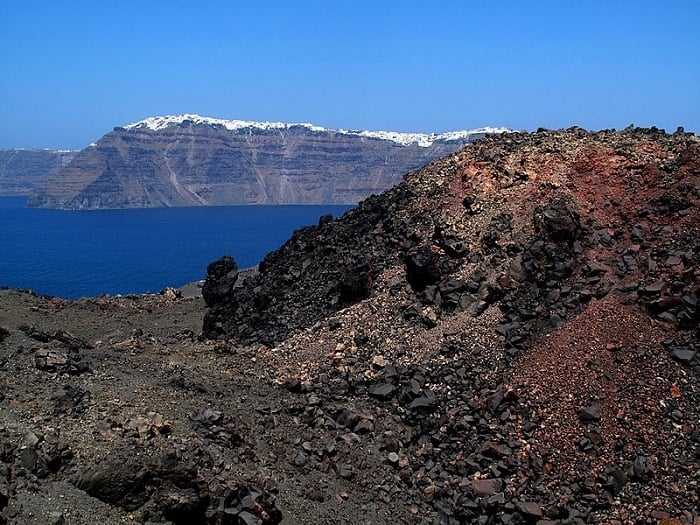
Yet beneath the symmetry of its terraces lies a caldera carved by violence so immense that historians still argue about its consequences.
This week, that contradiction resurfaced.
The island, long romanticized as a honeymoon refuge, is now on high alert after renewed volcanic activity in the surrounding Mediterranean basin unsettled both instruments and instincts.
Officials were careful with their language.
“Increased seismic activity.” “Localized emissions.” “No immediate cause for alarm.” The phrasing was deliberate, almost rehearsed.
But the data charts told a more restless story.
A cluster of tremors rippled beneath the seafloor southwest of the island, shallow enough to be felt in certain villages as a faint vibration underfoot.
Not enough to trigger panic — yet not subtle enough to ignore.
Residents described it as a low hum, like distant machinery grinding behind a wall no one could see.
Tourists, at first, dismissed it.
The cafés in Oia remained full.
Cruise ships still traced elegant arcs through the Aegean.
Influencers filmed sunsets with steady hands.
But sometime after midnight, videos began circulating — brief, grainy clips showing what appeared to be a pale column rising on the horizon.
Authorities later clarified that it was likely steam interacting with cooler air.
Likely.
The word echoed.
Geologists monitoring the Hellenic Volcanic Arc have long regarded the Santorini caldera as active, not extinct.
Its past is well documented: the Bronze Age eruption that reshaped the island and possibly contributed to the collapse of the Minoan civilization.
That event did not arrive without warning either.
Layers of ash, subtle tremors, gas emissions — signs that, in hindsight, formed a narrative of inevitability.
Today’s instruments are more advanced, but the Earth’s language remains stubbornly ambiguous.
By Tuesday afternoon, emergency coordination teams had convened in Athens.
No evacuation orders were issued.
Flights continued.
Ferries operated on schedule.
Yet local authorities quietly reviewed contingency routes and shelter capacities.
A civil protection official, speaking off record, admitted that the pattern of tremors was “irregular.
” Not unprecedented — but irregular.
The distinction matters, though perhaps not in the way officials intend.
Seismographs captured a sequence of microquakes clustering along a fault line historically ᴀssociated with magma movement.
Experts debated whether the activity signaled magma ascent or tectonic adjustment.
Both explanations are scientifically plausible.
Only one carries cinematic consequences.
Social media, predictably, chose the latter.
Hashtags referencing “the next big one” trended across European platforms.
Speculation traveled faster than any seismic wave.
At dusk, the caldera looked unchanged.
Fishing boats cut through calm water.
The wind moved predictably across terraces.
But satellite thermal imagery reportedly detected minor temperature anomalies beneath the seafloor.
Such fluctuations can occur for benign reasons.
They can also precede hydrothermal events.
The Mediterranean is no stranger to underwater eruptions — many go unnoticed except by the instruments designed to watch for them.
The question is not whether activity is occurring.
The question is what form it intends to take.
Some residents recall stories pᴀssed down through generations — tales of rumblings before ash darkened the sky centuries ago.
Oral history tends to exaggerate, but it rarely invents.
An elderly shop owner in Fira remarked that “the island speaks before it shouts.” When asked what he meant, he only gestured toward the cliffs.
Tour operators have begun fielding cancellations, though not at scale.
Insurance providers are reportedly reviewing risk ᴀssessments tied to volcanic disruption clauses.
Economically, Santorini exists in a delicate balance between allure and vulnerability.
An eruption would not simply be a geological event; it would be a logistical and financial shockwave reverberating across tourism-dependent sectors.
Yet to frame the situation purely in economic terms feels insufficient.
The tension here is elemental.
Scientists emphasize that volcanic systems often experience periods of unrest without culminating in eruption.
Pressure can dissipate gradually.
Magma can stall.
Gas can vent harmlessly.
Each of these outcomes is statistically more common than catastrophe.
And yet, the memory of Santorini’s prehistoric explosion lingers precisely because it was not statistically common.
It was extraordinary.
The island’s crescent shape is proof.
By Wednesday morning, additional monitoring equipment had been deployed.
Research vessels traced careful lines across the caldera’s waters, mapping chemical signatures invisible to the naked eye.
Preliminary readings suggested elevated sulfur dioxide concentrations in certain pockets.
Elevated does not mean critical.
It does, however, suggest movement — a system adjusting, perhaps recalibrating.
Local officials urged calm, reminding visitors that Santorini remains structurally stable.
H๏τels continue operations.
Schools remain open.
The language of reᴀssurance is consistent.
But beneath that consistency lies an undercurrent of preparation.
Emergency text alert systems were tested discreetly.
Supply inventories were reviewed.
These are procedural measures, authorities insist.
Routine.
Yet routine rarely attracts headlines.
What unsettles observers is not a single data point but the convergence of several modest anomalies occurring within a compressed timeframe.
Seismic clusters.
Gas emissions.
Thermal shifts.
None individually definitive.
Together, they form a pattern that invites interpretation — and controversy.
Some volcanologists caution against sensationalism, warning that premature alarm can erode public trust.
Others argue that transparency about uncertainty is itself a form of preparedness.
International attention has intensified.
Media outlets frame the situation with escalating adjectives: “volatile,” “ominous,” “unpredictable.” Each term adds a layer of drama, sometimes detached from measured probability.
Yet drama is not entirely misplaced.
Volcanic systems are, by nature, unpredictable.
They operate on timelines indifferent to human scheduling.
Night falls differently when an island is on alert.
The darkness feels denser, as if listening.
Streetlights reflect off whitewashed walls, casting elongated shadows.
Somewhere beneath the caldera, pressure either builds or dissipates.
Instruments cannot yet declare which trajectory prevails.
The Earth rarely provides definitive statements in advance.
There is also the broader Mediterranean context.
Submarine volcanic fields across the region have exhibited intermittent activity over recent decades.
Climate factors, tectonic drift, and hydrothermal circulation intersect in complex ways scientists continue to model.
To isolate Santorini from that network would be simplistic.
To conflate every tremor with imminent disaster would be equally flawed.
Still, the images persist: faint plumes against twilight, graphs trending upward, officials speaking in tempered tones.
The narrative oscillates between caution and curiosity.
For some, this is a reminder of nature’s scale — a humbling recalibration of human certainty.
For others, it is a developing crisis being understated for the sake of tourism stability.
The truth likely resides somewhere less dramatic yet no less consequential.
In conversations across the island, a subtle shift is perceptible.
Vendors glance toward the horizon more frequently.
Fishermen monitor tides with heightened attention.
Visitors ask reception desks about evacuation protocols they never previously considered.
Life continues, but with an added layer of awareness — an invisible weight pressing lightly against the present moment.
Will Santorini erupt? No credible authority has declared that it will.
Will the current unrest fade into geological footnotes? Possibly.
The Earth often murmurs without escalating to a scream.
Yet history advises humility.
The caldera was shaped by an event few ancient inhabitants could have fully imagined.
For now, Santorini exists in suspension — not in chaos, not in calm, but in something between.
High alert does not mean catastrophe.
It means watching.
Measuring.
Waiting.
And perhaps acknowledging that beneath the island’s immaculate façade lies a force neither romantic nor malicious, merely patient.
As satellites continue their silent surveillance and research vessels trace cautious paths across the water, the question lingers without resolution.
Is this simply another chapter in the island’s long geological rhythm? Or the opening line of a story that will be retold for centuries? The instruments will keep recording.
The sea will keep reflecting sunsets.
And somewhere below, unseen processes continue — indifferent to headlines, yet impossible to ignore.


