PARADISE UNDER SIEGE: EXPERTS WARN HIDDEN GEOLOGICAL TIPPING POINT MAY BE UNRAVELING FLORIDA’S SHORE FASTER THAN OFFICIALS ARE ADMITTING!
Recent reports describing Florida’s coastline as “caving in” and beaches being swallowed by mᴀssive sinkholes have generated widespread concern.
Dramatic pH๏τographs of steep drop-offs, collapsed sand, and exposed rock formations can make it appear as though entire sections of the state are disappearing overnight.
While localized collapses and severe erosion events do occur, the broader geological reality is more measured and rooted in well-understood natural processes.
Florida’s coastal changes are the result of a complex interaction between limestone geology, groundwater movement, storm activity, sea-level rise, and human development rather than sudden, mysterious destruction.
Florida sits atop a vast platform of limestone that formed millions of years ago when the region was submerged beneath warm, shallow seas.
Over time, the accumulated shells and skeletons of marine organisms compressed into thick layers of calcium carbonate rock.
As sea levels fluctuated across geological eras, portions of this limestone were exposed and covered again, leaving behind the flat, low-lying peninsula known today.
Limestone is relatively soluble, meaning that slightly acidic rainwater can slowly dissolve it.

As rainwater seeps into the ground and mixes with carbon dioxide in the soil, it forms a weak carbonic acid that reacts with calcium carbonate.
This process gradually creates underground cavities and channels in a landscape known as karst terrain.
Karst geology explains why Florida is especially prone to sinkholes.
When underground cavities grow large enough, the material above them can collapse.
Sometimes this happens gradually, with small depressions forming over years.
In other cases, particularly when groundwater levels change quickly, collapses can occur suddenly.
Central Florida is particularly well known for sinkhole activity because the limestone bedrock lies close to the surface.
Coastal areas can also experience collapses if voids develop beneath sandy layers near the shoreline.
However, many of the dramatic features seen along Florida’s beaches are not classic sinkholes but the result of coastal erosion.
Florida’s beaches are primarily composed of loose quartz sand that is constantly shifting under the influence of wind, waves, tides, and currents.
During hurricanes and strong tropical storms, wave energy can strip away large volumes of sand in a matter of hours.
Storm surge pushes water far inland, carving steep scarps into dunes and leaving behind sudden drop-offs that resemble sinkholes.
After such events, it can appear as though the beach has collapsed, when in fact it has been reshaped by powerful wave action.
When erosion removes the protective layer of sand, underlying limestone formations sometimes become visible.
These ancient rock surfaces can appear jagged, cracked, or uneven.
To observers unfamiliar with Florida’s geology, exposed limestone may look like something is being destroyed or fractured.
In reality, the rock has often been there for thousands or millions of years, previously buried beneath shifting sand deposits.
The sand layer is far more mobile than the bedrock, and it is typically the sand that has been displaced rather than the limestone being newly broken apart.

Sea-level rise adds another dimension to coastal change.
As global temperatures increase, thermal expansion of seawater and melting land ice contribute to gradually rising ocean levels.
Even relatively small increases can significantly affect low-lying regions like Florida.
Higher baseline sea levels allow waves to reach farther inland, increasing erosion during storms.
Over time, this can accelerate shoreline retreat.
Areas that once had wide, stable beaches may experience chronic narrowing as the balance between sand deposition and removal shifts.
Florida’s porous limestone foundation also makes the state uniquely vulnerable to groundwater-related changes.
Unlike regions with solid, impermeable bedrock, water in Florida can move through subsurface channels with relative ease.
Heavy rainfall, drought, and groundwater extraction all influence underground pressure conditions.
During drought, falling water tables reduce the buoyant support that groundwater provides to underground cavities.
Without that support, collapses become more likely.
Conversely, intense rainfall can saturate surface soils, increasing their weight and triggering subsidence in already weakened areas.
Human development intensifies these natural pressures.
Florida’s coastline is heavily developed, with homes, H๏τels, roads, and infrastructure often built close to the water.
Seawalls and other coastal engineering structures are commonly constructed to protect property from erosion.
While these measures can defend specific locations, they sometimes disrupt natural sand movement along the shore.
Beaches rely on a continuous flow of sediment transported by currents.

Interrupting that flow in one place can reduce sand supply elsewhere, contributing to erosion down the coast.
Groundwater pumping for residential, agricultural, and industrial use also affects subsurface stability.
Lowering the water table can increase the risk of sinkhole formation by reducing hydrostatic pressure in underground cavities.
Although modern monitoring systems track many of these changes, the interplay between geology and human activity remains complex.
When severe erosion exposes sections of beach that appear to have collapsed inward, local authorities typically ᴀssess the situation to determine whether the cause is surface sand removal or deeper ground instability.
Engineers may close affected areas temporarily while inspections are conducted.
In many cases, what initially appears dramatic stabilizes naturally as tides redistribute sand.
In other situations, remediation such as sand replenishment or reinforcement may be required.
Beach nourishment projects are frequently used in Florida to counteract erosion.
Sand dredged from offshore or inland sources is deposited along eroded shorelines to restore beach width.
These projects can provide temporary relief and storm protection but are not permanent solutions.
Newly placed sand remains subject to the same natural forces that removed it initially.
Repeated nourishment cycles are often necessary to maintain desired beach conditions.
Historically, Florida’s coastline has never been static.
During the last ice age, sea levels were significantly lower, and the shoreline extended far beyond its present boundary.
As glaciers melted and seas rose, barrier islands formed and migrated.
Inlets opened and closed.
Entire coastal landscapes shifted over centuries.
The modern era has simply layered dense human settlement onto an inherently dynamic environment.
While reports of mᴀssive sinkholes engulfing beaches can sound apocalyptic, widespread simultaneous collapse of Florida’s entire coastline is not occurring.
Instead, localized events reflect the interaction of weather patterns, geological conditions, and human influence.
Hurricanes remain among the most powerful drivers of rapid coastal change.
A single major storm can remove millions of cubic yards of sand, reshape dunes, and expose previously buried features.
Yet in many cases, calmer periods allow partial recovery as sand gradually returns.
Climate projections indicate that sea levels will continue to rise over the coming decades, likely increasing pressure on vulnerable coastal zones.
Communities are exploring adaptive strategies such as stricter building setbacks, improved drainage systems, dune restoration, and, in some cases, managed retreat from the most at-risk areas.
Strengthening natural buffers like mangroves and dune vegetation can also enhance resilience by absorbing wave energy and stabilizing sediment.
Understanding the science behind Florida’s coastal changes helps replace fear with informed awareness.
Limestone dissolution, sand migration, storm surge, and sea-level rise are processes that operate over varying timescales.
Some changes occur suddenly during extreme weather events, while others unfold gradually over years or decades.
The dramatic imagery that often accompanies headlines captures moments of transformation but does not necessarily represent permanent or universal collapse.
Florida’s coastline remains one of the most geologically dynamic regions in the United States.
Its beauty and vulnerability stem from the same characteristics: low elevation, porous bedrock, and constant interaction with ocean forces.
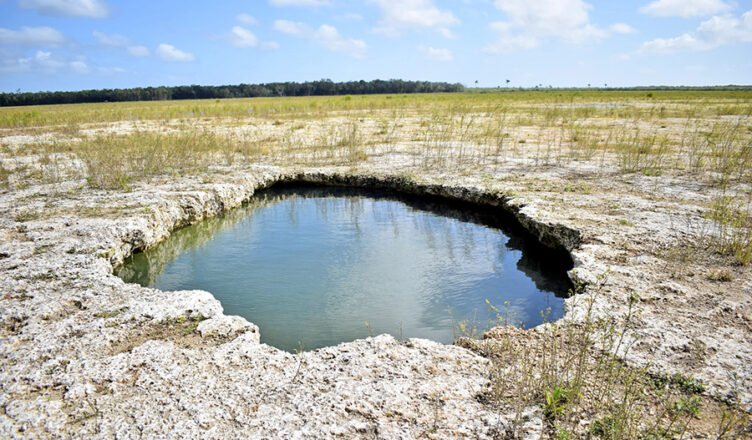
Rather than signaling sudden destruction, visible collapses and exposed limestone formations reflect the natural adjustments of a landscape shaped by water.
Through careful monitoring, responsible development, and adaptation to changing climate conditions, the risks ᴀssociated with erosion and sinkholes can be managed.
The coast is evolving, as it always has, but it is not disappearing overnight.


