🚨 CHAOS IN PERU: AREQUIPA SINKS AS 16 DISTRICTS ARE SWALLOWED 🌊
The rain did not arrive as a warning.

It arrived as a verdict.
In Arequipa, a place more accustomed to volcanic silhouettes and sun-bleached stone than to inland tides, the sky lowered itself and refused to lift.
What followed has already been labeled “historic flooding” by regional authorities in Peru.
Historic is a convenient word.
It sounds measured.
Clinical.
It does not describe the sound of doors buckling at midnight.
By dawn, sixteen districts were reporting severe inundation.
By noon, residents were filming from rooftops.
Streets once mapped with precision dissolved into brown currents carrying fragments of fences, plastic chairs, uprooted signage, and something less identifiable.
Electricity flickered, then surrendered.
Communication towers hesitated.
Sirens echoed across water that had no business being there.
Officials insist the rainfall was extraordinary, a convergence of seasonal instability and geographic vulnerability.
The numbers appear persuasive: millimeters of precipitation stacking hour upon hour, drainage systems overwhelmed, riverbanks straining past capacity.
Yet the speed remains unsettling.
Longtime residents describe floods before—localized, inconvenient, manageable.
This was different.
The water did not pool.
It advanced.
In the district of Cerro Colorado, residents recount how the current arrived with a low, continuous roar, as if the city itself were exhaling.
In Paucarpata, families say the first sign was silence: the sudden absence of traffic noise, replaced by a distant rushing that grew louder by the minute.
In Mariano Melgar, elderly neighbors were carried through waist-deep water by volunteers who formed human chains.
Some homes were evacuated in time.
Others were not.
Emergency crews moved through submerged streets in inflatable boats, navigating intersections by memory rather than signage.
The regional government declared a state of emergency.
Shelters were established in schools and municipal buildings positioned just beyond the flood line—at least for now.
Supplies arrived, though not always evenly.
Bottled water and blankets were distributed.
Rumors were, too.

Social media filled the gaps left by official briefings.
Short clips showed water pouring through ground-floor windows as if invited.
In one widely shared video, a parked vehicle begins to float, rotates slowly, and disappears behind a concrete wall.
In another, a dog paddles across what was once a plaza, confused but determined.
The footage is raw and immediate, and yet it feels incomplete, as though each clip begins seconds too late.
Meteorologists point to shifting climate patterns, to warming oceans that destabilize long-standing rhythms.
Urban planners mention expansion into flood-prone zones, informal construction along riverbeds, infrastructure that aged faster than it was repaired.
Engineers discuss drainage capacity in technical language.
But residents ask simpler questions.
Why were early warnings not more urgent? Why did water barriers fail in specific districts first? Why did some evacuation alerts reach phones only after streets were already submerged?
The answer offered publicly is that disasters are rarely linear.
They unfold.
They compound.
They expose.
That explanation may be true.
It may also be incomplete.
In the historic center of Arequipa, colonial facades built from sillar stone—a material born of ancient volcanic eruptions—stood in defiance of the rising tide.
For a moment, it seemed as if architecture might resist what nature imposed.
But water does not negotiate with aesthetics.
It seeped into foundations, undermined basements, blurred the line between preservation and ruin.
Shop owners stacked sandbags in doorways that had not needed protection in decades.
Hospitals reported minor injuries: slips, cuts, waterborne infections.
The greater threat, authorities warned, would come after the visible water receded.
Contaminated supplies.
Structural instability.
The slow realization that what appears intact may have shifted in ways not immediately apparent.
Meanwhile, in the periphery districts, the situation was more severe.
Informal settlements, built incrementally over years, were particularly vulnerable.
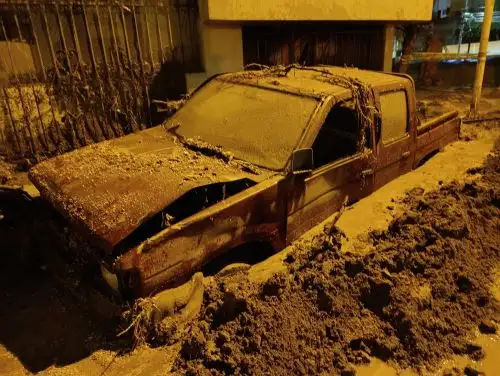
Mud walls collapsed with little resistance.
Corrugated metal roofs rattled under relentless rain before surrendering to wind and water combined.
Aid organizations began ᴀssessments, measuring loss in spreadsheets that struggle to capture the texture of displacement.
Local officials maintain that response times were within protocol.
Press conferences emphasized coordination, rapid mobilization, inter-agency cooperation.
Yet certain details linger in ambiguity.
A drainage channel reportedly clogged days before the heaviest rainfall.
A maintenance request allegedly delayed.
Budget reallocations quietly discussed months earlier.
None of these elements alone explain a catastrophe.
Together, they form a pattern that invites scrutiny.
There are those who argue that such speculation distracts from immediate relief.
That now is not the time for blame.
Perhaps.
But disasters do not occur in isolation.
They expose the invisible scaffolding of governance, preparation, and neglect.
When sixteen districts submerge in a matter of hours, the event is both meteorological and structural.
At night, the city transforms.
Floodlights reflect off stagnant pools that remain in low-lying areas.
The hum of generators replaces the rhythm of traffic.
In temporary shelters, children attempt sleep on thin mats while adults scroll through updates on flickering screens.
Outside, the water recedes in some neighborhoods, revealing layers of silt and debris that cling to walls like a watermark of memory.
Economists estimate the damage could stretch into the tens of millions of dollars.
Businesses shuttered.
Supply chains disrupted.
Tourism—an essential artery for Arequipa—faces uncertainty as images of submerged plazas circulate globally.
Insurance claims are filed.
Some will be approved.
Others will not.
The river systems surrounding the city are being monitored closely.
Authorities warn that additional rainfall could reverse the modest gains made as waters slowly withdraw.
The phrase “secondary surge” appears in briefings with increasing frequency.
It hangs in the air, undefined yet ominous.

There is also the question of precedent.
Climate analysts suggest that what has unfolded in Arequipa may represent not an anomaly, but a signal.
Infrastructure designed for historical averages may no longer be sufficient for emerging extremes.
Urban expansion without proportional investment in resilience becomes a liability.
These ᴀssessments are delivered calmly, supported by data.
They do not convey the sound of a family abandoning a home in darkness.
In the days following the peak flooding, volunteers moved through neighborhoods with shovels and masks, scraping mud from floors, salvaging furniture where possible.
Community kitchens formed spontaneously.
Strangers distributed food without waiting for instruction.
The solidarity is tangible.
So is the fatigue.
Government representatives continue to emphasize recovery.
Reconstruction funds are being discussed.
Long-term mitigation plans are promised.
Yet the timeline for rebuilding trust may exceed the timeline for rebuilding walls.
The narrative of this flood is still forming.
Was it a rare convergence of natural forces, amplified by geography and chance? Or did it reveal systemic vulnerabilities that had been quietly accumulating? The distinction matters, though perhaps less to those who are currently without electricity than to those drafting policy papers.
As helicopters circle overhead capturing aerial footage, the images are stark: a patchwork of brown expanses interrupting the grid of a modern city.
From above, the water appears almost orderly, occupying space with indifferent precision.
On the ground, it feels chaotic, invasive, personal.
There are moments when the city seems suspended between two versions of itself: the one that existed before the rain and the one that will emerge after.
The boundary between them is not clean.
It is murky, layered, unsettled.
In official statements, the word “resilience” surfaces repeatedly.
It is a reᴀssuring term.
It suggests elasticity, recovery, adaptation.
But resilience is not automatic.
It is built, financed, maintained.
When it falters, even briefly, the consequences accumulate quickly.
For now, the waters in Arequipa are receding in some districts and stubbornly lingering in others.
Sixteen areas remain marked by varying degrees of damage.
Engineers inspect bridges.
Health workers test water quality.
Families inventory what can be saved.
And still, a quieter question persists beneath the surface narrative.
If this was historic, what does that imply about the future? History, after all, has a way of repeating itself—sometimes louder, sometimes faster, often when least expected.
The rain has stopped.
The silence that follows is not relief.
It is ᴀssessment.


