The Unanswered Questions Behind Audie Murphy’s Final Flight
Audie Murphy’s death was officially ruled a tragic aviation accident. On May 28, 1971, a small twin-engine plane carrying Murphy and five others crashed into a wooded mountainside near Roanoke, Virginia. There were no survivors. The news shocked the nation. The most decorated American combat soldier of World War II—a man who had survived relentless enemy fire, artillery bombardments, and near-impossible battlefield odds—had died not in war, but in a civilian aircraft accident at the age of 45.
Yet, over time, questions began to surface.

The official explanation pointed to severe weather conditions: heavy rain, dense fog, and dangerously low visibility. The pilot, though experienced, was reportedly not certified for instrument flight rules (IFR), a critical qualification for navigating in poor weather without visual reference. According to investigators, the plane drifted off course and slammed into the mountain. Case closed.
But was it really that simple?
Some observers have noted that key details surrounding the crash were never fully clarified. Why did the flight proceed despite deteriorating weather conditions?
Were proper protocols followed? And why do certain eyewitness accounts appear to conflict with elements of the official findings? While no definitive evidence of foul play has emerged, the lack of transparency in some aspects of the investigation continues to fuel speculation.
To understand why Murphy’s death still stirs curiosity, one must first understand the magnitude of the man.
Born on June 20, 1922, near Kingston, Texas, Audie Murphy grew up in poverty. Small in stature and youthful in appearance, he seemed an unlikely candidate for military greatness. But after the attack on Pearl Harbor, he lied about his age to enlist in the U.S. Army at just 17 years old. What followed would become legend.

Murphy fought in North Africa, Sicily, Italy, and France. His courage in combat earned him rapid promotions and widespread respect. His most famous act of valor occurred on January 26, 1945, near Holtzwihr, France. When German forces launched a fierce ᴀssault on his company, Murphy ordered his men to retreat to safety while he remained behind. Climbing onto a burning tank destroyer, he used its mounted machine gun to hold off advancing enemy troops for nearly an hour—despite being wounded. He then led a successful counterattack.
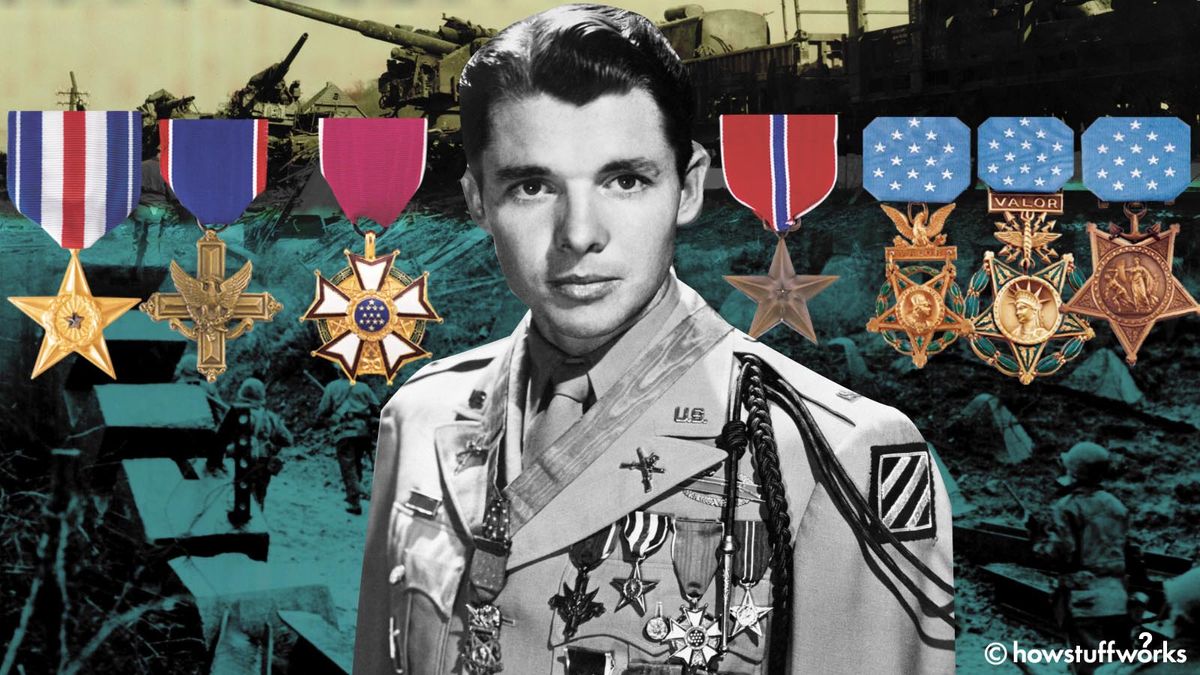
For his actions, Murphy received the Medal of Honor, along with 32 additional U.S. and foreign military awards. He became the most decorated American soldier of World War II.

But the war did not end when he returned home.
Though celebrated as a hero, Murphy struggled deeply with what is now recognized as post-traumatic stress disorder (PTSD). He suffered from insomnia, recurring nightmares, severe headaches, and anxiety. He reportedly slept with a loaded gun under his pillow. At one point, he became dependent on prescription sleeping pills, later locking himself in a H๏τel room for a week to overcome the addiction alone.
Despite his private battles, Murphy built a successful second career in Hollywood.
Between 1948 and 1969, he appeared in more than 40 films, primarily Westerns. In 1955, he portrayed himself in the film adaptation of his memoir, To Hell and Back, which became a major box-office success. To audiences, he represented courage and resilience. Off-screen, he wrestled with lingering trauma and mounting financial pressures.
By the late 1960s, Murphy faced serious monetary setbacks due to failed business ventures, including a disastrous oil investment. Though financially strained, he refused endorsement deals for alcohol and tobacco, believing such promotions would send the wrong message to young admirers.
He remained closely connected to the military, serving in the Texas Army National Guard and advocating for veterans’ mental health long before PTSD was widely acknowledged. His efforts contributed to greater awareness of the emotional wounds carried by returning soldiers.
Then came that final flight.
The crash investigation concluded that controlled flight into terrain—caused by poor weather and pilot limitations—was responsible. Yet some have questioned whether additional contributing factors were thoroughly examined. Aviation experts have debated the circumstances, while others point to Murphy’s financial troubles and speculate—without proof—about possible undisclosed pressures.

Importantly, no credible evidence has ever established conspiracy or sabotage. Still, the enduring fascination lies in what feels incomplete. For a man whose life was defined by extraordinary survival against overwhelming odds, the abruptness of his death feels almost cruelly ironic.
Murphy was laid to rest at Arlington National Cemetery on June 7, 1971. In keeping with his humble nature, he requested a simple headstone without special embellishment. Today, his grave remains one of the most visited at Arlington, second only to President John F. Kennedy’s.
In death, as in life, Murphy left behind complexity. He was not only a war hero and actor, but also a poet who quietly penned verses about grief and memory. His poem, The Crosses Grow on Anzio, reflects the sorrow he carried for fallen comrades.
Perhaps that is why the mystery surrounding his final hours continues to resonate.
It is not merely about a plane crash. It is about a national icon whose life embodied both triumph and torment. When details feel unresolved, curiosity persists.
Audie Murphy survived the ᴅᴇᴀᴅliest battlefields of World War II. Yet in the quiet mountains of Virginia, his journey ended abruptly. Whether the crash was simply tragic misfortune or something more complicated, one truth remains undeniable: the story of Audie Murphy is far greater—and far more haunting—than the headlines ever revealed.


