⚠️ 2026: The Year of 500,000 Earthquakes? Pacific Ring of Fire Shows Strange Signals 🧭🌊
For decades, the Pacific Ring of Fire has carried its name like a warning label the world learned to ignore.
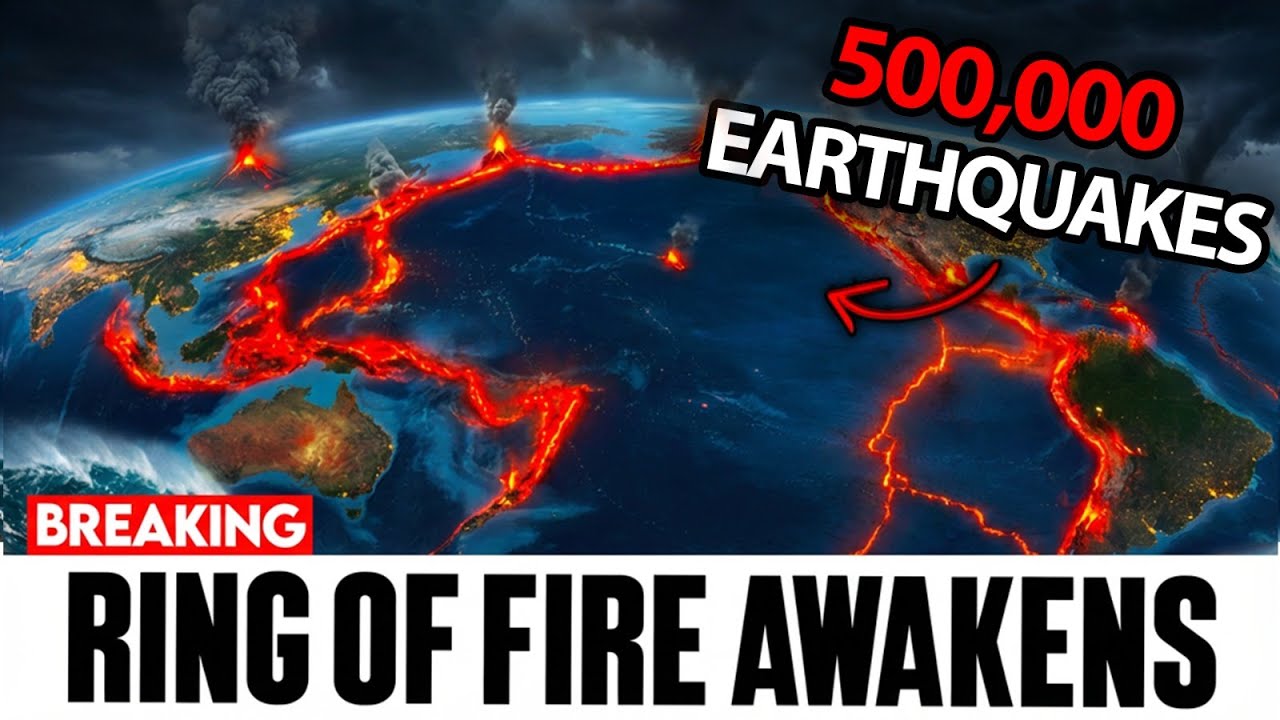
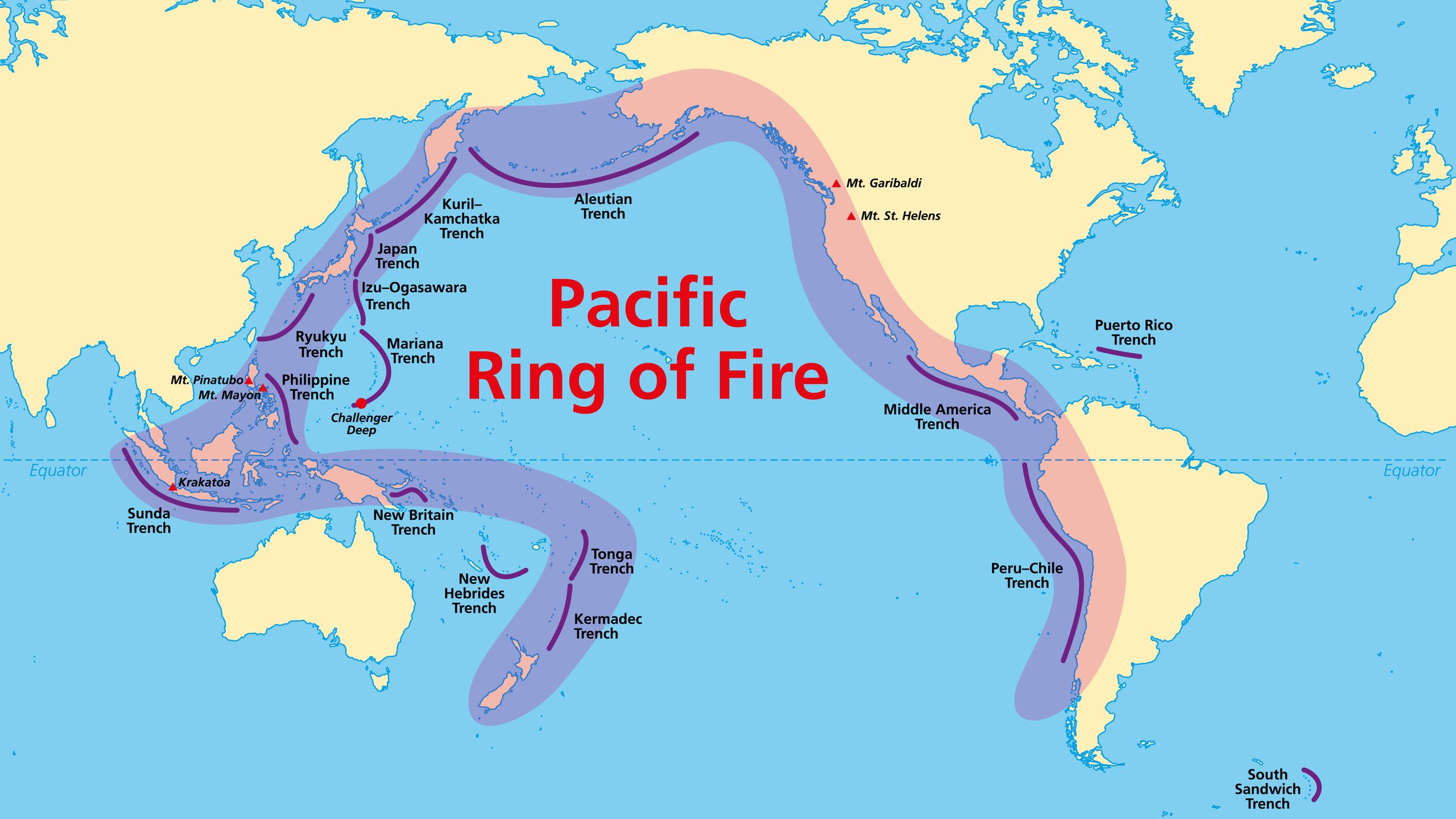
A horseshoe of tectonic boundaries stretching roughly 40,000 kilometers around the Pacific Ocean, it is responsible for nearly 90 percent of the planet’s earthquakes.
That statistic alone should be unsettling.
Yet what has begun to circulate in scientific forums, private research briefings, and more speculative corners of the internet is something far more provocative: projections suggesting that seismic activity along the Ring of Fire could spike dramatically in 2026, with cumulative tremors potentially reaching into the hundreds of thousands.
Five hundred thousand earthquakes.
The number sounds apocalyptic at first glance.
It conjures images of cities cracking open and coastlines collapsing into dark water.
But numbers, especially in seismology, can be both technically accurate and wildly misleading.
Each year, the Earth experiences hundreds of thousands of detectable quakes—most so small they are never felt.
So why is 2026 suddenly being whispered about as if it carries a darker weight?
The answer lies not in a single catastrophic forecast but in a pattern.
Over the past several years, seismic monitoring networks have recorded dense clusters of microquakes in regions already known for volatility: off the coast of Japan, near Indonesia’s subduction zones, along the western edges of the Americas from Alaska down to Chile.
Individually, these tremors barely register outside scientific databases.
Collectively, they form a pulse—steady, persistent, and difficult to dismiss.
Some geophysicists argue that what we are witnessing is a typical redistribution of tectonic stress.
Plates shift.
Energy accumulates.
Energy releases.
The Earth exhales in fragments.
Others, however, are less certain.
They point to anomalies: swarms occurring in unusual sequences, deeper-than-average rupture points, subtle ground deformations detected by satellite interferometry.
None of these signals alone prove that 2026 will be exceptional.
Together, they raise eyebrows.
The phrase “reactivating” has begun appearing in commentary, though it is scientifically imprecise.
The Ring of Fire never truly sleeps.
It is a perpetual engine driven by subduction, collision, and volcanic arcs.
Yet there are periods when that engine appears to idle—and others when it seems to rev.
Historical records show clusters of significant quakes occurring within compressed timeframes.
The early 20th century saw sequences that reshaped coastlines and economies.
The early 2000s brought the 2004 Indian Ocean earthquake and tsunami, followed by the 2011 Tōhoku earthquake in Japan.
Patterns like these invite uncomfortable speculation: are we approaching another clustered era?
It is here that projections of “500,000 earthquakes” take on a different tone.
In purely statistical terms, reaching that figure would require a surge in low-magnitude events, not necessarily a chain of megathrust disasters.
Yet seismologists know that swarms can precede larger ruptures—or they can dissipate without consequence.
The ambiguity is what unsettles observers.
There is no definitive line separating harmless background noise from a prelude.
Adding to the intrigue are recent advances in detection technology.
Modern seismographs are far more sensitive than those of previous decades.
Ocean-bottom sensors now capture vibrations once lost in the abyss.

Artificial intelligence systems sift through continuous streams of data, identifying patterns invisible to human analysts.
In that sense, the apparent “increase” in earthquakes could partly reflect better listening.
The Earth may not be speaking louder; we may simply be hearing more.
Still, there are geodynamic realities that cannot be dismissed as technological artifacts.
The Pacific Plate continues to grind relentlessly against its neighbors.
In some regions, stress accumulation models indicate that segments of major fault lines are approaching the upper bounds of their historical rupture intervals.
Along parts of the Cascadia Subduction Zone in North America, for instance, geological evidence suggests that mᴀssive earthquakes occur every few centuries.
The last known full-margin event happened in 1700.
Time alone does not predict disaster, but it sharpens attention.
In South America, the Nazca Plate pushes beneath the South American Plate with inexorable force.
Chile has experienced some of the strongest earthquakes ever recorded, including the 1960 Valdivia event.
While no credible insтιтution has forecast a specific megaquake for 2026, researchers acknowledge that stress transfer from recent moderate events can subtly alter probabilities elsewhere along a fault system.
It is not dominoes in the cinematic sense—but it is not random chaos either.
Japan’s seismic network remains among the most sophisticated in the world, and Japanese authorities routinely model worst-case scenarios for future megathrust quakes along the Nankai Trough.
Public reports emphasize preparedness rather than prediction.
Quietly, however, some independent analysts have noted shifts in slow-slip events beneath the region—gradual movements that sometimes precede more violent releases.
Whether these movements signify imminent escalation or routine tectonic adjustment is a matter of debate.
Indonesia, straddling multiple subduction zones, has also seen persistent activity.
Volcanic unrest in parts of the archipelago adds another layer of tension.
Magma movement and tectonic stress can interact in complex ways, though linking volcanic signals directly to earthquake forecasts remains speculative.
So where does 2026 enter the narrative? The year has surfaced in certain probabilistic models that project cyclical peaks in cumulative seismic energy release.
These models do not predict a singular cataclysmic event.
Rather, they suggest that the aggregate number of quakes—most minor—could spike due to synchronized stress adjustments across multiple plate boundaries.
Critics argue that such models rely heavily on retrospective fitting, identifying cycles only after they have occurred.
Proponents counter that ignoring emerging correlations would be negligent.
There is also the psychological dimension.
Humanity has become acutely sensitive to cascading crises.
Pandemics, climate extremes, geopolitical instability—each has conditioned the public to expect the unexpected.
In that environment, a projection of 500,000 earthquakes resonates differently than it might have twenty years ago.
It feels like part of a pattern, even if the data does not confirm one.
Yet the most haunting aspect of seismic risk is its indifference to human narrative.
Earthquakes do not schedule themselves around headlines.
They do not escalate to match online speculation.
They release energy when geological thresholds are crossed, regardless of whether we are watching.
Emergency management agencies across Pacific Rim nations continue to refine preparedness protocols.
Early warning systems can now provide seconds—sometimes tens of seconds—of notice before strong shaking arrives.
That margin can halt trains, shut down industrial systems, and prompt people to seek cover.
It is not much, but it is something.
If 2026 pᴀsses with no extraordinary spike, the projections will fade into obscurity, remembered only as another overhyped alarm.
If seismic counts do climb sharply—even if the majority are imperceptible microquakes—the narrative will shift.
Commentators will speak of warnings unheeded and patterns confirmed.
The ambiguity ensures that interpretation will remain contested.
What is certain is that the Ring of Fire is neither dormant nor predictable in the way people crave.
It operates on scales of time that dwarf political cycles and news feeds.
The tectonic plates beneath the Pacific do not pause for reᴀssurance.
They accumulate strain in silence.
Five hundred thousand earthquakes may ultimately prove to be a technical statistic rather than a harbinger.
Or it may mark an inflection point in a broader seismic phase that reshapes risk calculations for a generation.
The distinction matters less than the underlying reality: stress is building somewhere along that vast arc of faults.
It always is.
And perhaps that is the quiet truth behind the headlines.
Not that a specific year has been chosen by fate, but that the potential for sudden rupture is constant.
The Earth’s crust is a mosaic of locked boundaries, each holding more energy than any city skyline can withstand.
We map them.
We measure them.
We debate them.
Yet we cannot command them.
Whether 2026 becomes a footnote or a chapter will depend not on speculation, but on physics unfolding miles beneath the ocean floor.
Until then, the Pacific Ring of Fire continues its low, relentless murmur—an ancient mechanism turning without pause, reminding us that beneath the appearance of stability lies motion, and beneath motion, the possibility of shock.


