Most people think they know this story.
A disfigured boy.
A flamboyant biker mother.
A tear-jerking 1980s movie starring Cher in leather and defiance.
But the 1985 film Mask, directed by Peter Bogdanovich, only told part of what really happened.
The truth—messier, harsher, and far more human—belongs to Roy L. Dennis (nicknamed Rocky) and his mother, Florence Tullis, better known as Rusty Dennis.
Here’s what the record actually shows.
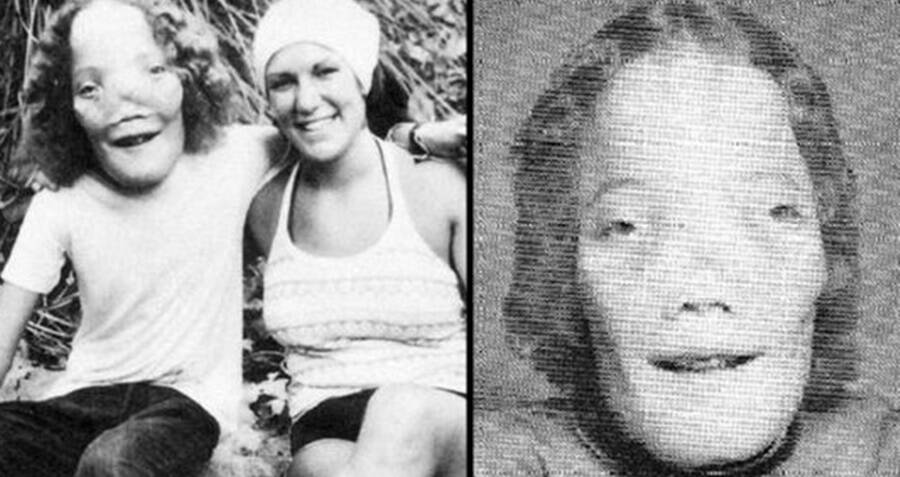
Roy Lee Dennis was born December 4, 1961, in Glendora, California.
As a toddler, doctors discovered he had a rare condition known as craniodiaphyseal dysplasia—a disorder that causes abnormal calcium buildup in the skull, progressively thickening the bones of the face and head. The disease can compress cranial nerves, affecting vision, hearing, and neurological function.
At the time of Rocky’s diagnosis in the 1960s, only a handful of documented cases existed worldwide.
Doctors gave Rusty a devastating prognosis:
Her son would likely be blind, severely impaired, and ᴅᴇᴀᴅ before age seven.
Rocky lived to 16.
The Mother Behind the Myth
The film version of Rusty—played by Cher—was bold, glamorous, and chaotic.
The real Rusty was even more complex.
Born in Brooklyn in 1936, she dropped out of school young, ran with motorcycle clubs, married early, and lived hard. By the time Rocky was diagnosed, she had already developed a personal philosophy that would define her parenting:
If the mind could make you sick, it could also make you well.
She refused to let insтιтutions limit her son.
When schools attempted to move Rocky out of mainstream classes, she fought. When doctors predicted cognitive decline, she dismissed them. Rocky attended regular school, graduated junior high with honors, and was known for his humor and warmth.
Screenwriter Anna Hamilton Phelan, who later wrote Mask, said Rusty wasn’t conventional—but she was exactly the mother Rocky needed.

The Biker Family Was Real
The motorcycle culture shown in the film wasn’t Hollywood invention.
Rusty was affiliated with a biker community known as the Turks. These weren’t stylized rebels—they were a тιԍнт-knit subculture built on loyalty and blunt honesty. They embraced Rocky fully.
The character “Gar,” played by Sam Elliott, was based on Rusty’s real-life partner.
Rocky grew up surrounded not by pity—but by acceptance.
What the Movie Changed
When Mask was released in 1985, it grossed over $48 million at the box office.
Rusty received $15,000 for the film rights.
That figure sounds shocking next to the box office total—but context matters. Much of the money reportedly went toward medical bills for her older son, Joshua, who was battling AIDS during the height of the 1980s crisis.
Rusty later described the movie as “a fairy tale.”
Not because it was cruel—but because it softened the edges.
Key differences between film and reality include:
-
The movie compresses over a decade into what feels like one year.
-
Rusty’s older son, Joshua, is completely omitted.
-
The soundtrack originally intended to feature Bruce Springsteen—Rocky’s favorite artist—but was replaced with Bob Seger tracks due to licensing disputes.
Rusty publicly remarked that she didn’t think Rocky even knew who Bob Seger was. It was a subtle but pointed correction.
Director Peter Bogdanovich later sued the studio over the music change; Springsteen’s songs were restored in a 2004 director’s cut.
The Night Rocky Died
By fall 1978, Rocky’s condition had worsened significantly.
On October 3, the family went out to dinner. He returned home with a severe headache.
Rusty told him what she had always told him:
Go to your room and make yourself well.
The next morning, October 4, 1978, Rocky was found ᴅᴇᴀᴅ in his sleep at age 16.
In the film, Rusty discovers him herself in a dramatic scene. In reality, she was reportedly away handling a legal matter when she received the call.
The difference doesn’t change the grief. But it shows how Hollywood streamlined a complicated life into emotional clarity.

Joshua: The Son the Movie Erased
Rusty’s first son, Joshua Mason, was not included in Mask.
In the mid-1980s, he was diagnosed with Kaposi’s sarcoma, an AIDS-related cancer. He died in 1987 at age 32.
Rusty lost both sons within a decade.
She once said that neither she nor Joshua believed in death—that it was simply “another place to go.”
Rocky’s Real Legacy
Strip away the film, and Rocky’s achievements stand on their own:
-
He attended regular school.
-
He earned academic honors.
-
He tutored classmates.
-
He memorized constellations.
-
He fell in love at summer camp.
-
When offered surgery to alter his face, he reportedly asked:
“Who would I see in the mirror?”
He chose himself.
That choice may be the most powerful part of his story.
Rusty’s Final Years
After Rocky’s death, Rusty moved to San Francisco and later became involved in Buddhist practice. She worked in counseling and planned involvement with AIDS support organizations.
In 2006, she was injured in a motorcycle accident when a tire came off her trike. She survived the crash but later died from complications at age 70.
Until the end, she remained unapologetically herself.


