🦊 DIGITAL REVELATION: Artificial Intelligence Uncovers Enigmatic Detail in the Shroud of Turin That Has Researchers Scrambling for Answers! ⚡
Scientists recently used artificial intelligence tools to analyze high-resolution images of the Shroud of Turin, and the results have drawn renewed attention to one of the world’s most debated religious artifacts.
While some headlines suggest that researchers are unable to explain what the AI discovered, the reality is more measured: the technology revealed additional detail and structural characteristics in the image that continue to puzzle scholars.
The Shroud of Turin is a linen cloth that bears the faint image of a man who appears to have suffered crucifixion.
For centuries, many Christians have believed it to be the burial cloth of Jesus.
Others argue that it dates to the medieval period and was created as a devotional object.
The cloth is kept in Turin, where it has been studied extensively by scientists, historians, and theologians.
In 1988, radiocarbon dating tests conducted by three laboratories concluded that the cloth likely originated between 1260 and 1390.
Those findings led many researchers to consider it a medieval artifact.
However, critics of the tests have argued that the samples may have been taken from a repaired section of the cloth, potentially affecting the results.
The debate has continued ever since.
The latest development involves the use of AI-driven image processing software.
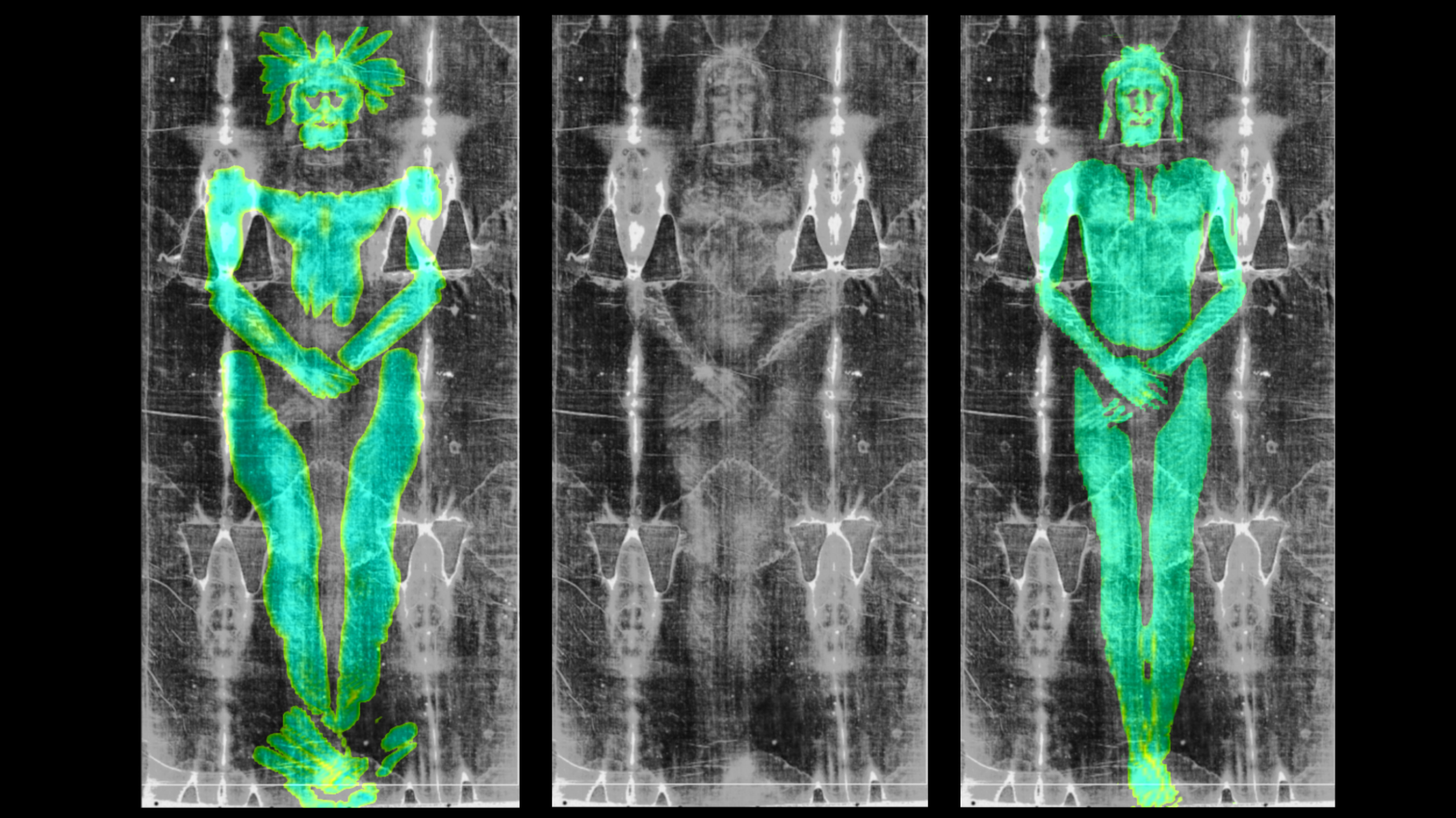
Researchers applied advanced algorithms to extremely high-resolution scans of the Shroud in order to enhance subtle details not easily visible to the human eye.
Artificial intelligence systems are particularly effective at detecting patterns, gradients, and structural consistencies in complex images.
According to reports, the AI analysis highlighted several notable features.
First, it reinforced earlier observations that the image appears to rest primarily on the surface of the linen fibers rather than penetrating deeply into the fabric.
This superficial nature has long been considered unusual, as painted images typically seep more thoroughly into textile threads.
Second, the enhanced imaging suggested that the tonal variations in the image correspond in a consistent way to three-dimensional depth information.
Previous research had already shown that when the Shroud’s image is processed using 3D mapping software, it can produce a relatively coherent three-dimensional rendering.
The AI analysis appears to have supported this observation by identifying subtle gradations in intensity that correlate with body contours.
Importantly, the AI did not uncover a hidden message, secret inscription, or encoded symbol.
Instead, it provided a more refined look at the image’s structure.
Researchers emphasize that the findings do not consтιтute proof of authenticity or supernatural origin.
Rather, they raise ongoing questions about how the image was formed.
One of the central challenges in Shroud research has been explaining the mechanism that produced the image.
Various hypotheses have been proposed over the years, including the possibility of a medieval artistic technique, chemical reactions involving substances placed on the cloth, or thermal processes.

None of these explanations has been universally accepted, largely because the image has characteristics that do not perfectly align with conventional painting methods.
For example, the image lacks clear evidence of brush strokes, and it does not appear to contain significant pigment layers.
Earlier scientific examinations also noted that the coloration seems to involve a chemical change in the outermost fibers of the linen, rather than the application of paint.
The new AI analysis does not overturn the 1988 radiocarbon dating results.
It does not determine the age of the cloth, nor does it identify a specific individual represented in the image.
Instead, it refines the visual and structural data available to researchers.
Experts caution that AI-enhanced imaging must be interpreted carefully.
Artificial intelligence tools are designed to detect patterns and can amplify subtle variations in ways that may appear significant.
Therefore, researchers must distinguish between meaningful structural information and artifacts introduced through digital processing.
Despite the caution, many scholars consider the application of AI to be a valuable addition to Shroud research.
Modern imaging technologies allow for more detailed analysis than was possible decades ago.
As computational methods continue to advance, they may help clarify aspects of the cloth’s formation and history that have remained uncertain.
The renewed attention to the Shroud reflects its enduring cultural and religious significance.
Whether viewed as a sacred relic, a historical artifact, or a subject of scientific inquiry, it continues to attract interest worldwide.
Public exhibitions of the Shroud have drawn millions of visitors, and each new study tends to reignite debate.
The intersection of artificial intelligence and religious history has also contributed to public fascination.

The idea that advanced algorithms are examining an artifact ᴀssociated with ancient events captures imagination, even if the results are more technical than dramatic.
At present, the scientific consensus remains cautious.
The AI findings highlight unusual features of the image but do not provide definitive answers about its origin.
Further analysis, including continued textile studies, chemical testing, and historical research, will likely be needed to advance understanding.
In summary, scientists have used AI to enhance and analyze detailed images of the Shroud of Turin.
The technology revealed structural characteristics that remain difficult to explain fully, particularly regarding the image’s superficial placement on fibers and its apparent three-dimensional qualities.
However, no conclusive breakthrough has occurred.
The Shroud continues to be an object of study and debate, with modern tools adding new layers of analysis to an already complex historical question.


