Felonies, Evictions, and ICE Holds 🔥 Inside Florida’s Most Aggressive Immigration Overhaul
Florida has quietly positioned itself as the epicenter of the toughest state-level immigration enforcement in modern America, and what began in 2023 is now setting the stage for what many fear will be an even harsher reality in 2026.
This is not speculation.
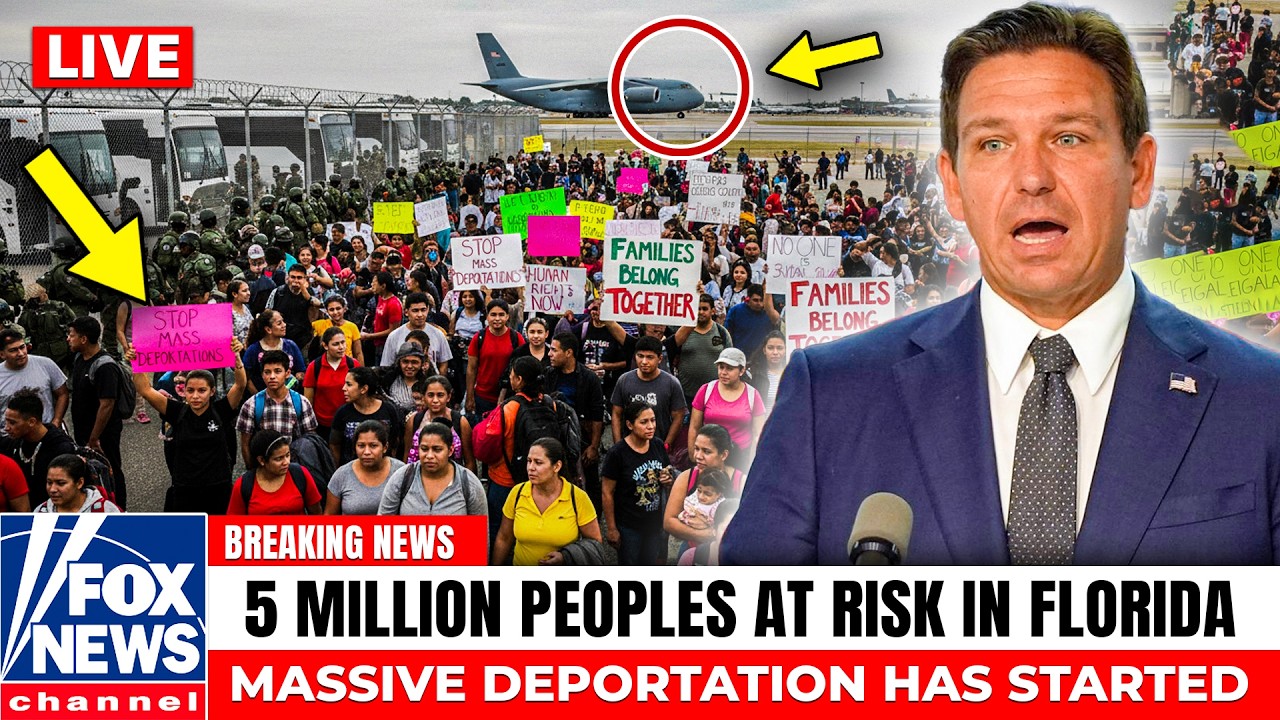
The laws are already on the books.
They are being enforced.
And the ripple effects are spreading through neighborhoods, workplaces, farms, rental properties, and courtrooms across the state.
In May 2023, Governor Ron DeSantis signed Senate Bill 1718 into law, transforming Florida into what critics describe as an immigration enforcement machine.
When the bill took effect on July 1, 2023, it did far more than send a political message.
It created criminal penalties and civil obligations that now touch nearly every aspect of daily life: housing, employment, transportation, healthcare, and law enforcement cooperation with federal authorities.
One of the most controversial provisions requires hospitals that accept Medicaid funds to ask patients about their immigration status on intake forms and report that data quarterly to the state.
While officials argue the information is for statistical purposes and does not automatically trigger enforcement, immigrant communities describe a chilling effect.
Families now hesitate before seeking medical care, fearing that a hospital visit could place them on a government radar.
Housing has become another pressure point.
Under SB 1718, knowingly harboring undocumented immigrants can result in third-degree felony charges.
For landlords, this has created a climate of intense caution.
The law does not explicitly require every landlord to verify immigration status in every lease agreement, yet the risk of criminal liability has led many property owners to тιԍнтen screening procedures dramatically.
Applicants are increasingly asked for Social Security numbers, work visas, green cards, or proof of citizenship.
Some landlords are even running documents through verification systems normally used for employment screening.
The consequences are severe.
A third-degree felony in Florida can carry up to five years in prison and a $5,000 fine.
Real estate attorneys are advising landlords to protect themselves at all costs.
The result is a rental market where fear drives decision-making.
Tenants who cannot provide specific documentation may be denied housing even if they can pay the rent in full.
Fair housing advocates warn that this environment encourages discrimination based on accent, surname, or perceived ethnicity.
Landlords counter that they are simply trying to avoid prison.
Employment is another battlefield.
SB 1718 mandates that private employers with 25 or more employees use the federal E-Verify system to confirm work authorization for every new hire.
If an employer knowingly hires someone flagged as unauthorized, the penalties escalate quickly.
A first violation can result in suspension of the company’s business license for up to a year.
A second violation can mean permanent revocation.
Industries that rely heavily on immigrant labor are feeling the strain.
Agriculture, construction, hospitality, and tourism have reported labor shortages.
Florida produces nearly half of America’s citrus and large shares of tomatoes and strawberries.
Growers warn that crops are being left unpicked due to a lack of workers.
Some farms are considering relocating operations.
In construction, projects are delayed.
In hospitality, staffing gaps are widening.
Employers say they fear making even an innocent paperwork mistake.
Transportation laws have added another layer of risk.
SB 1718 made it a third-degree felony to knowingly transport an undocumented immigrant into Florida.
The language is sweeping.
Driving a family member across state lines into Florida, if that person lacks legal status and the driver knows it, could result in criminal charges.
The maximum penalty again is up to five years in prison.
This provision has created panic among mixed-status families.
People now think twice before picking up relatives at airports or state borders.
Law enforcement agencies have been trained to question drivers during traffic stops, particularly near state lines.
Defense attorneys argue the statute is vague and raises consтιтutional concerns, especially regarding how prosecutors prove knowledge.
Yet the risk remains real, and the mere possibility of prosecution has altered behavior.
Driver’s licenses have also become a flashpoint.
Florida no longer recognizes certain out-of-state licenses issued to undocumented immigrants in states such as Connecticut, Delaware, Hawaii, Rhode Island, and Vermont.
If someone drives in Florida using one of these licenses, they may be treated as driving without a valid license under Florida law.
That can mean citations, arrest, or even vehicle impoundment.
For visitors and new residents, the shock has been profound.
They believed they were legally licensed, only to discover Florida does not honor their credentials.
At the law enforcement level, cooperation with federal immigration authorities is mandatory.
Florida statute 908.
101 requires state and local agencies to honor immigration detainers and share information with federal databases.
When someone is arrested, fingerprints are automatically checked against immigration records.
If ICE identifies a match, a hold can be placed, keeping the individual in custody for up to 48 hours beyond their scheduled release.
Some counties have gone further by allowing ICE officers access inside local jails.
This means immigration interviews and transfer arrangements can occur without the individual ever leaving the facility.
For undocumented immigrants and even some legal residents, a minor arrest can quickly escalate into deportation proceedings.
Legal residents are not immune.
Under federal immigration law, certain criminal convictions can trigger removal, even for green card holders.
Florida’s broad definitions of certain crimes mean that offenses such as drug possession, theft over a specific threshold, domestic battery, or DUI with injury can have immigration consequences.
Even if criminal charges are reduced or dismissed, ICE involvement may continue.
Immigration courts in Florida are known for high deportation rates, and relief options can be limited.
The crackdown on false documents has intensified as well.
Using a fake Social Security number or fraudulent immigration document to obtain employment or housing is a third-degree felony under Florida law.
Prosecutors are working closely with federal authorities, meaning state charges can quickly become federal immigration cases.
Individuals who used false numbers years ago to secure employment are now vulnerable if records are audited or cross-checked.
Tenant rights remain murky.
Florida landlord-tenant law does not clearly define what immigration documentation a landlord may request.
Yet the fear of criminal charges pushes landlords to demand more paperwork.
At the same time, federal fair housing law prohibits discrimination based on national origin.
This legal collision leaves both tenants and landlords navigating a minefield.
Tenants are afraid to ᴀssert rights.
Landlords are afraid to take risks.
The human toll is mounting.
Mixed-status families face impossible choices.
Should they drive children to school, risking a traffic stop? Should they seek medical care if questioned about status? Should they report crimes? Community leaders report increased absenteeism in schools and declining cooperation with law enforcement investigations.
Churches and nonprofits that traditionally offered shelter or ᴀssistance now worry they could be accused of harboring undocumented individuals.
Small businesses are struggling to find reliable labor.
Rental markets in immigrant-heavy neighborhoods are shifting as families relocate or leave the state entirely.
Economically, the impact could be significant.
Undocumented immigrants contribute billions of dollars annually in taxes and consumer spending in Florida.
They work in essential sectors.
When those workers leave or are deported, the consequences ripple outward.
Lower tax revenue, higher prices for produce and services, and stalled development projects are part of the equation.
Supporters of the laws argue that strict enforcement restores rule of law and deters unauthorized migration.
Critics contend the measures go too far, sweeping up families and long-term residents while destabilizing communities.
As 2026 approaches, enforcement is expected to intensify rather than ease.
What is clear is that Florida has made a deliberate choice to align closely with aggressive federal immigration priorities.
The state’s policies are reshaping daily life.
For immigrants, landlords, employers, and even legal residents with past convictions, the stakes are enormous.
In Florida today, a routine traffic stop can become an immigration case.
A hiring decision can become a licensing crisis.
A lease agreement can become a felony risk.
The legal framework is already in place, and the enforcement momentum is building.
For families across the state, the message is unmistakable: stay informed, seek legal advice, and understand the risks.
Because in Florida’s new immigration landscape, knowledge may be the only protection left.


